The Role of Brand in Link Building
Brand recognition makes link building easier because publishers, journalists and readers already trust a name they know.
Two nearly identical outreach pitches, one from a brand people recognise and one from an unfamiliar name, get very different response rates. Brand isn’t a separate tactic from link building — it’s a multiplier that makes every other tactic work better, and its absence is one of the most common reasons outreach underperforms.
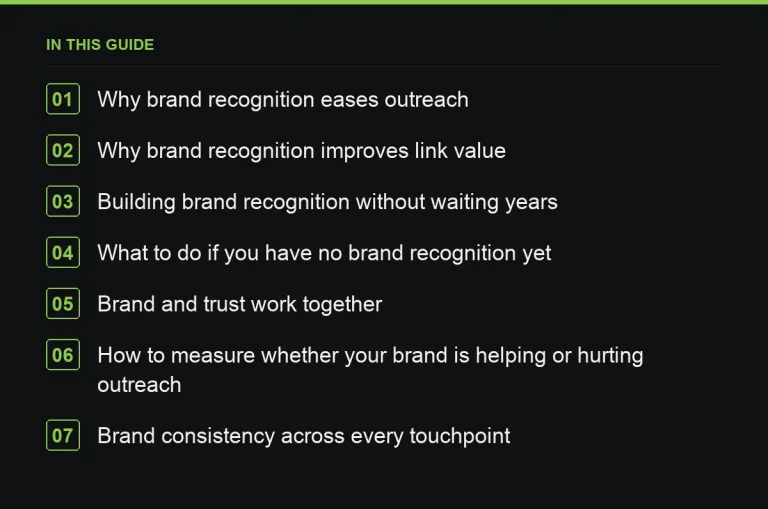
Why brand recognition eases outreach
Publishers and journalists are, understandably, cautious about who they link to. A recognisable brand carries an implicit vouch: if this company is well known and still operating, linking to them is low-risk. An unknown brand has to earn that trust from scratch with every single pitch, which is slower and has a lower success rate.
Why brand recognition improves link value
Even at equal link metrics, a link that mentions a brand readers already know tends to get more genuine engagement — clicks, searches for the brand name, and eventual direct visits. Search engines can also pick up on brand mentions that aren’t even hyperlinked, as a supporting trust signal alongside actual links. This is one reason established companies often need comparatively less aggressive link building to maintain visibility.
Building brand recognition without waiting years
- Be consistent with your name, logo and messaging across every guest post, profile and mention — fragmented branding dilutes recognition.
- Pursue a few notable placements deliberately, even at higher cost, because visibility compounds — a handful of recognisable mentions can matter more than dozens of anonymous ones.
- Encourage unlinked brand mentions too; ask politely for a link when you spot one, but value the mention itself.
- Use consistent contact and company details so search engines and readers can connect mentions back to the same entity.
What to do if you have no brand recognition yet
Lean harder on relevance and genuine usefulness rather than reputation. A smaller brand can still win a link by offering the single best explanation of a niche topic, a genuinely useful free tool, or an interview-worthy expert perspective. This is slower than trading on an existing name, but it’s how every recognised brand started. See https://successtoroad.com/blog/link-building-without-a-budget/ for tactics that don’t depend on brand or budget.
Brand and trust work together
Brand recognition is really a shortcut version of trust — publishers extend trust to names they already know instead of having to evaluate from first principles. Everything that builds general credibility, including a healthy link profile itself, feeds back into brand recognition over time. It’s a virtuous cycle once it gets moving.
How to measure whether your brand is helping or hurting outreach
A practical test: track your outreach response rate over time, and separately note whether the recipient appeared to recognise your brand name before you explained who you were. If response rates are noticeably better among publishers already familiar with you, that’s a sign brand recognition is doing real work in your outreach, and it’s worth continuing to invest in visibility, not just direct link acquisition. If there’s little difference, your current brand recognition may not yet be strong enough in your specific niche to matter, and content quality and relevance are doing all the heavy lifting instead.
Brand consistency across every touchpoint
Consistency matters more than most people expect. Using a slightly different company name, an inconsistent logo, or scattered contact details across guest posts, directories and social profiles fragments what should be a single, recognisable identity into several weaker, disconnected ones. Before scaling up outreach or PR activity, it’s worth auditing your own existing footprint — search your brand name and see what comes up — to check that it reads as one coherent, recognisable entity rather than several inconsistent variants.
Where to go next
Read https://successtoroad.com/blog/why-links-still-matter/ for how brand and link value interact, https://successtoroad.com/blog/link-building-without-a-budget/ for approaches that don’t rely on existing recognition, https://successtoroad.com/blog/press-releases-link-building-reality/ for a common brand-building tactic worth using carefully, https://successtoroad.com/blog/reading-a-backlink-report/ for auditing your current link and mention footprint, and browse https://successtoroad.com/marketplace/ to find publishers whose audiences overlap with the brand you’re building.
Small brands can still borrow credibility, carefully
Even without broad brand recognition, a smaller company can borrow some credibility by association — for instance, through genuine partnerships, certifications, or being featured by a more established organisation in the space. This isn’t the same as having your own brand recognition, but it can meaningfully ease the path toward building it, provided the association is genuine and not simply implied or exaggerated in marketing materials.
Brand recognition and pricing power in outreach
An often overlooked effect of stronger brand recognition is that it can reduce how much you need to rely on paid placements over time, since organic invitations to contribute or be featured increase as more publishers already know and trust your name. This is a long-term payoff worth factoring into any comparison between investing in brand-building activities versus simply paying for more placements in the short term.
Frequently asked questions
Can link building itself help build brand recognition?
Yes, especially placements on well-read, relevant sites where your name appears repeatedly over time. It's a slower brand-building channel than advertising, but it compounds and tends to be more trusted.
Do unlinked brand mentions matter at all for SEO?
They're generally considered a supporting signal, separate from actual hyperlinks. It's reasonable to track them and occasionally ask for a link to be added, without expecting every mention to include one.
Is it worth paying more for a placement on a brand-name-recognisable site?
Often yes, if it fits your budget, because the value extends beyond the link itself into referral traffic and reader trust. Weigh it against several smaller, relevant placements rather than assuming it's always the better use of budget.
How long does it take a small brand to build real recognition through link building?
There's no fixed timeline; it depends on niche size, publishing frequency, and how distinctive the brand is. Consistency over many months matters more than any single placement.
Put it into practice
Filter 54,483 websites by DR, traffic, niche and price, and order with escrow — you pay only after the link is live.
Browse the marketplace