Press Releases: What They Actually Do for Link Building
Press releases mostly earn links from syndication sites, not genuine editorial pickup, unless the news is genuinely newsworthy.
Press release distribution services are still widely sold as a link building tactic, and the honest answer is more nuanced than either “useless” or “great strategy.” What a press release delivers depends almost entirely on whether the underlying news is genuinely newsworthy, not on how widely it’s distributed.
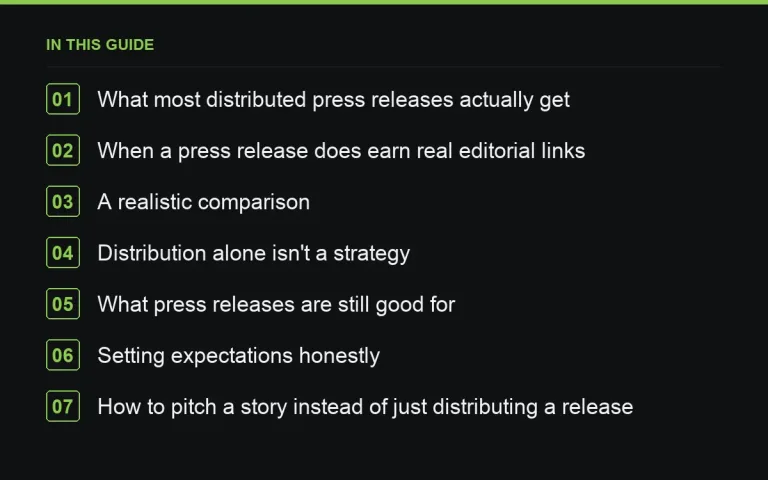
What most distributed press releases actually get
Sent through a standard distribution service, a routine press release mostly gets picked up and republished on syndication and aggregator sites that exist specifically to host this kind of content. These links are typically nofollow, come from sites with limited genuine readership, and add up to a fairly uniform, low-value cluster in your backlink report.
When a press release does earn real editorial links
If the underlying news is genuinely interesting — a notable funding round, a distinctive piece of data, a genuinely new product angle, something a journalist would want to write about independently — then the press release can serve as the initial hook that leads a reporter to write their own piece and link properly. In this case, the release itself isn’t the link source; it’s the trigger for one.
A realistic comparison
| Press release type | Realistic link outcome |
|---|---|
| Routine company update, minor news | Mostly syndication site links, low individual value, some brand mention benefit |
| Genuinely newsworthy story, well-pitched to specific journalists | Possible real editorial coverage and links, though not guaranteed |
| Distributed widely with no direct journalist outreach | Syndication only, regardless of how interesting the news is |
Distribution alone isn’t a strategy
Wide distribution without direct outreach to specific, relevant journalists rarely converts into genuine editorial pickup on its own. If the news is worth covering, pairing distribution with direct, personalised pitches to a shortlist of relevant reporters meaningfully improves the odds of real coverage.
What press releases are still good for
- Creating a citable, dated, official record of an announcement that journalists and other writers can reference and link to later.
- Some brand mention and syndication presence, useful in a minor supporting way even without high-value links.
- Serving as the anchor document for a broader digital PR push rather than the whole push itself.
Setting expectations honestly
If a press release distribution service is sold to you as a guaranteed way to earn high-authority editorial backlinks, treat that claim skeptically — distribution guarantees placement on syndication networks, not genuine journalist pickup, which can’t be guaranteed by any service. See https://successtoroad.com/services/ and https://successtoroad.com/services/seo/press-release-distribution/ for what’s realistically included in these offerings.
How to pitch a story instead of just distributing a release
The more reliable path to genuine coverage looks less like a press release and more like a short, direct pitch to a small, carefully chosen list of journalists who specifically cover your industry. Lead with the actual news angle in the first sentence, keep it brief, and offer to provide more detail, data, or an interview if they’re interested. This takes more effort per journalist than mass distribution, but it converts at a meaningfully higher rate for anything that’s genuinely newsworthy.
Building a small, curated media list over time
Rather than treating every announcement as a one-off distribution event, build and maintain a small list of journalists and bloggers who cover your specific niche, noting what they’ve written about before and how they prefer to be contacted. This list becomes a genuine asset that compounds over time — a relationship built through one useful, well-targeted pitch makes the next pitch easier, in a way that anonymous mass distribution never achieves. Combine this with the placement options on https://successtoroad.com/marketplace/ for the parts of your visibility plan that don’t depend on unpredictable journalist pickup.
Where to go next
Read https://successtoroad.com/blog/link-building-myths/ for other overstated tactics, https://successtoroad.com/blog/the-role-of-brand-in-link-building/ for why brand mentions still have some value, https://successtoroad.com/blog/documenting-links-you-build/ for tracking coverage as it comes in, and browse https://successtoroad.com/services/seo/pr-links/ for digital PR services aimed at genuine editorial coverage rather than pure distribution.
Timing a release around genuine news cycles
Even a genuinely newsworthy release performs differently depending on timing — competing against major, unrelated news events for journalist attention, or landing during a quiet period when reporters have more bandwidth to consider smaller stories. Where you have some flexibility on timing, avoid releasing significant news during periods likely to be dominated by major unrelated stories in your target publications’ coverage areas.
What to include to make a journalist’s job easier
Journalists are more likely to act quickly on a pitch that includes everything they’d need to write the story with minimal extra research: a clear, specific angle, any relevant supporting detail, a contact available for quick follow-up questions, and where relevant, genuine data or a concrete example rather than vague claims. Making their job easier meaningfully improves your odds compared to a release that requires significant additional digging on their part.
To sum up, treat a press release as one component of a broader digital PR effort rather than a standalone link building tactic, and reserve your highest expectations for genuinely newsworthy stories paired with direct, personalised journalist outreach.
Frequently asked questions
Do press releases still help SEO in 2026?
They can, indirectly, when the underlying news is genuinely newsworthy and paired with direct journalist outreach. Wide distribution alone mostly produces low-value syndication links.
Is it worth paying for press release distribution?
It depends on your goal. For a citable, dated record and some syndication presence, it can be worth a modest cost. For guaranteed high-authority editorial links, treat that promise with skepticism.
What makes a press release more likely to get real journalist pickup?
Genuinely newsworthy content — distinctive data, a notable event, a real story angle — paired with a direct, personalised pitch to specific relevant journalists rather than mass distribution alone.
Are press release syndication links harmful to a site?
Not typically harmful on their own in modest numbers, but they shouldn't be counted as high-value link building, and relying on them heavily produces a fairly uniform, low-quality link cluster.
Put it into practice
Filter 54,483 websites by DR, traffic, niche and price, and order with escrow — you pay only after the link is live.
Browse the marketplace