Page-Level vs Domain-Level Authority
Domain authority reflects the whole site's trust; page authority reflects one specific page's own standing, and they don't always match.
It’s common to hear “that’s a DR 70 site” as shorthand for “any link from it is great.” But authority operates at two levels — the domain as a whole, and the individual page — and they don’t always move together. A high-authority domain can still have plenty of weak, barely-linked individual pages.
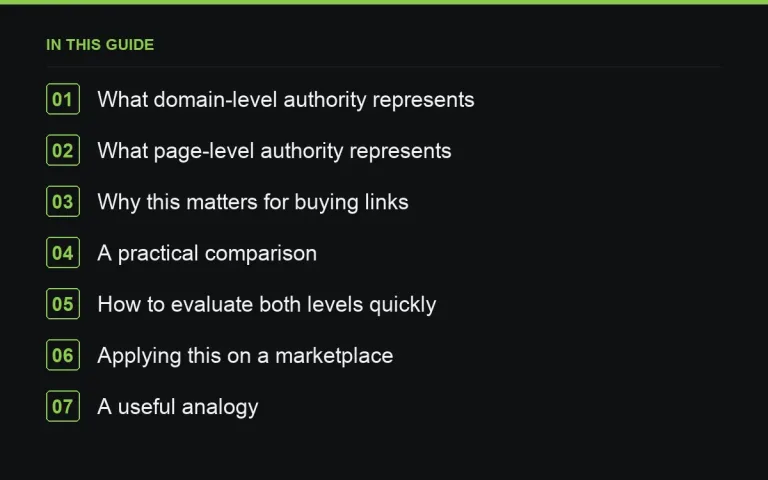
What domain-level authority represents
Domain-level scores aggregate signals across an entire site: how many other sites link to it overall, how established it is, its general trust profile. This is useful as a rough proxy for a site’s overall standing, but it says nothing about any specific page on that domain.
What page-level authority represents
Page-level signals reflect what’s happened to that one URL specifically: does it have its own inbound links, is it indexed, does it get its own traffic or engagement. A homepage of a major, well-linked site will have strong page-level signals. A deep, rarely-linked blog post from three years ago on that same domain might have almost none, despite living on a high-authority domain.
Why this matters for buying links
When you buy a placement, you’re not really getting “the domain’s authority” — you’re getting whatever authority that specific page carries, plus a smaller halo effect from the domain around it. A guest post added to a fresh URL on a high-DR site starts closer to that page-level baseline and builds up its own standing over time, rather than inheriting the domain score wholesale.
A practical comparison
| Scenario | Domain-level signal | Page-level signal |
|---|---|---|
| New guest post on a strong, active domain | Strong | Starts modest, grows over time |
| Old, well-linked article on a strong domain | Strong | Strong — has its own history |
| New guest post on a weak, barely active domain | Weak | Very weak |
How to evaluate both levels quickly
- Check the domain’s overall metric as a first filter for general trust.
- Then check the specific page or section where your content will live — is that part of the site active and linked to elsewhere?
- For guest posts, ask whether the publisher promotes new posts (social shares, newsletter mentions) — this helps a new page build its own signals faster.
Applying this on a marketplace
Filters on https://successtoroad.com/marketplace/ typically surface domain-level metrics because they’re easiest to standardise across tens of thousands of sites. Use them as a first pass, then spot-check a few recent live articles on shortlisted sites to judge page-level reality before committing budget.
A useful analogy
Think of a domain as a university and individual pages as its departments. A university with an excellent overall reputation can still have a newly formed department that hasn’t published much yet, alongside a decades-old department with an outstanding track record. A recommendation from the university’s name alone carries some weight, but a recommendation from its most established, well-regarded department carries more. Page-level and domain-level authority interact the same way — the domain provides a baseline, and the specific page adds (or fails to add) its own track record on top of that baseline.
Why buyers sometimes get this backwards
It’s tempting to treat domain-level metrics as the whole answer because they’re the number displayed most prominently in most tools and marketplaces. This isn’t a flaw in the tools so much as a limitation of what’s practical to standardise at scale — computing a reliable page-level score for every single page across tens of thousands of sites is a much heavier undertaking than a domain-level aggregate. Knowing this helps explain why the burden falls on you, the buyer, to do a small amount of manual page-level diligence rather than expecting any single number to capture everything.
Where to go next
Read https://successtoroad.com/blog/dr-vs-da/ for what these scores measure at the domain level, https://successtoroad.com/blog/links-from-new-vs-established-pages/ for the related timing question, https://successtoroad.com/blog/placement-and-crawlability-basics/ for another page-specific factor worth checking, and https://successtoroad.com/blog/topical-relevance/ for another dimension worth weighing alongside authority.
A note on tools that only report one number
Some simpler or older backlink tools report only a domain-level score and don’t offer a page-level equivalent at all. If that’s the only data available to you, treat it explicitly as a partial picture and supplement it with manual checks — is the specific page indexed, does it have any inbound links of its own, is it linked to from elsewhere on the same domain’s navigation — rather than assuming the domain score alone tells the whole story.
Why this distinction matters most for larger sites
The domain-versus-page distinction becomes especially important on very large sites with thousands of pages, such as major news outlets or large e-commerce platforms, where the gap between the strongest and weakest individual pages can be enormous despite a single, high, shared domain-level score. Buying a placement on such a site without checking the specific section or page can lead to a much weaker outcome than the headline domain metric would suggest.
Frequently asked questions
Which matters more for SEO, domain or page authority?
Both matter, but they answer different questions. Domain authority is a useful first filter for overall trust; page authority tells you how much standing the specific linking page itself has built.
Does a new page on a strong domain get an instant authority boost?
Some benefit, yes, through internal links and general domain trust, but it still needs to build its own page-level signals over time rather than fully inheriting the domain's score.
How can I check a specific page's authority before buying a link there?
Most backlink tools offer a page-level metric alongside the domain-level one. Also check manually whether that specific URL is indexed and has any inbound links of its own.
Should I avoid guest posting on high-authority domains if the specific section is weak?
Not necessarily avoid, but temper your expectations and factor it into the price you're willing to pay compared to a page in a more actively linked section of the same site.
Put it into practice
Filter 54,483 websites by DR, traffic, niche and price, and order with escrow — you pay only after the link is live.
Browse the marketplace