How Long Does It Take for Links to Be Discovered?
Most new links get discovered within days to a few weeks, depending on how often the linking site gets crawled.
One of the most common questions after building a link is simply: how long until this shows up? The honest answer is a range, not a fixed number, and it depends more on the linking site’s own crawl frequency than on anything you can control directly.
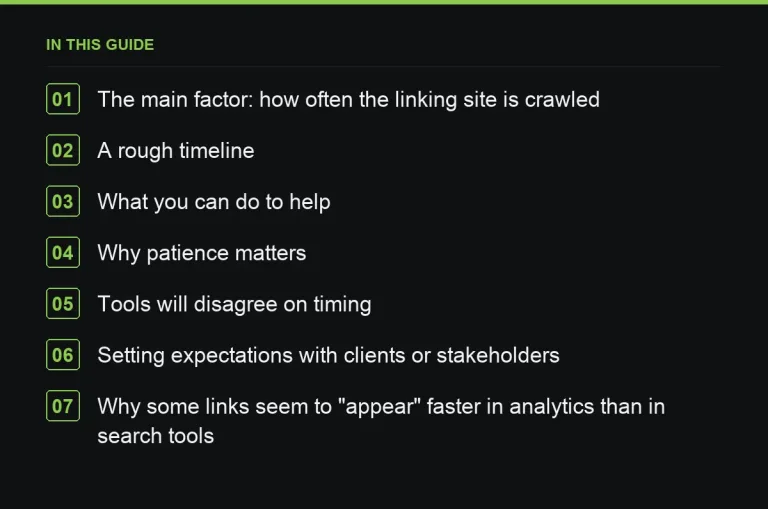
The main factor: how often the linking site is crawled
Large, frequently updated sites — major news outlets, high-traffic blogs — get crawled very often, sometimes within hours of publishing something new. Smaller, less active sites might only get revisited every few weeks. This single factor explains most of the variation people see, more than any property of your own site.
A rough timeline
| Linking site type | Typical discovery window |
|---|---|
| High-traffic, frequently updated site | Hours to a few days |
| Moderately active niche site | A few days to two weeks |
| Low-activity or rarely updated site | Several weeks, sometimes longer |
What you can do to help
- Ask the publisher to share the new post on their own channels — social shares often get pages crawled faster.
- Make sure the linking page isn’t accidentally blocked from indexing (see https://successtoroad.com/blog/placement-and-crawlability-basics/).
- Submit your own page’s sitemap if it’s the one being linked to and isn’t indexed yet.
- Avoid the temptation to build the same link twice out of impatience — duplicate placements rarely help and can look odd.
Why patience matters
Discovery is only the first step. Even after a link is found, any ranking or trust impact tends to show up gradually, often over weeks or months, not instantly. Checking your backlink report daily and reacting to short-term noise is a good way to make decisions on incomplete information. See https://successtoroad.com/blog/reading-a-backlink-report/ for how to read this data sensibly.
Tools will disagree on timing
Different backlink checking tools crawl the web on their own schedules, separate from search engines. A link might be live and even indexed by a search engine well before a particular third-party tool reports it, or vice versa. Don’t treat any one tool’s discovery date as gospel — cross-check when it matters for a client report or a dispute with a publisher.
Setting expectations with clients or stakeholders
If you manage link building for others, it helps to set this expectation up front: links take time to appear and even more time to show measurable impact. Promising instant visibility sets a plan up to look like a failure in its first month, when it’s often just a normal delay. Sites on https://successtoroad.com/marketplace/ vary widely in crawl frequency, so factor that into any timeline you give.
Why some links seem to “appear” faster in analytics than in search tools
There’s an important distinction between a link sending referral traffic and a link being recognised by a search engine. If a publisher shares the new piece on social media or in a newsletter, you may see referral visits in your analytics within hours, well before any search engine has recrawled the page. This is real, valuable traffic, but it’s a separate signal from search discovery, and it’s easy to mistakenly conclude a link has been “picked up” by search when really only the direct, social-driven traffic has arrived so far. Keep these two timelines mentally separate when reporting on a new placement’s early performance.
What to do while waiting
Rather than repeatedly checking the same link for discovery, use the waiting period productively: line up the next few placements, refine your outreach targeting based on what’s working, or work on the linkable asset for your next campaign. Link building rewards a steady cadence far more than intense bursts followed by anxious waiting, and treating the discovery lag as normal background time rather than a problem to solve keeps momentum going.
Where to go next
Read https://successtoroad.com/blog/link-decay/ for what happens to links over the longer term, https://successtoroad.com/blog/setting-realistic-link-building-goals/ for how to frame timelines honestly, https://successtoroad.com/blog/why-links-still-matter/ for the referral-traffic angle mentioned above, and https://successtoroad.com/blog/reading-a-backlink-report/ for interpreting what you see once links do appear.
What “discovered” actually means in practice
Discovery isn’t a single binary event — a search engine may fetch a page, note the new link, but take additional time to fully process and factor it into its broader understanding of your site. Treat discovery timelines as approximate ranges rather than precise deadlines, and avoid over-interpreting small day-to-day fluctuations in any tool’s reporting as meaningful signals on their own.
Building a realistic internal expectation document
If you regularly report on link building progress to others, it’s worth writing a short internal note explaining typical discovery and impact timelines in plain language, so that expectations are set once, clearly, rather than re-explained defensively every time a new link doesn’t show immediate results. This small bit of upfront documentation saves a surprising amount of friction over the life of an ongoing campaign.
One last practical note: if you’re running paid campaigns across many publishers at once, it’s reasonable to track average discovery time as its own internal metric, since it can reveal whether a particular vendor or publisher type consistently under- or over-performs relative to your expectations, informing future sourcing decisions.
Frequently asked questions
Why hasn't my new link shown up in my backlink tool yet?
Third-party tools crawl on their own schedule, separate from search engines, and can lag behind. Check whether the linking page itself is indexed by a search engine as a more direct test.
Does a link start helping rankings as soon as it's discovered?
Not necessarily instantly. Discovery is the first step; any trust or ranking effect tends to build gradually over subsequent weeks.
Can I speed up discovery by requesting indexing manually?
For your own site, yes, submitting a URL or sitemap can help. For someone else's linking page, you generally can't request indexing on their behalf.
Is a slow-to-discover link less valuable?
Not inherently. Discovery speed reflects the linking site's crawl frequency, not the link's quality. A valuable, relevant link on a smaller site is still worth having even if it takes longer to show up.
Put it into practice
Filter 54,483 websites by DR, traffic, niche and price, and order with escrow — you pay only after the link is live.
Browse the marketplace