How Search Engines Use Links Today
Links still do three jobs for search engines: help them find pages, help them judge trust, and help them understand context.
It is easy to get lost in speculation about ranking factors. Strip that away and links do a small number of durable jobs for a search engine: they help it find new pages, they act as one of many trust signals, and they add context about what a page is about. None of this requires believing in a secret formula — it is closer to how a librarian works, using references from other trusted sources to decide what to catalogue and how to describe it.
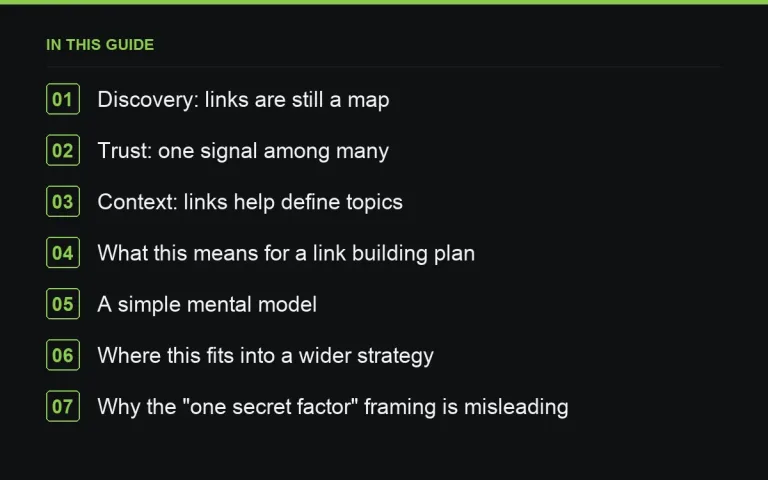
Discovery: links are still a map
Search engines crawl the web by following links, starting from pages they already know and trust. A brand-new page with zero links pointing to it may still get indexed eventually through sitemaps and direct submission, but a link from an already-crawled page is a faster, more reliable route in. This is the most mechanical of the three jobs and the easiest to prove: check any https://successtoroad.com/blog/reading-a-backlink-report/ and you will usually see indexation follow shortly after a handful of solid links appear.
Trust: one signal among many
A link from a page that itself has established trust carries weight, but it is not a single dial you can turn. Search engines combine link signals with content quality, user behaviour, technical health and more. Treat links as one input to a trust score, not the whole score. This is why a site with beautiful backlinks but thin, unhelpful content still struggles, and why understanding https://successtoroad.com/blog/quality-vs-quantity-link-building/ matters more than chasing a number.
Context: links help define topics
The anchor text, surrounding sentences and the linking page’s own subject matter all give a search engine clues about what the linked page covers. A page about commercial insurance linked from finance publications in sentences about business risk reinforces a topical identity. This is a big part of why https://successtoroad.com/blog/relevance-vs-authority-link-building/ is a real trade-off worth thinking through deliberately, rather than defaulting to the highest metric available.
What this means for a link building plan
- Prioritise being findable — sitemaps, internal links, and a handful of external links get new pages crawled sooner.
- Treat every link as a small trust contribution, not a guaranteed ranking jump.
- Choose linking pages that are topically close to the page you are promoting, not just the ones with the highest metrics.
- Watch for indexation and organic visibility changes over months, not days.
A simple mental model
Think of your site as a shop in a city. Links are recommendations from other shopkeepers and residents. A recommendation from someone in the same trade, on the same street, who is well regarded, does more for your reputation than a mention from a stranger three towns over with an inflated reputation. That is the whole model — no algorithm required to understand why it works.
Where this fits into a wider strategy
Links are not the only lever, but they remain one of the few external signals that search engines can observe directly. Pairing a sensible link plan with strong on-page content and a technically sound site gives you the best odds. Browse https://successtoroad.com/marketplace/ when you are ready to find publishers whose audiences already care about your topic, rather than sites chosen purely for a high metric.
Why the “one secret factor” framing is misleading
A lot of confusion in this space comes from treating search engines as a single black box with one dial marked “links.” In reality, a search engine is closer to a large collection of systems working together: crawling infrastructure that decides what to fetch, indexing systems that decide what to store and how to describe it, and ranking systems that decide what to show for a given query. Links touch several of these systems in different ways, which is exactly why their effect is hard to describe with one sentence. A link can speed up crawling without meaningfully affecting ranking, or it can shape topical understanding without changing crawl priority at all. Recognising that these are separate mechanisms, rather than one lever pulling in one direction, helps explain why two seemingly similar links can behave so differently in practice.
How this plays out for a typical small business
Consider a local service business publishing a new guide on its site. Without any external links, that guide might sit undiscovered for a while, especially if the site itself is rarely crawled. A single relevant link from an industry association’s resource page changes the discovery timeline meaningfully, and if that association is genuinely respected in the field, it also contributes a small amount of trust. None of this requires the business to understand any algorithm detail — it only requires understanding that being referenced by real, relevant sources makes you easier to find and easier to trust, which is the same logic that applied to reputation before search engines existed at all.
Where to go next
For the foundational vocabulary, read https://successtoroad.com/blog/what-is-a-backlink/ and https://successtoroad.com/blog/dr-vs-da/. To understand why links keep mattering despite algorithm changes, see https://successtoroad.com/blog/why-links-still-matter/, and for a framework on choosing which links to pursue, read https://successtoroad.com/blog/quality-vs-quantity-link-building/. For the placement details that affect whether a link can even be crawled, see https://successtoroad.com/blog/placement-and-crawlability-basics/.
Frequently asked questions
Do more links always mean higher rankings?
No. Links are one input among many, and a page with excellent links but weak content or poor technical health can still underperform. Think of links as raising your odds, not guaranteeing an outcome.
How quickly do new links get noticed?
It varies by site and crawl frequency, but many links are discovered within days to a few weeks. See {{post:how-long-until-links-get-discovered}} for a fuller answer.
Does anchor text still matter for context?
Yes, in moderation. Natural, varied anchor text that describes the destination helps context without looking manipulative. Overly exact-match anchors repeated everywhere look unnatural.
Is it worth building links to a brand-new site with no content yet?
Build the content first. Links point search engines and readers toward something worth finding — sending them to an empty or thin page wastes the link's value.
Put it into practice
Filter 54,483 websites by DR, traffic, niche and price, and order with escrow — you pay only after the link is live.
Browse the marketplace