Links From Images, PDFs and Embeds: What Actually Counts
Links in images, PDFs and embeds are usually crawled less reliably than plain text links, and referral clicks depend heavily on format.
Not every link lives as a simple text anchor in a paragraph. Infographic credits, PDF downloads, and embedded widgets all carry links in less standard ways, and each format behaves differently in terms of both crawlability and real reader clicks.
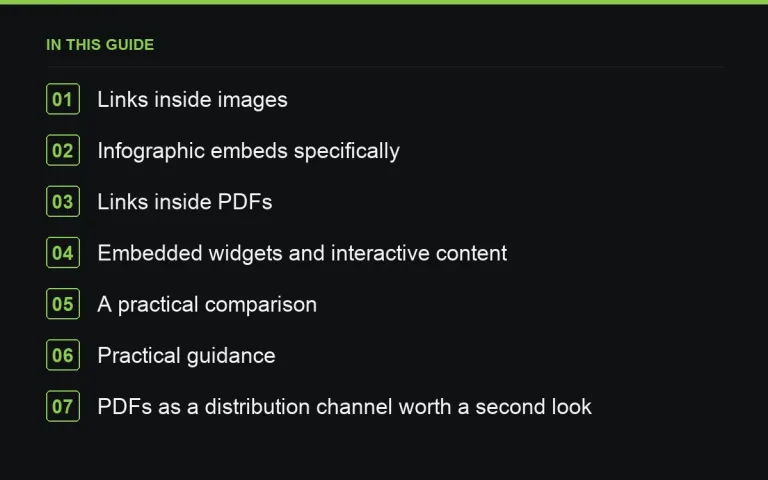
Links inside images
A hyperlinked image works fine as a link technically, but a link sitting inside an image with no accompanying text link nearby is easy for both crawlers and readers to miss the context of. If your infographic gets embedded elsewhere with only an image and no surrounding attribution text, you often lose the actual clickable link entirely, keeping only the visual credit.
Infographic embeds specifically
The classic infographic outreach tactic — offering embed code that includes a credit link back to you — still works, but its real value depends entirely on whether sites embedding it also keep the accompanying text link, rather than just the image. Many will strip or alter it. Treat resulting placements as a bonus layer on top of a broader strategy rather than a primary tactic; see https://successtoroad.com/blog/infographic-link-building/ for more detail.
Links inside PDFs
PDFs can be crawled and indexed, and links inside them can be followed, but this happens less reliably and less frequently than with standard HTML pages. A link buried deep inside a downloadable whitepaper or report is unlikely to be discovered as quickly, or valued as highly, as the same link placed in the surrounding webpage that hosts the PDF.
Embedded widgets and interactive content
Calculators, interactive maps, and other embeddable tools sometimes include a small “powered by” or attribution link. These can accumulate into a meaningful number of links if the embed spreads widely, but individually each one is usually low-authority (it’s often the same widget on many small, low-authority sites) and should be valued as a volume play, not a quality one.
A practical comparison
| Format | Crawl reliability | Referral click potential |
|---|---|---|
| Standard in-content text link | High | Good, if well placed |
| Hyperlinked image, no nearby text link | Lower, easily lost | Low — readers rarely click images expecting a link |
| Link inside a PDF | Moderate, slower discovery | Low, unless the reader is already engaged with the document |
| Widget attribution link | Moderate | Very low per instance, but can scale in volume |
Practical guidance
- Whenever you offer embeddable content, always pair it with a suggested text credit line, not just the image or widget alone.
- Don’t build a strategy primarily around PDF-embedded links; treat them as a secondary benefit of publishing genuinely useful downloadable resources.
- Track these link types separately in your own records, since they behave differently from standard placements — see https://successtoroad.com/blog/documenting-links-you-build/.
PDFs as a distribution channel worth a second look
Despite the crawlability caveats, well-produced PDFs still have a role in link building, particularly as downloadable reports, guides or whitepapers that other sites reference and link to from their own webpage, rather than embedding the PDF’s internal links directly. In this pattern, the actual backlink lives on the referencing site’s normal HTML page pointing to your PDF (or, better, to a webpage summarising the PDF), which sidesteps the crawlability weaknesses of links embedded inside the PDF itself.
A better pattern: pair every downloadable asset with a webpage
Rather than relying purely on a standalone PDF or embeddable widget, create a normal webpage that hosts or summarises the asset, with the download as a supplementary option. This gives you a stable, easily crawlable target for other sites to link to, while still letting the PDF or widget serve its original purpose for the end user. This single habit meaningfully improves the reliability of any link building built around downloadable or embeddable content.
Where to go next
Read https://successtoroad.com/blog/infographic-link-building/ for the specific outreach tactic, https://successtoroad.com/blog/placement-and-crawlability-basics/ for the broader crawlability picture, https://successtoroad.com/blog/link-building-for-mobile-apps-and-non-website-assets/ for a related non-standard-asset problem, and browse https://successtoroad.com/marketplace/ for standard, more reliably crawlable text-link placements.
Video content and link value
Video embeds follow a similar pattern to images and PDFs: a video hosted elsewhere and embedded on a page doesn’t typically carry a standard crawlable text link unless the surrounding page includes one explicitly. If video is a core part of your content strategy, make sure any page hosting an embedded video also includes normal text content and a proper link back to your site, rather than relying on the video platform’s own attribution features alone.
Accessibility benefits align with SEO benefits here
Adding clear text links and descriptions alongside images, PDFs and embeds isn’t just good practice for crawlability — it also improves accessibility for users relying on screen readers or other assistive technology. This is a case where doing the right thing for accessibility and doing the right thing for link building point in exactly the same direction, which makes it an easy improvement to prioritise.
In short, treat images, PDFs and embeds as supporting, secondary link sources rather than primary targets, and always pair them with a normal, crawlable webpage wherever possible to capture the fullest available value.
Frequently asked questions
Do search engines follow links inside PDFs?
Generally yes, PDFs can be crawled and links within them followed, but less reliably and often more slowly than standard HTML pages.
Is an infographic credit link worth pursuing as a strategy?
It can add incremental value, especially if paired with a clear text credit line, but it shouldn't be a primary tactic since many sites will strip or alter the link when embedding the image.
Should I add alt text with a link description to hyperlinked images?
Adding descriptive alt text is good practice for accessibility and context, though it doesn't substitute for having an actual nearby text link for both readers and crawlers to follow.
Are widget attribution links worth building deliberately?
They can add up in volume if the widget spreads, but treat any individual one as low value. Build the widget because it's genuinely useful, and treat the links as a secondary benefit.
Put it into practice
Filter 54,483 websites by DR, traffic, niche and price, and order with escrow — you pay only after the link is live.
Browse the marketplace