Setting Realistic Link Building Goals
Realistic link building goals are tied to your niche's competitiveness, your budget, and a defined time horizon, not a round number.

“Get more backlinks” isn’t a goal, it’s a wish. Useful link building goals are specific about volume, quality bar, timeframe, and how they connect to a business outcome. Here’s how to set targets that hold up under scrutiny and actually guide decisions.
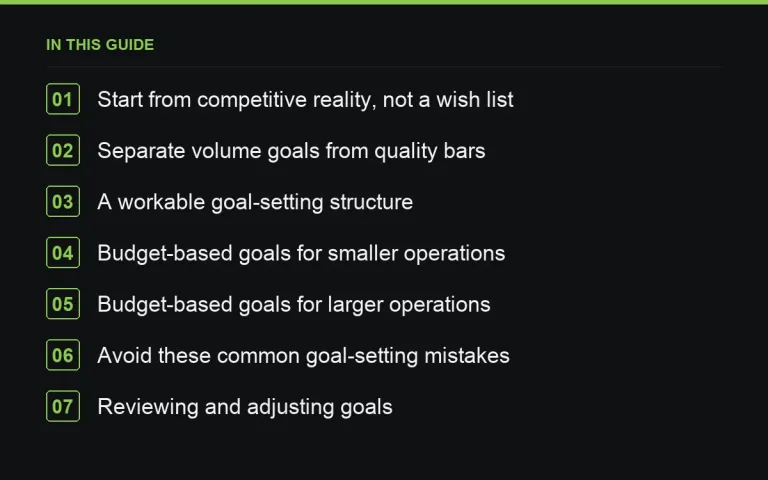
Start from competitive reality, not a wish list
Look at what the sites currently ranking for your target terms actually have in their link profiles — referring domain counts, general relevance, rough age of the profile. This gives you a realistic sense of what “competitive” looks like in your specific niche, rather than an arbitrary round number pulled from a generic guide.
Separate volume goals from quality bars
A goal like “10 links per month” is meaningless without a quality bar attached. Pair every volume target with a minimum standard: genuinely relevant to your niche, from a site with real ongoing activity, placed in-content rather than a footer. Without this pairing, volume goals quietly incentivise the wrong shortcuts.
A workable goal-setting structure
| Element | Example |
|---|---|
| Volume | 4-6 new referring domains per month |
| Quality bar | Topically relevant, in-content placement, active publishing site |
| Timeframe | Reviewed quarterly, adjusted based on results |
| Business tie-in | Supports ranking growth for 3 defined target pages |
Budget-based goals for smaller operations
If you’re working without a dedicated budget, tie your goal to effort rather than spend: a fixed number of outreach pitches per week is a more controllable goal than a fixed number of links, since response rates vary. See https://successtoroad.com/blog/link-building-without-a-budget/ for tactics that fit this model.
Budget-based goals for larger operations
With a meaningful budget, it’s reasonable to set both a spend target and an expected quality/volume range per unit of spend, reviewed and adjusted as you learn which types of placements perform. See https://successtoroad.com/blog/link-building-with-a-large-budget/ for how this scales.
Avoid these common goal-setting mistakes
- Setting a target based on what a competitor “seems to have” without checking whether their niche or history is comparable to yours.
- Measuring success purely by link count while ignoring relevance, which incentivises the wrong behaviour.
- Expecting month-one results to match month-six results — early goals should be lower, reflecting the ramp-up time for relationships and content.
Reviewing and adjusting goals
Revisit goals quarterly against actual ranking movement, referral traffic, and how outreach response rates are trending. A goal that looked reasonable at the outset may need revising once you have real data about your niche’s responsiveness.
Communicating goals to non-specialists
If you report link building progress to a manager, business owner, or client who isn’t deeply familiar with SEO, translate the goal into terms they already understand. Instead of “6 new referring domains per month,” frame it as “steady, relevant coverage growth that supports rankings for our priority pages, reviewed each quarter against real traffic movement.” This reduces the temptation for a non-specialist stakeholder to fixate purely on a raw link count as the measure of success, when relevance and eventual traffic impact matter more.
What a goal should never incentivise
Any goal-setting exercise should be checked against one question: does hitting this target in the cheapest, laziest possible way still count as success? If a target could technically be satisfied by buying a hundred low-relevance links from an unfamiliar network, the goal is poorly specified regardless of how motivating the number itself sounds. Always pair a volume target with an explicit quality bar, as covered earlier, so that the easiest path to hitting the number is also a reasonably good one.
Where to go next
Read https://successtoroad.com/blog/beginners-first-month-link-building-plan/ for an early-stage version of this planning, https://successtoroad.com/blog/link-building-budget/ and https://successtoroad.com/blog/measuring-link-building-roi/ for how goals tie into spend and outcome measurement, and browse https://successtoroad.com/marketplace/ to see what’s realistically available at various price points.
Goals for a defensive, rather than growth, situation
Not every link building goal is about growth. Sometimes the honest goal is simply maintaining current visibility against increasingly aggressive competitors, or recovering after a period of neglect or a past problem. Frame these situations explicitly as defensive or recovery goals rather than forcing them into a standard growth-target template, since the appropriate tactics and success measures genuinely differ.
Aligning goals across departments
In larger organisations, link building goals sometimes get set in isolation from broader marketing or PR goals, leading to duplicated effort or missed opportunities where a PR win could have easily included a link but nobody coordinated on it. Where possible, align link building goals with adjacent teams working on content, PR and brand, so that opportunities aren’t lost purely due to internal coordination gaps.
Finally, write goals down somewhere visible to everyone involved, rather than keeping them only in one person’s head. A goal that’s actually referenced during planning and review meetings shapes behaviour far more effectively than one that was agreed once and then forgotten.
A goal without a review date attached tends to quietly drift into irrelevance. Put a specific quarterly review date on the calendar the moment you set any link building goal, so revisiting it becomes a scheduled habit rather than something that only happens reactively when someone happens to ask about progress.
Frequently asked questions
What's a realistic number of new links per month for a small business?
There's no universal number, but a modest, sustainable pace of a few genuinely relevant links per month, maintained consistently, usually outperforms sporadic bursts. Base your specific target on what competitors in your niche actually have.
Should goals be based on link count or ranking outcomes?
Ideally both, with link count as a leading indicator and ranking or traffic movement as the outcome you ultimately care about. Link count alone can be gamed in ways that don't help rankings.
How often should link building goals be reviewed?
Quarterly is a reasonable cadence for most small and mid-size efforts — frequent enough to adjust based on real results, infrequent enough to give tactics time to show an effect.
Is it a mistake to copy a competitor's exact link count as a goal?
Yes, without also checking whether their niche, age, and history are genuinely comparable to yours. Use it as a rough reference point, not a direct target.
Put it into practice
Filter 54,483 websites by DR, traffic, niche and price, and order with escrow — you pay only after the link is live.
Browse the marketplace