Link Building Ethics: What’s Fair Game and What Isn’t
Ethical link building comes down to disclosure, genuine relevance, and not deceiving either readers or search engines about a link's nature.
Link building sits at an uncomfortable intersection of marketing, journalism and search engine rules, which is why ethical questions come up constantly: is a paid link acceptable, does it need disclosure, is it fair to ask a small blogger for a free link? These questions have practical, defensible answers, even without a single universal rulebook.
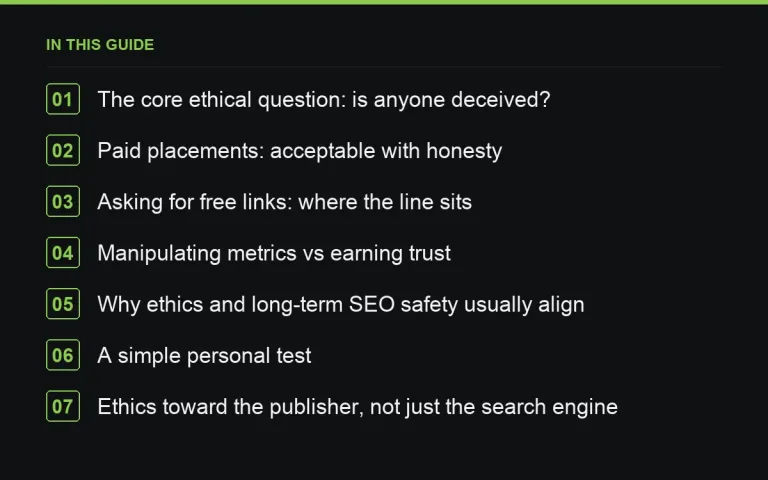
The core ethical question: is anyone deceived?
Most link building ethics reduces to one question: does this practice deceive a reader, a publisher, or a search engine about what’s actually happening? A disclosed sponsored post deceives no one — the reader knows it’s sponsored, the search engine sees the appropriate link attribute. An undisclosed paid link dressed up as pure editorial opinion deceives both.
Paid placements: acceptable with honesty
Paying for a guest post or sponsored placement is not inherently unethical — it’s a normal part of how publishers monetise and how businesses get visibility, similar to advertising. The ethical line is disclosure: readers should be able to tell a piece is sponsored, and the link itself should typically carry a sponsored or nofollow attribute rather than being presented as a spontaneous, unpaid editorial endorsement.
Asking for free links: where the line sits
Asking a publisher for a link is fine. Pressuring them, misrepresenting your relationship to the content, or offering something in exchange without disclosing it, is not. A polite, honest pitch that clearly explains why the link would help their readers is ethical outreach; a pitch dressed up as unrelated correspondence to sneak in a request is not.
Manipulating metrics vs earning trust
- Building genuinely useful content that earns links on its merits: ethical and durable.
- Buying disclosed sponsored placements on relevant sites: ethical, widely accepted practice.
- Buying undisclosed links designed to look like organic editorial endorsement: ethically and practically risky.
- Operating or using networks of low-quality sites purely to manufacture links: dishonest to search engines even if no single reader is deceived — see https://successtoroad.com/blog/pbn-risks/.
Why ethics and long-term SEO safety usually align
Search engines’ own guidelines exist largely to catch exactly the deceptive practices described above, which means the ethical path and the safer path overlap most of the time. This isn’t a coincidence — both are trying to preserve a link’s original meaning as a genuine recommendation. See https://successtoroad.com/blog/white-grey-black-hat-link-building/ for how this plays out across the spectrum of tactics.
A simple personal test
Before pursuing any link building tactic, ask: would I be comfortable explaining exactly how this link was obtained, to the publisher, to a client, and to a search engine’s own support team? If any of those explanations require euphemism or omission, reconsider the tactic.
Ethics toward the publisher, not just the search engine
Most discussions of link building ethics focus entirely on the search engine’s perspective, but publishers deserve consideration too. A publisher accepting a guest post or sponsored placement is trusting that the content is accurate, that you are who you say you are, and that you won’t later edit a published piece to insert something they didn’t agree to. Respecting that trust — providing accurate information, not attempting sneaky post-publication edits, honouring any agreed terms about disclosure — is its own form of ethical practice, separate from any concern about search engine guidelines specifically.
Client-facing ethics for agencies and freelancers
If you build links on behalf of clients, an additional ethical layer applies: being honest with clients about what a given tactic actually is and what risk it carries, rather than dressing up a risky shortcut in more palatable language. A client who later discovers that a “guaranteed high-authority link package” was actually a private network of low-quality sites has a legitimate grievance, separate from any search engine penalty that may or may not follow. Transparency with clients about method and risk is part of ethical practice, not just a legal safeguard.
Where to go next
Read https://successtoroad.com/blog/white-grey-black-hat-link-building/ for the full spectrum of tactics and their honest risk levels, https://successtoroad.com/blog/what-makes-a-link-natural/ for the naturalness angle, https://successtoroad.com/blog/pbn-risks/ for a concrete example of the client-trust problem described above, and browse https://successtoroad.com/services/seo/press-release-distribution/ and https://successtoroad.com/services/writing/ for disclosed, above-board ways to build placements through https://successtoroad.com/services/, or https://successtoroad.com/marketplace/ for transparently listed publisher placements.
How disclosure requirements vary by context
What counts as adequate disclosure can differ depending on the platform and audience — a sponsored blog post might need a clear label at the top of the article, while a social media post might need a specific disclosure hashtag or tag depending on local advertising rules. Rather than applying a single blanket approach everywhere, check what’s expected in each specific context you’re operating in, and default to clearer disclosure rather than minimal disclosure when in doubt.
Ethics as a long-term reputational investment
Publishers, journalists and even competitors within a niche talk to each other more than people often assume. A reputation for honest, straightforward dealing in link building outreach compounds over years into easier future conversations, better response rates, and more trust extended by default. Conversely, a reputation for deceptive or pushy tactics can quietly close doors in a niche community long after any individual instance is forgotten.
Frequently asked questions
Is buying links against the rules?
Search engines generally ask that paid links carry a sponsored or nofollow attribute so they aren't treated as pure organic endorsements. Buying disclosed placements this way is common and widely practiced; disguising them as unpaid editorial content is the risky part.
Do I have to disclose every sponsored post to readers?
Many jurisdictions have advertising disclosure rules separate from SEO considerations, and it's good practice regardless. Check what applies in your market, but defaulting to clear disclosure is the safer choice both legally and ethically.
Is it unethical to ask a friend or business partner for a link?
Not inherently, as long as the link is genuinely relevant and not deceptive about the relationship. A link purely between unrelated, unassociated pages purely for SEO value is a different, weaker case.
What's the risk of ignoring these ethical lines?
Beyond any search engine risk, there's reputational risk with readers and publishers who discover a deceptive practice, which can damage relationships that took a long time to build.
Put it into practice
Filter 54,483 websites by DR, traffic, niche and price, and order with escrow — you pay only after the link is live.
Browse the marketplace