Links From New Pages vs Established Pages
A link from an established, previously-indexed page generally carries more immediate weight than one from a page published yesterday.
Not all linking pages start on equal footing. A page that has existed for years, been crawled repeatedly, and built its own trust behaves differently from a page published yesterday specifically to host your link. Understanding this difference helps you judge opportunities more realistically.
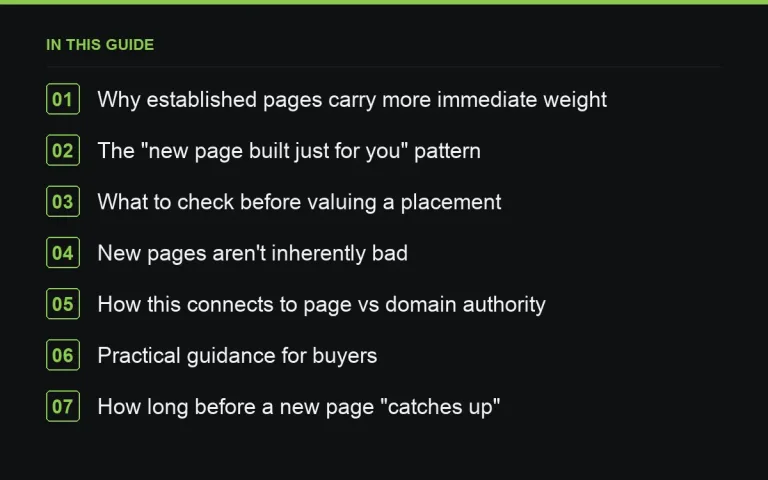
Why established pages carry more immediate weight
A page with a track record — regular crawling, existing rankings, maybe its own inbound links — has already demonstrated it is a real, trusted part of the web. A link added to that page inherits some of that standing right away. A brand-new page has to earn its own trust first, and until it does, any link on it is passing through less established authority.
The “new page built just for you” pattern
Watch out for offers where a publisher creates a fresh page or post solely to host your link, on a site that otherwise looks abandoned or barely active. This pattern — new content on old, low-activity domains, existing mainly to sell placements — is a common feature of lower-quality link networks. It doesn’t automatically mean the link is worthless, but it deserves more scrutiny than a link added to an already-thriving, regularly updated page.
What to check before valuing a placement
- Does the specific linking page have its own history — is it indexed, does it get any traffic or engagement?
- Is the site as a whole actively publishing and updating, or does this look like the first new content in months?
- Does the domain have other, older, still-live pages with real backlinks of their own?
New pages aren’t inherently bad
A guest post on a genuinely active, well-established site is still a new page — and that’s fine, because the domain and the publishing pattern around it are established, even if this specific URL is fresh. The distinction is domain-level and pattern-level trust, not simply the age of the individual page.
How this connects to page vs domain authority
This is closely related to the broader question of https://successtoroad.com/blog/page-vs-domain-authority/: a new page benefits from whatever authority the domain has already built, but it still needs to earn its own signals over time. A link on a brand-new page of a well-established domain is a reasonable middle ground.
Practical guidance for buyers
When evaluating a site on https://successtoroad.com/marketplace/, look past the domain-level metric and check a few actual recent articles: are they getting any engagement, are older ones still live and indexed, does the site read like something with a real ongoing audience? This takes a few extra minutes and meaningfully improves your hit rate compared to sorting purely by a headline authority score.
How long before a new page “catches up”
There’s no fixed timeline for a new page to build page-level signals comparable to older, established pages on the same domain, but a reasonable general pattern is gradual improvement over months rather than weeks, assuming the page continues to get internal links, occasional external mentions, and genuine traffic. If you’re tracking a specific guest post’s performance, don’t expect it to behave like a five-year-old cornerstone article within its first month — judge it against a realistic timeline for a newly published page instead.
Why some publishers deliberately reuse older, proven pages
Some publishers offer to add a link to an existing, well-established article rather than creating a brand-new one for you specifically — sometimes called a “link insertion” or “niche edit.” This can be a genuinely strong option precisely because it starts from an already-proven page rather than a fresh one still building its own signals. It comes with its own considerations, though: the addition needs to fit naturally into existing content, and older articles sometimes carry outdated context that an inserted link doesn’t quite match. Weigh this option alongside fresh guest posts rather than assuming one is always superior to the other.
Where to go next
Read https://successtoroad.com/blog/page-vs-domain-authority/ for the related distinction, https://successtoroad.com/blog/pbn-risks/ for the more extreme version of this pattern to avoid, https://successtoroad.com/blog/how-long-until-links-get-discovered/ for the discovery timeline itself, and https://successtoroad.com/blog/reading-a-backlink-report/ to learn how to spot these patterns in your own existing profile.
How to read early signals on a brand-new placement
Rather than waiting passively to see how a newly linked page performs, keep an eye on a few early indicators: whether the page gets indexed within a reasonable timeframe, whether it starts appearing for its own branded or specific title searches, and whether the publisher shares or promotes it at all beyond simply publishing it. These early signals give a rough read on whether a new page is building momentum, well before any broader ranking impact would be expected to show up.
Setting expectations when negotiating a new-page placement
If you’re negotiating a guest post that will live on a freshly created page, it’s reasonable to factor the extra ramp-up time into your expectations and pricing discussions, compared to a niche edit on an already-established article. Neither option is inherently better in all cases, but understanding this difference helps you negotiate and plan with realistic timelines rather than assuming every placement behaves identically from day one.
Frequently asked questions
Is a link from a new page ever a red flag on its own?
Not on its own. It becomes a concern when combined with other signals: a barely-active domain, content created seemingly just to host paid links, or a site with no other real publishing history.
How can I check if a domain is actively publishing?
Look at its content archive or sitemap for a publishing history — a steady stream of dated content over months or years is a good sign, versus a handful of pages all created recently.
Does the age of my own page matter for receiving links?
Less than the age of the linking page, though a brand-new page on your own site will also take some time to build its own standing, independent of any links pointing to it.
Should I avoid all guest posts on newer sites?
Not necessarily. A newer site with genuine, growing engagement can still be a reasonable link source; just weigh it accordingly and don't expect the same immediate impact as an established authority.
Put it into practice
Filter 54,483 websites by DR, traffic, niche and price, and order with escrow — you pay only after the link is live.
Browse the marketplace