White Hat, Grey Hat and Black Hat Link Building, Explained Honestly
White, grey and black hat describe risk levels, not morality — here's what actually falls into each category and why it matters.

These labels get used loosely, often as marketing rather than description. Stripped of the moralising, they describe a spectrum of risk: how closely a tactic follows search engines’ stated preferences, and how much it relies on tricking either readers or crawlers. Here’s an honest, practical breakdown.
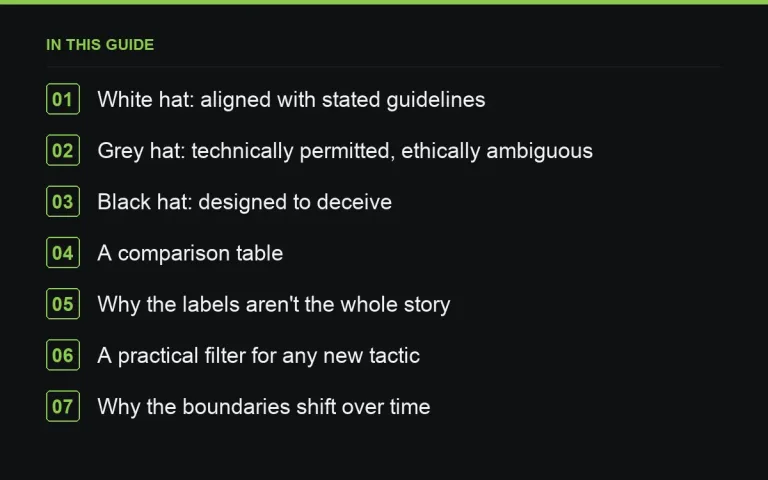
White hat: aligned with stated guidelines
White hat tactics earn links by creating something genuinely worth linking to, and by asking honestly. Examples: publishing original research, offering a genuinely useful free tool, disclosed sponsored guest posts on relevant sites, digital PR based on real newsworthy angles, and polite outreach for legitimately broken or missing links. The defining trait: nothing here would embarrass you if fully explained to the linking site or a search engine.
Grey hat: technically permitted, ethically ambiguous
Grey hat sits in the middle: tactics that don’t clearly break any rule but stretch the spirit of “genuine editorial endorsement.” Examples: undisclosed paid guest posts presented as pure editorial content, aggressive reciprocal linking arrangements, or buying links from otherwise legitimate sites without a sponsored attribute. These carry real but moderate risk — individually survivable, cumulatively risky if it becomes the majority of your link profile.
Black hat: designed to deceive
Black hat tactics exist specifically to manufacture link signals that wouldn’t occur naturally: private blog networks built purely to host links (see https://successtoroad.com/blog/pbn-risks/), automated link injection into hacked or abandoned sites, comment and forum spam at scale, and link farms trading links with no topical relevance whatsoever. These carry the highest risk of penalties and, separately, rarely deliver durable value even when undetected.
A comparison table
| Category | Typical tactic | Risk level |
|---|---|---|
| White hat | Disclosed guest posts, digital PR, useful content | Low |
| Grey hat | Undisclosed paid editorial links, aggressive reciprocal linking | Moderate |
| Black hat | PBNs, automated spam, link farms | High |
Why the labels aren’t the whole story
Two “grey hat” tactics can carry very different actual risk depending on scale and context. A single undisclosed sponsored link on an otherwise organic profile is a minor grey area; building an entire strategy on undisclosed paid links is a much bigger bet. Judge risk by pattern and proportion, not just by which bucket a single tactic falls into.
A practical filter for any new tactic
- Would this survive a fully honest explanation to the linking site?
- Does it rely on tricking a crawler, a reader, or both?
- Is it something a large share of the web genuinely does, or a shortcut built purely to avoid the slower, honest path?
Why the boundaries shift over time
What counted as acceptable white hat practice a decade ago sometimes drifted toward grey or black hat territory as it became widespread enough to abuse at scale, and search engines adjusted their tolerance in response. Directory submissions, for example, were once a mainstream, uncontroversial tactic and are now viewed with far more screpticism because low-quality directory networks became a popular manipulation vector. This history is worth knowing because it means today’s white hat tactic isn’t guaranteed to stay that way forever if it becomes heavily commoditised and abused — durability favours tactics rooted in genuine value rather than a specific mechanic that happens to currently be tolerated.
Judging vendors and offers using this framework
When evaluating an outside vendor or a bulk link package, ask directly which category their methods fall into, and be wary of vague or evasive answers. A vendor confident in white hat methods will typically describe their process clearly: which sites they work with, how content is written, whether placements are disclosed. Reluctance to explain the actual mechanism, or heavy reliance on phrases like “guaranteed” and “bulk” without further detail, often signals a grey or black hat operation regardless of how it’s marketed. Reputable options, including transparently listed publishers on https://successtoroad.com/marketplace/, typically make their process and site details easy to inspect before you commit.
Where to go next
Read https://successtoroad.com/blog/link-building-ethics/ for the disclosure-focused version of this discussion, https://successtoroad.com/blog/pbn-risks/ for the clearest black hat case study, https://successtoroad.com/blog/link-building-vocabulary-confusions/ for related terminology, and https://successtoroad.com/blog/what-makes-a-link-natural/ to understand what all three categories are ultimately being measured against.
Grey areas that experienced practitioners still disagree on
Even seasoned link builders don’t fully agree on where certain tactics sit — reciprocal linking between genuinely related sites, for instance, is defended by some as normal, healthy collaboration and criticised by others as a manipulation risk if done at scale. When you encounter a genuinely disputed tactic like this, the safest approach is to apply the naturalness and disclosure tests from earlier sections yourself, rather than relying purely on a single source’s categorisation.
A pragmatic recommendation for most businesses
For most ordinary businesses without a dedicated, highly experienced in-house SEO team, sticking close to white hat practices and being cautious about grey hat tactics is the more sensible default, simply because the potential downside of a serious link-related problem tends to outweigh the modest extra results riskier tactics might occasionally produce for a typical, non-specialist operation.
Frequently asked questions
Is grey hat link building worth the risk?
It depends on your tolerance and how central it is to your strategy. Occasional grey-area tactics rarely sink a site alone, but building a majority of your profile on them raises cumulative risk over time.
Can a white hat strategy still get penalised by mistake?
It's rare but not impossible, especially if a legitimate guest posting arrangement is later judged too aggressive in scale or pattern. Staying relevant, disclosed, and moderate in volume reduces this risk substantially.
Are all paid links black hat?
No. Disclosed, properly attributed paid links on relevant sites are a normal, widely accepted practice, closer to white hat than black hat. It's the lack of disclosure that shifts a paid link toward the riskier end.
How do I recover if I've used black hat tactics in the past?
Start with an audit — see {{post:reading-a-backlink-report}} — identify the risky links, and disavow or attempt removal where appropriate, then rebuild with white hat tactics going forward.
Put it into practice
Filter 54,483 websites by DR, traffic, niche and price, and order with escrow — you pay only after the link is live.
Browse the marketplace