What Is Guest Posting? A Practical Guide for 2026
How guest posting actually works in 2026 — what you get, what it costs, where it helps rankings, and the rules that keep it from backfiring.
Guest posting means publishing an article on someone else’s website, usually with a link back to your own. Done well, it puts your brand in front of an audience you don’t have yet and earns a reference from a site search engines already trust. Done badly, it is one of the fastest ways to waste a marketing budget on links nobody reads and nobody trusts.
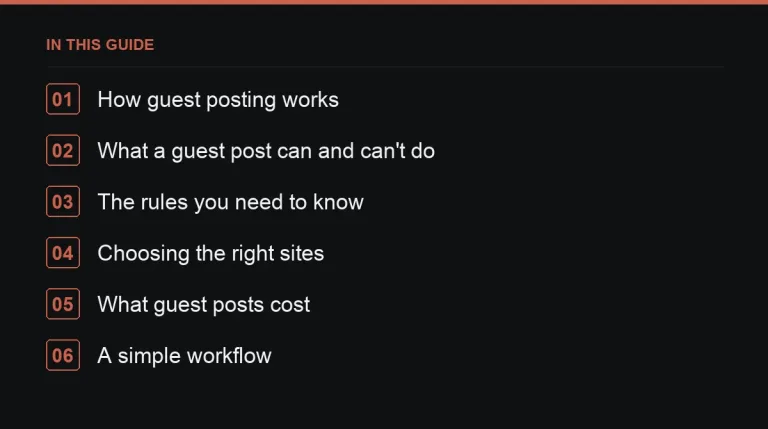
This guide covers how guest posting works today, what it realistically achieves, what it costs, and the decisions that separate useful placements from expensive noise.
How guest posting works
There are two routes to a guest post:
- Editorial pitching. You pitch an idea to an editor, they accept it on merit, and you write the piece. No money changes hands. It is slow and the acceptance rate is low, but the links are about as clean as links get, and the process looks a lot like the outreach described in our journalist outreach guide.
- Paid placement. A publisher offers guest posts for a fee. You choose a site, supply a brief or an article, and the publisher places it. This is faster and predictable, which is why marketplaces like ours exist.
Most teams end up using both: pitching for the handful of publications that matter most for reputation, and paid placements to build steady, relevant coverage across the sites their audience actually reads.
What a guest post can and can’t do
A single guest post will not rank a page on its own, and anyone who promises that is selling something else. What a well-chosen placement does is add one more signal that your site is referenced by others in its field. Over months, a consistent set of relevant references from real publications is what moves rankings, alongside the on-page and technical work covered in technical SEO before you buy links.
Beyond SEO, a guest post on a site with an actual readership can send referral traffic, build brand familiarity with people who’ve never heard of you, and give a sales team something credible to point prospects toward. Those benefits only show up when the host site has real readers, which is why organic traffic matters more than any authority score when you choose where to publish — we explain why in this guide to traffic as a metric.
The rules you need to know
Google’s spam policies treat links bought to manipulate rankings as link spam, and ask that paid or sponsored links carry the sponsored or nofollow attribute. Many publishers now apply that attribute to paid posts by default, and our marketplace shows whether a site does so on each listing, which we cover in more depth in sponsored, nofollow and dofollow attributes.
What this means in practice:
- Judge a placement by what it does for readers and your brand, not only by whether the link passes authority through.
- Avoid sites whose only purpose is selling links. They carry the most risk and the least value — our list of red flags covers how to spot them fast.
- Keep anchor text natural and varied across your placements, rather than repeating one exact-match commercial phrase (see our anchor text guide).
Choosing the right sites
The best guest post sites share three traits: they cover your topic, they have readers who arrive from search, and they publish content an editor has clearly looked at before it went live. A useful order of checks:
- Relevance. Is the site about your subject, or at least your audience’s interests? Start from the relevant niche, for example technology or finance.
- Traffic. Does it get organic visitors, and is that number stable rather than collapsing over the past year?
- Editorial quality. Read three recent posts. Would you be comfortable being published next to them?
- Metrics. Only now look at DR and DA, as a tiebreaker between similar sites rather than a starting point.
We go through each of these checks in detail in How to Evaluate a Guest Post Site Before You Pay. Some industries have their own quirks; see our guides for SaaS, ecommerce and travel.
What guest posts cost, and the alternative
Prices range from a few dollars to several thousand, driven mostly by traffic, topical authority and how selective the publisher is. Cheap is rarely a bargain: very low prices usually signal a site that sells to anyone, which is exactly the kind of neighbourhood you don’t want your link in. Our pricing breakdown shows what drives the numbers, and if you’re weighing a guest post against a cheaper link insertion, guest posts vs niche edits lays out when each makes more sense.
A simple workflow
- Pick the page you want to support and the topic it should cover.
- Shortlist relevant sites with real, stable traffic.
- Write a clear brief: target URL, anchor, angle and tone (brief template here).
- Order, and keep payment in escrow until the post is live.
- Check the live post: link, attributes, indexing and placement (checklist).
- Track rankings and referral traffic to the target page over the following months.
Once this works for a handful of pages, the challenge becomes doing it at volume without quality slipping, which scaling guest posting covers in detail.
Where to go next
On Digital PR, payment stays in escrow until you have seen the live link, and you can filter every listing by traffic, relevance and price in the marketplace. If you’re deciding whether to do this yourself or hand it to a specialist, marketplace vs manual outreach is a good next read.
All guest posting guides
- 12 Red Flags That a Guest Post Site Is a Link Farm
- A Guest Post Checklist for Quality Assurance Before Submission
- A Guest Posting Workflow for a Team of Three
- Anchor Text for Guest Posts: A Safe, Natural Mix
- Disclosure Rules for Sponsored Guest Posts
- Getting More Value From Every Guest Post
- Getting a Recurring Guest Post Column
- Ghostwritten Guest Posts: The Ethics You Should Know
- Guest Post Content Ownership and Rights
- Guest Post SLAs and Delivery Times: What to Expect
- Guest Post Structure That Keeps Readers Reading
- Guest Post Topics Editors Accept
- Guest Post Turnaround Times: What to Expect
- Guest Posting for Beginners: Your First 5 Placements
- Guest Posting for Consultants and Advisors
- Guest Posting for Local Businesses
- Guest Posting for Non-Native English Writers
- Guest Posting for Personal Brands
- Guest Posting in Regulated Industries: Finance, Health, and Legal
- Guest Posting on B2B Sites: What Works
- Guest Posting on Lifestyle Sites
- Guest Posting on Magazines: What’s Different
- Guest Posting vs Content Marketing on Your Own Site
- Guest Posts That Rank on Their Own in Search
- Guest Posts With Multiple Links: When It’s Appropriate
- Guest Posts and Social Amplification: Making a Post Work Harder
- Guest Posts on News Sites vs Blogs: Key Differences
- Guest Posts vs Niche Edits: Which to Buy and When
- Handling Editorial Changes to Your Guest Post
- How Editors Judge a Guest Post Submission
- How Long Should a Guest Post Be?
- How Many Links Should a Guest Post Include?
- How Much Does a Guest Post Cost? What Drives the Price
- How to Evaluate a Guest Post Site Before You Pay
- How to Pitch Topic Ideas to a Publisher
- Images in Guest Posts: Sourcing and Rights
- Measuring a Guest Post’s Traffic and Real Value
- Negotiating Guest Post Prices With Publishers
- One Great Guest Post Site or Five Average Ones?
- Renewing or Extending Guest Post Placements
- Running a Guest Post Series Across Multiple Sites
- Scaling Guest Posting Without Losing Quality
- Using Original Images and Charts in Guest Posts
- What to Check When Your Guest Post Goes Live
- When a Publisher Deletes Your Guest Post
- Writing Guest Post Headlines Editors Actually Accept
- Writing a Guest Post Author Bio
Frequently asked questions
Is guest posting still worth it in 2026?
Yes, when the host site is relevant and has real readers. It builds brand exposure and topical references over time. It stops being worth it when the only goal is a link from a site nobody reads.
Are paid guest posts against Google's guidelines?
Google asks for paid links to be marked sponsored or nofollow. Buying links intended purely to manipulate rankings is treated as link spam. Choose placements for their audience and relevance, not only for the link.
How many guest posts do I need?
There is no fixed number. A steady pace of relevant placements beats a sudden burst. Plan around your competitors' referring domains and your budget rather than a round target.
What's the difference between guest posting and digital PR?
Guest posting places a full article on a chosen site, usually for a fee. Digital PR earns coverage by pitching a story, data or angle to journalists, often without payment. Many campaigns use both.
Put it into practice
Filter 54,483 websites by DR, traffic, niche and price, and order with escrow — you pay only after the link is live.
Browse the marketplace