Guest Post Structure That Keeps Readers Reading
The structural patterns that stop readers from bouncing off your guest post early.
A guest post can have a strong topic, a great headline, and still lose most of its readers by the third paragraph. Structure is usually the reason, and it’s the part writers spend the least time on because it feels less important than the sentences themselves.
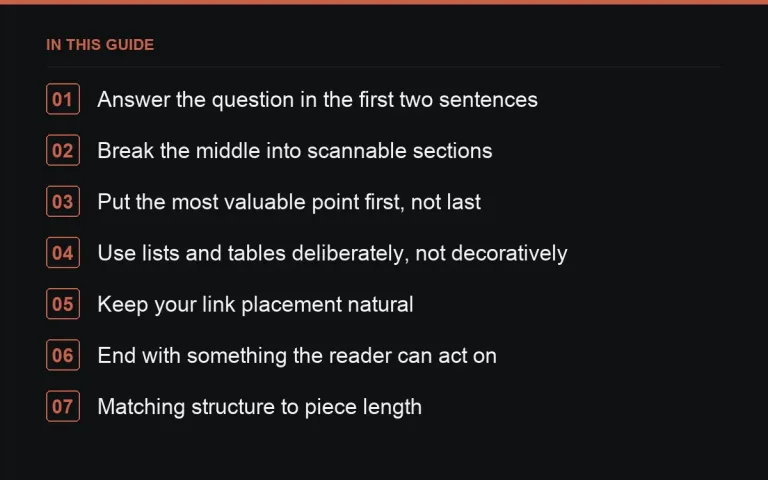
Answer the question in the first two sentences
Readers arriving from search or a social link decide within seconds whether the page will answer what they came for. Open with a direct answer or a clear statement of what the piece covers, not a scene-setting anecdote. Save any story or example for after you’ve earned the reader’s trust that the piece delivers.
Break the middle into scannable sections
Long unbroken blocks of text are the single biggest cause of early exits. Use an H2 every few hundred words, and drop to H3 when a section itself has distinct sub-points. This isn’t just about readability on screen — https://successtoroad.com/blog/guest-posts-that-rank-on-their-own/ explains how clear heading structure also helps a piece perform in search once it’s live.
A structure that tends to hold attention
- Opening: the answer or the stakes, in two to three sentences
- Section one: the most important point, not a warm-up point
- Middle sections: specific, concrete guidance, one idea per section
- A list or table somewhere in the middle to break up prose
- A closing section that points to what to do next
Put the most valuable point first, not last
Writers trained in essay-style writing often save their strongest point for the conclusion. Online readers don’t stick around that long. Lead with your best insight, then use the rest of the piece to support and expand it.
Use lists and tables deliberately, not decoratively
A bullet list should replace a paragraph that was genuinely list-shaped information — steps, comparisons, or criteria — not just chop up prose for the sake of variety. Editors and readers can both tell the difference between a list that clarifies and one that’s padding.
Keep your link placement natural
Where you place your author link or in-text link affects whether readers trust it. A link that appears mid-sentence, supporting a specific claim, reads as a citation. One dropped awkwardly into an unrelated sentence reads as an ad. https://successtoroad.com/blog/how-many-links-per-guest-post/ covers how many is reasonable, but placement matters as much as count.
End with something the reader can act on
A strong closing section doesn’t just summarise — it gives the reader a next step, whether that’s a checklist, a related resource, or a clear takeaway they can apply immediately. This is also where a natural mention of https://successtoroad.com/marketplace/ or a related niche fits, if relevant to the piece’s topic.
Matching structure to piece length
A short 800-word post and a long 2,000-word guide need different internal proportions. A short piece can usually get away with three or four sections and a tight close; a long guide needs more deliberate signposting — a brief note early on about what the piece will cover, clear section breaks, and sometimes a short summary list near the end so a skimming reader can still extract the key points without reading every paragraph. Check https://successtoroad.com/blog/guest-post-word-count/ for how expected length varies by publisher, and adjust your structural plan accordingly before you start writing rather than after.
Transitions between sections matter more than writers expect
A jarring jump from one section to the next, with no connecting sentence, makes even well-organised content feel disjointed. A single transitional sentence at the start of a new section — briefly linking it back to the point before — keeps the reader oriented and reduces the feeling of reading a bullet-pointed outline rather than a coherent piece.
Reading your draft the way a skimmer would
Before submitting, try reading only the headings and the first sentence of each paragraph, skipping everything else. If that skimmed version still communicates the core argument clearly, your structure is doing its job. If it reads as disconnected fragments, the underlying logic between sections probably needs tightening before the piece goes any further, regardless of how good the full prose reads when read in full.
Adapting structure for mobile readers
A large share of guest post traffic arrives on a phone screen, where long paragraphs look even more daunting than on a desktop monitor. Favour shorter paragraphs than you might default to in other writing contexts, and check how your draft actually renders on a narrow screen if you have the option, since a structure that looks fine in a wide document can feel dense and uninviting once compressed into a phone-width column. A quick test on your own phone before submitting catches this more reliably than reviewing on a desktop alone.
Where to go next
Structure works alongside topic and headline choice, not instead of them. Pair this with https://successtoroad.com/blog/guest-post-headlines-that-get-accepted/ and https://successtoroad.com/blog/pitching-topic-ideas-to-a-publisher/ before your next pitch, and once the piece is live, https://successtoroad.com/blog/measuring-a-guest-posts-traffic/ will tell you whether the structure actually held reader attention.
Frequently asked questions
How many words should a section be before it needs its own heading?
There's no fixed number, but if a section runs past 200–250 words without a natural break, it's usually a sign it covers more than one idea and should be split.
Is it fine to use a numbered list instead of H2 sections?
Numbered lists work well for sequential steps, but a guest post generally still needs H2 headings around broader themes, with lists used inside sections rather than replacing them entirely.
Where in a guest post should the author's link appear?
Usually within the body where it naturally supports a specific point, plus in the author bio at the end. Avoid clustering multiple links in the first paragraph.
Does structure really affect whether a post ranks well later?
Yes. Clear headings help search engines and readers both parse the content's hierarchy, which supports the post's ability to rank on its own over time.
Put it into practice
Filter 54,483 websites by DR, traffic, niche and price, and order with escrow — you pay only after the link is live.
Browse the marketplace