Disclosure Rules for Sponsored Guest Posts
Advertising rules in many countries require paid content to be recognisable. Here's what that means for guest posts.
Sponsored guest posts sit at the intersection of advertising law, consumer protection rules and search engine guidelines, and the details differ by country. The direction across nearly all of them is consistent, though: readers should be able to tell when content is paid for. This is a general overview to help you plan sensibly, not legal advice — check the specific rules that apply in your market before relying on any of it.
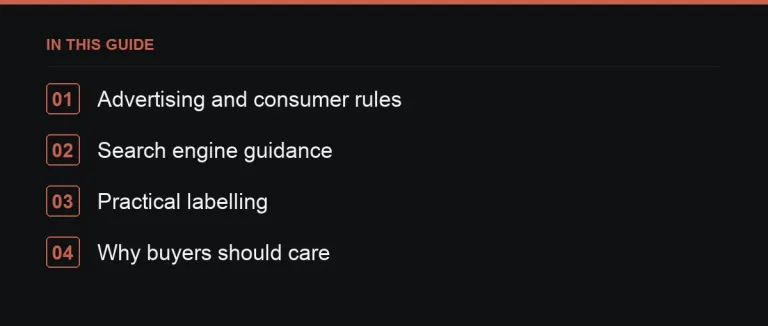
Advertising and consumer protection rules
In many countries, advertising regulators and consumer protection statutes require paid content to be clearly identifiable as advertising to an ordinary reader, not buried in fine print. Common labels include “Sponsored”, “Advertisement”, “Paid partnership” and local-language equivalents such as “Anzeige” in Germany. The exact wording required, and who is responsible for it, varies by jurisdiction — this is one area where checking local guidance genuinely matters rather than assuming a label used in one country is sufficient in another (notes on the German market).
Search engine guidance
Separately from advertising law, Google asks that links inside paid content be qualified with a rel=”sponsored” or rel=”nofollow” attribute, so the link isn’t treated as an unqualified editorial endorsement (link attributes explained). This is a search-quality guideline rather than a legal requirement, but ignoring it while also failing to disclose commercially is the combination most likely to draw attention.
Practical labelling that satisfies both
- A visible label near the title or at the very start of the article — not hidden in a footer or only in the URL.
- Consistent wording used across all sponsored content on a site, so readers learn to recognise it.
- The appropriate link attribute applied to any commercial link within the piece.
- A policy the publisher applies uniformly, rather than deciding case by case which advertisers get labelled.
Why this matters to buyers, not just publishers
It’s tempting to see disclosure as the publisher’s problem, but in several markets both the advertiser and the publisher can carry responsibility for undisclosed paid content. Beyond the legal exposure, publishers who label honestly and consistently also tend to be more careful across the board — in site selection, editorial standards and how they handle disputes — which is itself a useful signal when vetting a site to work with (evaluating a guest post site).
A quick comparison
| Requirement source | What it asks for | Who it applies to |
|---|---|---|
| Advertising/consumer law | Clear, visible disclosure of paid content | Advertiser and/or publisher, depending on jurisdiction |
| Search engine guidance | rel=”sponsored” or “nofollow” on paid links | The publisher’s site, indirectly affecting the advertiser’s link value |
| Platform-specific policies | Varies by social or content platform | Whoever is publishing on that platform |
Market-specific notes
Requirements and norms differ enough across regions that it’s worth reading local notes before running campaigns there: see the pages on the UK market and the US market alongside the German sites overview.
Platform policies beyond legal minimums
Independent of any legal requirement, many social platforms and some content networks impose their own disclosure policies on sponsored content shared through them, which can be stricter than the underlying advertising law. A post that satisfies a country’s minimum legal disclosure standard can still violate a platform’s separate content policy if it’s shared there without the platform’s own required labelling. Treat legal compliance as the floor, and check the specific policy of any platform or network where the content will actually be distributed.
What buyers sometimes get wrong
A common misconception is that disclosure only matters for content that mentions a specific product by name, and that a more general “expert” article sponsored by a brand doesn’t need the same treatment. In most frameworks, what triggers the disclosure requirement is the payment relationship itself, not how directly the content promotes a specific product — an article that’s paid for but reads as neutral advice can still need labelling if the underlying arrangement is commercial. When in doubt, err toward disclosing rather than assuming a piece is subtle enough not to need it.
Disclosure and editorial trust
Some buyers worry that visible disclosure makes a placement look weaker to readers, but the evidence from how audiences actually respond suggests the opposite tends to be true over time: readers who discover undisclosed sponsorship after the fact trust that publication less going forward, while clearly labelled sponsored content that’s still genuinely useful is judged mainly on its usefulness. Treat disclosure as a cost of doing this kind of marketing honestly, not as a tax on its effectiveness.
Where to go next
Disclosure is one part of running guest posting responsibly — pair it with a sensible approach to link attributes (rel attributes) and honest pricing negotiation (negotiating guest post prices). Publishers on the Digital PR marketplace operate under clear terms, which is worth factoring in when you’re choosing where to place sponsored content.
Frequently asked questions
Do sponsored guest posts have to be labelled?
In many countries, yes — advertising and consumer protection rules generally require paid content to be clearly recognisable to an ordinary reader.
Does labelling reduce a guest post's value?
No. Labelling doesn't remove the audience, traffic or brand value of the placement — and honest labelling is itself a sign of a carefully run publisher.
Who is responsible for disclosure?
Often both the advertiser and the publisher can carry some responsibility, depending on the market; check the specific rules that apply where the content will be seen.
What link attribute should sponsored content use?
Google's guidance asks for a sponsored or nofollow rel attribute on links within paid content, separate from any advertising-law disclosure requirement.
Put it into practice
Filter 54,483 websites by DR, traffic, niche and price, and order with escrow — you pay only after the link is live.
Browse the marketplace