Link Building for the US Market
The US is many markets in one. Here's how to build links that match whether you sell nationally, by state or locally.

The United States is the largest English-language market, but it behaves like many markets stacked on top of each other: national publications, state-level media, and a dense local news and community web. The right link building approach depends heavily on whether you sell nationally, regionally, or in specific local areas.
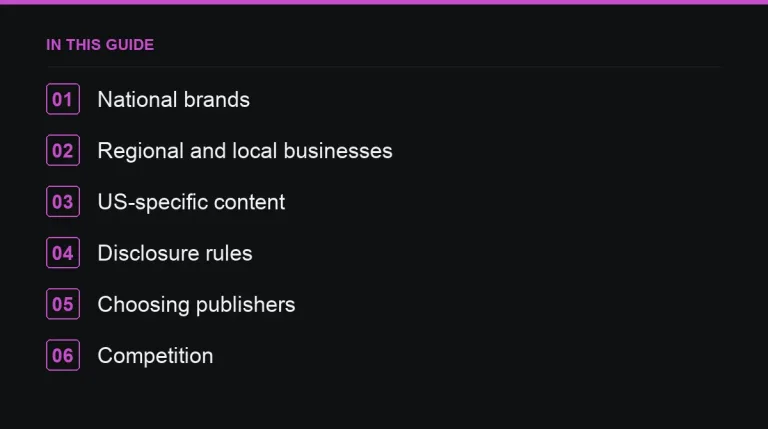
National brands need national and topical authority
National data stories, expert commentary tied to national news, and placements on national publications all build broad authority (see what is digital PR for how this differs from straightforward guest posting). State-by-state breakdowns of a single data campaign can multiply pickup significantly, since each state’s media gets its own locally relevant angle from the same underlying dataset.
Regional and local businesses need something different
Local news outlets, city magazines, chambers of commerce and community sites carry strong local relevance that a national blog simply can’t replicate for a local audience (see link building for local service businesses). A link from your city’s business journal can matter more to local rankings and to real customers than a much bigger national blog post ever will.
US-specific content decisions
| Element | US convention |
|---|---|
| Spelling | US spelling throughout (color, organize, license) |
| Currency and units | Dollars, imperial units |
| Regulation | Many topics — tax, insurance, law, healthcare — differ meaningfully by state |
That last row matters more than it looks: state-by-state regulatory differences create genuine demand for state-specific guides, which in turn give you a natural reason to pitch state and regional media rather than only national ones.
Disclosure rules
US rules on endorsements and advertising require clear disclosure of paid relationships between a brand and a publisher. Professional publishers label sponsored content appropriately and apply the correct link attributes rather than presenting a paid placement as ordinary editorial coverage (see link attributes).
Choosing publishers carefully
Many nominally English-language sites have mostly non-US audiences, so check traffic by country in your SEO tool before paying US-market prices for a site that is not actually read by US users (see organic traffic as a metric). This check alone prevents a surprising amount of wasted budget in a market as large and commercially attractive as the US.
Competition is intense
US search results are among the most competitive anywhere, across almost every commercial niche. Plan realistic budgets and timelines, and focus link-building effort on pages that are already close to ranking rather than the hardest, most generic head terms (see choosing which pages to build links to).
Working across time zones
A national US campaign spans several time zones, which affects when to send pitches and how quickly journalists on the coasts versus in the middle of the country tend to respond. Scheduling outreach to land during a journalist’s own morning, rather than sending everything at once from a single time zone, tends to improve response rates modestly across a large campaign.
Seasonal spending and news cycles
US retail and consumer spending follows a predictable seasonal rhythm around back-to-school, the holiday season and tax season, and journalists across many verticals look for expert comment and fresh data tied to these moments every year. Building a simple annual calendar of these recurring windows makes it easier to prepare data and expert commentary in advance, rather than scrambling to respond once a news cycle has already started.
Franchise and multi-location considerations
Businesses operating across several US states or metro areas face a specific challenge: national content can feel generic to local audiences, while purely local content doesn’t scale across every location. A workable middle ground is a national content and PR programme supplemented by location-specific pages and local press outreach for the handful of markets that matter most commercially, rather than trying to run identical local campaigns everywhere at once (see link building for franchises for this in more depth).
Industry vertical media
The US has an unusually deep trade and vertical media landscape — publications dedicated to specific industries, professions or even single product categories. These titles often carry more weight with a specific B2B or niche audience than a general business publication would, and they tend to be more receptive to well-targeted, genuinely useful pitches than oversaturated general-interest outlets.
Building a state-by-state shortlist
For businesses that operate in specific states rather than nationally, it helps to build a publisher shortlist state by state rather than treating “US publishers” as one undifferentiated pool. Use the marketplace‘s country and traffic filters to confirm US audiences, then narrow further by checking which state or region a site’s readership actually concentrates in before pitching state-specific content.
Combining PR and guest posts
The most competitive US niches typically need both approaches: guest posts for steady, plannable link acquisition, and reactive or data-driven PR for the higher-authority placements that guest posting alone rarely reaches. See what is digital PR for how the two fit together rather than compete for the same budget.
Where to go next
If you also serve the UK, read link building for the UK market alongside this guide rather than assuming one English-language strategy covers both, and consult link building budget when setting spend for a market this competitive.
Frequently asked questions
Should US businesses target state-level media?
If you serve specific states, yes; state breakdowns of national data campaigns also tend to widen pickup at the national level too.
Are local US links worth it for national brands?
For national brands, national and topical links usually matter more; local links matter most for businesses that actually serve a specific city or region.
Do US sponsored posts need disclosure?
Yes. Paid relationships between a brand and a publisher should be clearly disclosed, and professional publishers label them accordingly.
Why check traffic by country for English-language US targets?
Many English-language sites are read mostly outside the US, so a country check prevents paying US-market prices for an audience you're not actually reaching.
Put it into practice
Filter 54,483 websites by DR, traffic, niche and price, and order with escrow — you pay only after the link is live.
Browse the marketplace