Currency, Invoicing and Payment Differences Across Markets
A practical, general overview of currency and invoicing differences to plan for across international guest posting markets.

The commercial mechanics of a guest post placement — what currency to pay in, how invoicing works, when funds should actually move — vary more across markets than most campaigns plan for upfront. None of this is legal or tax advice; treat it as a planning checklist and confirm specifics with your own finance or compliance team, especially for anything involving cross-border payment or currency exposure.
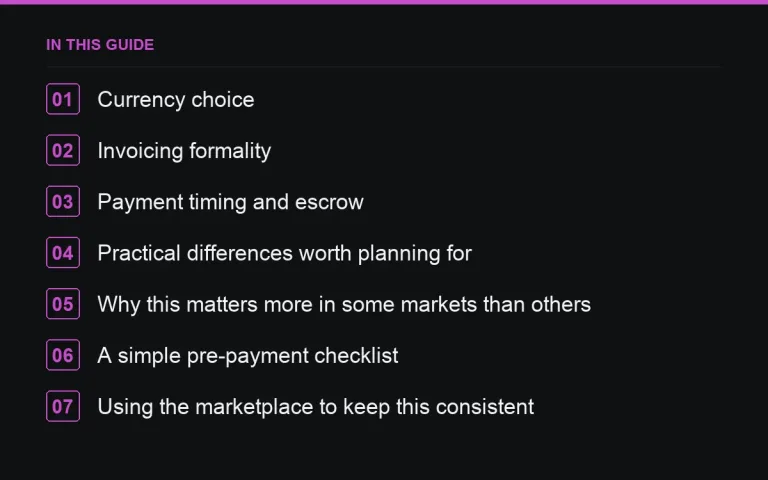
Currency choice
Many publishers in smaller or more currency-volatile markets, Turkey being a clear example, prefer to quote and invoice in USD or EUR specifically to avoid the exposure of pricing in a fluctuating local currency. EU-based publishers generally quote in euros as standard; UK publishers in pounds; and Swiss publishers separately in Swiss francs despite sharing a language region with parts of the EU. Confirm currency explicitly in any quote rather than assuming a default.
Invoicing formality
EU member states generally expect formal invoices with VAT details, reflecting standardised regional tax requirements; publishers in less formally regulated markets may work with simpler receipts or payment confirmations instead. Neither is inherently more trustworthy than the other, but your own accounting team may have requirements about what documentation they need to process a payment, so check this before committing to a publisher whose invoicing style might not fit your internal process.
Payment timing and escrow
Paying upfront in full carries more risk in markets or with publishers you don’t have an established relationship with; an escrow arrangement, where funds release once you’ve confirmed the live URL, protects both sides and is worth using as a default for new publisher relationships regardless of market. Established relationships with a track record can reasonably move to more flexible terms once trust is built.
Practical differences worth planning for
- Some markets have slower banking transfer times for cross-border payments than others; factor this into project timelines, not just the content production timeline.
- Payment method preferences vary — bank transfer is close to universal, but some smaller publishers in certain regions prefer other payment rails.
- Tax withholding requirements differ by country and by your own business’s jurisdiction; this is a genuine area to route through a tax professional rather than guess at.
- Keep records of currency and invoicing terms per publisher relationship so renewals don’t require renegotiating basics each time.
Why this matters more in some markets than others
Markets with volatile currencies, less standardised invoicing, or slower banking infrastructure benefit most from clear upfront agreement on these terms, since ambiguity is more likely to cause friction later. Markets with mature, standardised financial infrastructure — most of Western Europe, North America, Australia — generally need less upfront negotiation on this front, since defaults are well understood on both sides.
A simple pre-payment checklist
Before the first payment to any new publisher, confirm the currency, the invoicing format your accounting team needs, and whether escrow is available for that transaction — resolving all three upfront avoids the more common problem of discovering a mismatch only after content is already written and a deadline is looming.
Using the marketplace to keep this consistent
Buying through https://successtoroad.com/marketplace/ keeps currency handling and escrow consistent across markets, which is often simpler than negotiating individual payment terms with dozens of publishers directly, especially once a campaign spans several countries with different invoicing norms.
Reconciling payments across many currencies
Running placements across several currencies at once can complicate internal reporting if costs aren’t converted to one reference currency consistently. Agree on a standard conversion approach with your finance team early, whether that’s a fixed monthly rate or actual transaction rates, so campaign cost comparisons across markets stay meaningful over time.
Keep clear records of each transaction’s original currency and converted value; this makes any later reconciliation or audit far more straightforward than trying to reconstruct the detail after the fact.
A closing thought
None of the practices above substitute for proper financial and tax guidance specific to your business. Treat this as a starting checklist for planning conversations with your own finance team, not as a complete or authoritative set of rules for every jurisdiction you might work with.
Handling disputes or payment issues
When a payment issue does arise, resolve it through the agreed process — typically escrow adjudication or direct discussion with the publisher — rather than escalating immediately to a dispute. Most issues in practice turn out to be simple misunderstandings about currency, timing or invoicing format rather than genuine bad faith on either side.
Working with a centralised payment process across markets
As a campaign scales across many currencies, centralising payment processing through one internal team or system, rather than letting individual campaign managers handle payments independently, tends to reduce errors and makes it easier to spot unusual patterns or issues across the whole portfolio of publisher relationships.
Where to go next
Read https://successtoroad.com/blog/turkey-market-link-building-strategy/ for a market where currency volatility is an active planning factor, and https://successtoroad.com/blog/eastern-europe-link-building-overview/ for how EU invoicing standards play out regionally. Our https://successtoroad.com/blog/international-link-building/ guide covers the wider operational picture, and https://successtoroad.com/blog/cultural-norms-publisher-negotiations/ covers the negotiation side that often runs alongside these commercial details.
Frequently asked questions
Should I always pay in the publisher's local currency?
Not necessarily. Many publishers, especially in more volatile-currency markets, prefer to quote and invoice in USD or EUR. Confirm currency explicitly with each publisher rather than assuming a default.
Is escrow worth using for every placement?
It's a sensible default for new publisher relationships in any market, since it protects both sides until the live URL is confirmed. Established relationships with a track record can reasonably move to more flexible terms.
Do all publishers provide formal VAT invoices?
No. EU-based publishers generally do, reflecting standardised regional requirements, but publishers in less formally regulated markets may use simpler receipts. Check this against what your own accounting process requires.
Is this guide legal or tax advice?
No. It's a general planning overview only. Currency, invoicing and tax withholding requirements vary by jurisdiction, and specifics should go through your own finance, tax or compliance team.
Put it into practice
Filter 54,483 websites by DR, traffic, niche and price, and order with escrow — you pay only after the link is live.
Browse the marketplace