Choosing Between Local-Language and English Placements
How to decide, market by market, whether a guest post placement should run in the local language or in English.

This decision comes up in almost every international campaign, and the right answer varies enough by market that a blanket policy — “always localise” or “English is fine everywhere” — tends to leave value on the table either way. The honest answer is: it depends on the market’s English proficiency, the publication’s own readership, and what the content is actually for.
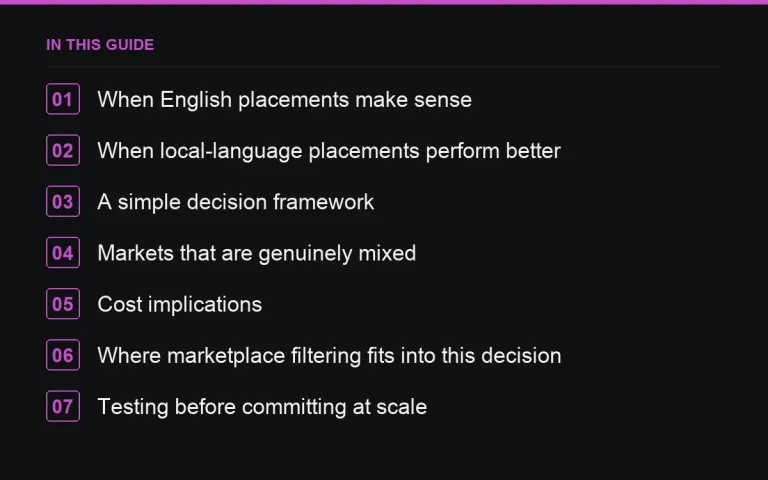
When English placements make sense
English works well on publications whose own readership is genuinely international or business-focused — trade press, fintech blogs, and outlets in markets with very high English proficiency and a business culture that already operates largely in English, such as parts of Northern Europe, Singapore, or English-heavy African markets like Nigeria and Kenya. It also makes sense when the destination page you’re linking to is itself in English and a translated placement would send readers to a mismatched landing page.
When local-language placements perform better
General consumer, lifestyle and news publishers almost always expect and perform better with local-language content, even in markets with high English proficiency, because everyday reading habits stay in-language regardless of how well readers can handle English professionally. Search behaviour follows the same pattern — people search in their own language for everyday topics far more than the English proficiency of a country might suggest.
A simple decision framework
- Check the publication’s own default language, not just the country’s general English proficiency — a business-only outlet in a highly bilingual country still might expect local-language submissions.
- Check what language the destination landing page is in, and avoid sending readers into a language mismatch after they click.
- Weigh reach against cost: local-language content usually costs more to produce well but reaches a meaningfully larger audience in most markets.
- When in doubt, ask the publisher directly rather than guessing — most editors will tell you plainly which they’d accept.
Markets that are genuinely mixed
Some markets don’t have one clean answer. Singapore, Hong Kong, and parts of Scandinavia all have publishers that comfortably accept either, depending on the specific outlet’s own positioning. In these cases, it’s worth building a small test — a handful of English and a handful of local-language placements — and comparing engagement rather than assuming based on the country’s overall profile.
Cost implications
English-only campaigns are cheaper to produce, since they avoid translation or native-writing costs, but this savings can be a false economy in markets where local-language content clearly outperforms for reach. Budget for native-language production in markets where the framework above points that way, rather than defaulting to English purely to save on content costs.
Where marketplace filtering fits into this decision
Once you’ve decided a market needs local-language content, use https://successtoroad.com/language/german/, https://successtoroad.com/language/japanese/ or the relevant language filter to build your actual shortlist, rather than filtering by country alone and then discovering later that many of the matching sites publish in a different language than expected.
Testing before committing at scale
For markets where the right call genuinely isn’t obvious, a small controlled test — several English placements and several local-language placements on comparable sites — gives a much more reliable answer than guessing from a country’s general English proficiency reputation, and the cost of a small test is minor compared to committing a full campaign budget to the wrong approach.
Documenting the decision per market
Once you’ve made this call for a given market, write the reasoning down — which factors tipped the decision, and what evidence supported it — so future team members don’t have to re-litigate the same question from scratch for a market you’ve already carefully considered. This is especially useful as a campaign scales to cover more countries over time.
Revisit the decision periodically rather than treating it as permanent; English proficiency and publisher landscapes do shift over several years, even if not within a single campaign cycle.
A closing thought
This decision is rarely permanent. As a market’s publisher landscape and your own brand’s presence there evolve, it’s worth revisiting the local-language-versus-English question periodically rather than treating an early decision as fixed for the life of the campaign.
Accounting for destination page quality
Even when a market clearly favours local-language placements, the decision can still tip toward English if your own local-language landing pages are thin or poorly maintained compared to a stronger English version. Factor the quality of your own destination content into this decision, not just the target market’s general language preferences.
Considering the competitive landscape in each market
In markets where competitors are already running strong local-language campaigns, matching that investment is often necessary just to stay visible, regardless of what a general English-proficiency assessment of the market might otherwise suggest. Checking what serious competitors are actually doing in a given market is a useful practical input alongside the more general framework discussed above.
Where to go next
Read https://successtoroad.com/blog/translating-vs-native-content-guest-posts/ for the follow-on decision once you’ve settled on localising, and https://successtoroad.com/blog/multilingual-site-link-strategy/ for how this fits into a broader multi-market plan. Our https://successtoroad.com/blog/guest-posting-swedish-sites/ and https://successtoroad.com/blog/link-building-singapore/ posts are both good examples of genuinely mixed markets discussed above, and https://successtoroad.com/blog/international-link-building/ covers the wider planning context.
Frequently asked questions
Is it ever fine to only run English placements internationally?
In specific cases — highly international trade publications, or markets with very high English proficiency and English-first business culture — yes. For general consumer and lifestyle publishers, local-language content almost always performs better.
How do I know which a specific publisher prefers?
Check the publication's own default language rather than assuming based on the country's general English proficiency, and ask the editor directly if it's not obvious from the site itself.
Does local-language content always cost more?
Usually yes, given translation or native-writing costs, but it typically reaches a meaningfully larger audience, so it's often worth the extra cost rather than a place to cut corners.
What should I do in a genuinely mixed market?
Test both: run a small number of English and local-language placements and compare engagement, rather than guessing based on the country's overall profile.
Put it into practice
Filter 54,483 websites by DR, traffic, niche and price, and order with escrow — you pay only after the link is live.
Browse the marketplace