When a Publisher Deletes Your Guest Post
A practical response plan for when a live guest post disappears without warning.
A guest post going live isn’t necessarily permanent. Sites redesign, change ownership, clean up old content, or simply decide to remove a piece months or years later. Knowing how to respond calmly, and how to reduce the odds of it happening in the first place, saves a lot of frustration.
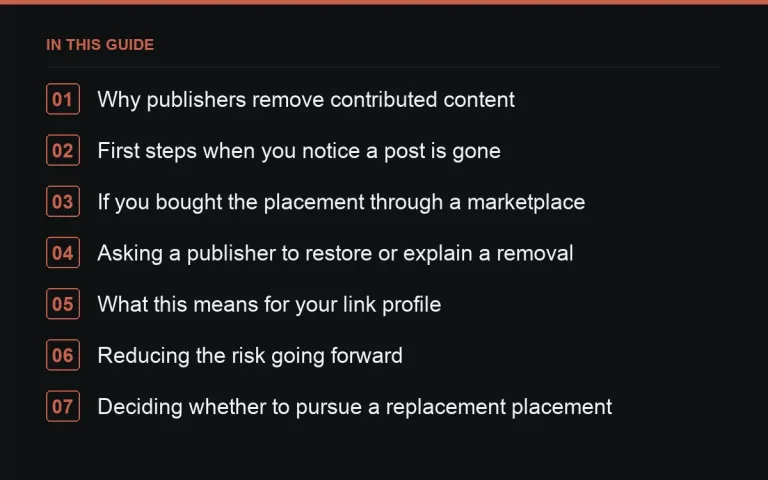
Why publishers remove contributed content
Common reasons include a site-wide content audit removing older or underperforming pages, a change in editorial policy about contributed or sponsored content, a site redesign that drops sections entirely, or in some cases the site itself shutting down or changing ownership. It’s rarely personal, and it’s rarely about your specific piece being singled out.
First steps when you notice a post is gone
- Confirm it’s actually removed, not just moved to a new URL — check for a redirect first
- Check whether other contributed content on the site has also disappeared, which suggests a policy change rather than an issue with your piece specifically
- Reach out to the editor or contact you originally worked with, if the relationship still exists
- Check your monitoring tools or weekly link checks for when the removal likely happened
If you bought the placement through a marketplace
Marketplace orders often include a weekly link monitor on completed orders specifically for this reason, and escrow or completion terms may address what happens if a purchased placement is removed within a certain window. Check the order terms and reach out through order messaging rather than assuming there’s no recourse.
Asking a publisher to restore or explain a removal
A polite, direct message asking why the piece was removed and whether it can be restored is reasonable, especially if it was a paid placement with an agreed duration. Publishers vary in responsiveness here — some will restore it without issue, others may explain a policy change that applies broadly and isn’t reversible for any single piece.
What this means for your link profile
A removed link simply stops counting toward your backlink profile going forward — it doesn’t typically cause active harm, but it does mean any value you were counting on from that placement is gone. If the link mattered to a broader campaign, this is worth factoring into how you evaluate whether that placement, or similar ones, are still worth pursuing.
Reducing the risk going forward
| Practice | Why it helps |
|---|---|
| Favour established sites with a track record over brand-new ones | Newer sites are more likely to change direction or shut down |
| Use ongoing link monitoring on completed orders | Catches removal quickly rather than months later |
| Keep records of the original agreement and terms | Useful if you need to raise the issue later |
| Diversify placements rather than concentrating value in one site | Limits the impact if any single one is removed |
Deciding whether to pursue a replacement placement
If a removed post mattered to a broader campaign, the simplest fix is often a fresh placement elsewhere rather than an extended dispute over restoring the original. Weigh the effort of pursuing a restoration against simply securing a new, comparable placement through https://successtoroad.com/marketplace/, especially if the original site’s removal reflects a broader policy shift unlikely to reverse for your specific case.
Vetting sites more carefully to begin with
A thorough vetting pass before you ever place a piece — checking a site’s history, ownership stability, and how long its existing contributed content has stayed live — reduces the odds of this happening in the first place. https://successtoroad.com/blog/how-to-evaluate-a-guest-post-site/ and https://successtoroad.com/blog/guest-post-red-flags/ both cover signals worth checking before committing budget to a new site.
Keeping your own archive of published content
Beyond monitoring the live URL, keep a saved copy of the final published text and any correspondence around the placement. If a removal does happen and a dispute or a decision about next steps follows, having your own record independent of the publisher’s site is useful, and it also gives you the option of repurposing the content elsewhere once it’s no longer live anywhere else.
Distinguishing removal from a temporary technical issue
Before treating a missing page as a genuine removal, rule out simpler explanations — a site experiencing temporary downtime, an ongoing migration, or a caching issue on your own end. Wait a day or two and check again from a different browser or network before concluding the content is actually gone rather than temporarily inaccessible, since a premature conclusion can lead to an unnecessary and awkward conversation with the publisher over something that resolves itself within a day or two on its own without any action needed from you at all.
Where to go next
Regular monitoring is the best defence here, and it pairs naturally with the broader practice covered in https://successtoroad.com/blog/checking-a-live-guest-post/. If a removal prompts you to reconsider a site relationship entirely, https://successtoroad.com/blog/renewing-guest-post-placements/ covers what a healthier, ongoing arrangement looks like by contrast.
Frequently asked questions
Is it common for guest posts to get removed after they've been live for a while?
It happens, though it's not the norm. Site redesigns, content audits, and policy changes are the most common causes, and it's rarely a reflection of the piece itself.
Can I get compensated if a paid guest post placement is removed early?
It depends on the specific terms agreed at purchase. Marketplace orders with defined terms or ongoing monitoring may offer more recourse than an informal direct arrangement with a publisher.
How would I even know if my guest post got removed?
Regular manual checks or a link monitoring tool are the most reliable ways to catch a removal promptly rather than discovering it by accident much later.
Should I ask the publisher to restore a removed post?
Yes, a polite direct request is reasonable, especially for a paid placement with agreed terms. Responses vary, but asking costs little and sometimes resolves the issue quickly.
Put it into practice
Filter 54,483 websites by DR, traffic, niche and price, and order with escrow — you pay only after the link is live.
Browse the marketplace