Guest Posting for Beginners: Your First 5 Placements
How to land your first five guest posts without wasting money on the wrong sites.
Your first guest post rarely goes the way you imagined. You send a pitch, hear nothing for a week, and start wondering whether the whole exercise is worth it. It is, but only if you treat the first five placements as a learning run rather than a campaign to win at all costs.
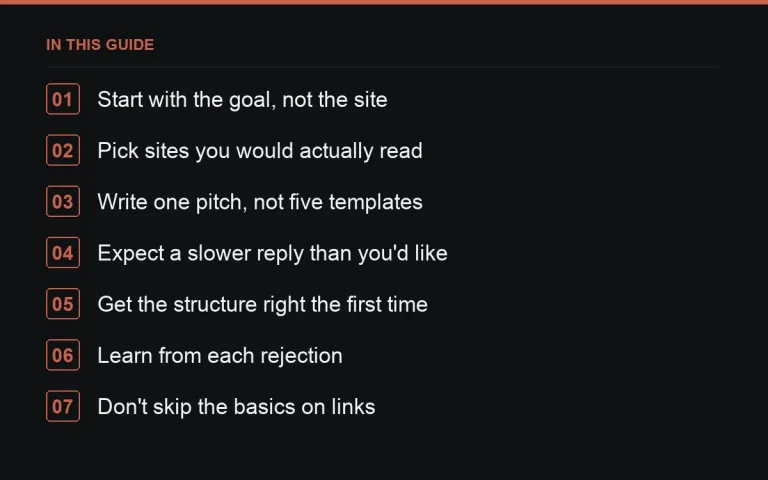
Start with the goal, not the site
Before you open a marketplace tab, decide what a guest post is supposed to do for you: referral traffic, a relevant backlink, or simply a byline you can point to. Beginners often chase domain authority numbers and ignore the fact that a mid-authority site in their exact niche will usually outperform a generic high-authority one. If you are new to the concept entirely, https://successtoroad.com/blog/what-is-guest-posting/ is worth reading first, since it lays out the mechanics you will use for every placement after this.
Pick sites you would actually read
A simple filter works better than any metric dashboard: would you bookmark this site if you were a reader in your industry, not a marketer? If the answer is no, skip it even if the price is attractive. Use https://successtoroad.com/how-it-works/ to understand how listings, filters, and orders connect, then browse https://successtoroad.com/marketplace/ with niche and traffic filters set rather than sorting by price alone.
Write one pitch, not five templates
Beginners often blast the same three-line email to twenty publishers. Editors notice. A pitch that references something specific from the site’s last few posts and proposes a title, not just a “topic idea,” gets replies far more often. See https://successtoroad.com/blog/pitching-topic-ideas-to-a-publisher/ for a workable structure you can adapt.
What a first pitch should include
- A one-line reason you’re reaching out to this specific site
- A working title, not a vague theme
- Two or three bullet points on what the post will cover
- A note on your relevant experience, if any
- No attached draft yet — wait for a yes
Expect a slower reply than you’d like
Most publishers reply within a week if they reply at all; some take longer, and a portion never respond. This is normal, not a signal that your pitch was bad. Build a simple tracker with columns for site, pitch date, status, and follow-up date, and follow up once, politely, after ten days.
Get the structure right the first time
A guest post that keeps readers past the second paragraph shares a few traits: a direct opening, short sections, and a natural place for your link rather than a bolted-on mention. Read https://successtoroad.com/blog/guest-post-structure-that-keeps-readers/ before you draft your first piece so you’re not rewriting it from scratch after an editor’s notes.
Learn from each rejection
Every “not a fit right now” is data. Note whether it was the topic, the site’s current editorial calendar, or a mismatch in tone, and adjust the next pitch. By your fifth placement you should have a much sharper sense of which sites reply, which topics land, and how long the whole cycle takes from pitch to published link.
Don’t skip the basics on links
New guest posters sometimes stuff three or four links into a 700-word post and wonder why it gets rejected. One contextual link, sometimes two, is the norm for a first placement. https://successtoroad.com/blog/how-many-links-per-guest-post/ covers the reasoning if you want the full picture.
Set a realistic budget before you commit
Beginners often either overspend on the first site they find or refuse to pay anything at all, and both extremes cause problems. Set a modest budget for your first few placements, treat it as tuition for learning how the process actually works, and resist the urge to negotiate hard on price before you’ve even confirmed the site is a good fit. https://successtoroad.com/blog/guest-post-pricing/ explains what typically drives cost differences between listings, which helps you avoid overpaying for a site that isn’t actually a strong match.
Keep a simple record of everything
From your very first pitch, log the site, the date, the topic, the outcome, and the live URL once published. This sounds like overkill for five placements, but the habit pays off the moment you’re managing fifteen or twenty, and it also gives you a factual basis for judging which types of sites and topics actually work for you rather than relying on memory or impression.
A basic beginner tracker
| Column | Purpose |
|---|---|
| Site and contact | Avoid duplicate or repeat pitches |
| Pitch date and topic | Know when to follow up and on what |
| Status | Pitched, accepted, drafting, live, rejected |
| Live URL and date | Basis for later traffic checks |
Common early mistakes worth avoiding
Beyond the ones already covered, a few other patterns trip up beginners specifically. Some try to write about a topic they don’t actually know well simply because it seems easy to place, which tends to produce thin, generic content that editors can spot immediately. Others get discouraged after two rejections and either give up or start compromising heavily on site quality just to get something published. Neither serves you well — a modest pace with genuinely relevant topics on genuinely relevant sites beats a rushed volume-first approach every time, especially early on when you’re still learning what works.
Why your first placements shouldn’t be your only marketing effort
Guest posting takes time to compound, so treat your first five placements as one input among several rather than your entire visibility strategy while you’re getting started. This keeps expectations realistic and takes pressure off any single pitch succeeding, which paradoxically tends to produce better, more patient pitches in the first place.
Where to go next
Once your first five placements are live, shift from learning mode to a repeatable process: a shortlist of sites, a pitch template you actually customise, and a QA pass before submission using https://successtoroad.com/blog/guest-post-checklist-for-qa/. From there, scaling up is mostly a matter of discipline, which https://successtoroad.com/blog/scaling-guest-posting/ covers in more depth.
Frequently asked questions
How many guest posts should a beginner send pitches to before expecting a yes?
There's no fixed number, but expect a reply rate well under half. Pitching ten to fifteen well-matched sites to land your first two or three acceptances is a realistic starting expectation for most niches.
Should beginners pay for their first guest post or only pitch for free?
Both are reasonable. Paid placements on vetted sites remove a lot of the uncertainty around reply times and quality, while free pitching teaches you how editors think. Many people do both in parallel.
What's the biggest mistake first-time guest posters make?
Writing the full draft before getting a yes on the topic. It wastes time when the pitch is rejected and makes writers reluctant to change direction even when an editor asks for one.
Is domain authority the right metric to filter sites by as a beginner?
It's one signal among several. Real traffic, topical relevance, and editorial standards matter more for a first placement than a high authority score on a site with little active readership.
Put it into practice
Filter 54,483 websites by DR, traffic, niche and price, and order with escrow — you pay only after the link is live.
Browse the marketplace