How Editors Judge a Guest Post Submission
The criteria editors quietly apply when deciding whether to accept your guest post.
Writers often assume a guest post gets judged purely on writing quality. In practice, editors are running a wider checklist, much of it unspoken, and understanding it changes how you should prepare a submission from the start.
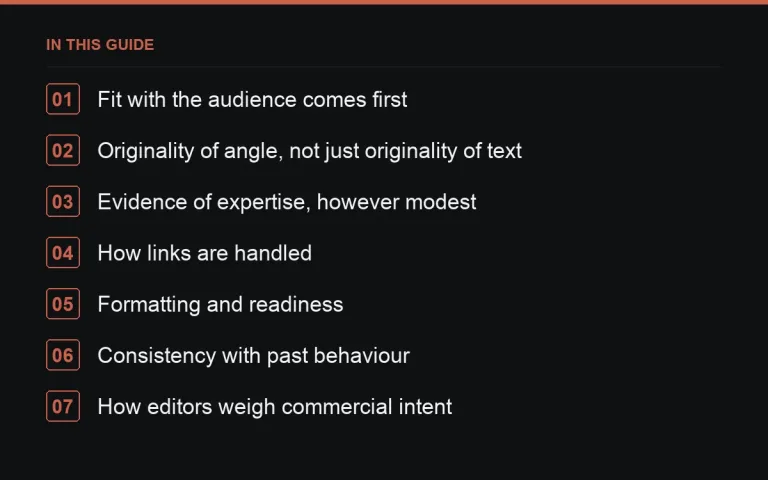
Fit with the audience comes first
Before an editor reads a single sentence for quality, they’re asking whether the topic and angle fit their readership. A well-written piece on the wrong subject for the site gets rejected faster than a rougher piece that’s clearly right for the audience. This is why research before pitching, covered in https://successtoroad.com/blog/pitching-topic-ideas-to-a-publisher/, matters more than most writers expect.
Originality of angle, not just originality of text
Plagiarism checks catch copied text, but editors are also screening for a more subtle problem: a topic that’s technically original wording but says nothing the site hasn’t already covered five times. A fresh angle on a familiar topic reads better than a generic take on a novel one.
What editors commonly check, in rough order
- Does the topic fit our audience and haven’t we covered it recently?
- Is the writing clear and does it read like a real person wrote it?
- Are claims specific and, where relevant, sourced?
- Is the link placement natural or does it read as an ad?
- Does the author have a credible reason to be writing on this topic?
Evidence of expertise, however modest
You don’t need to be a recognised authority, but editors look for signals that you know the subject beyond surface level — specific examples, a clear point of view, or details that a generic content mill wouldn’t include. A bio that briefly states relevant experience helps here.
How links are handled
Editors scrutinise link placement closely because it’s the part most likely to be abused. A single contextual link supporting a specific claim reads as normal; several links clustered around commercial anchor text reads as a paid placement dressed up as editorial content, and many sites will reject or heavily edit this regardless of how good the writing is. See https://successtoroad.com/blog/anchor-text-strategy/ for how to keep this natural.
Formatting and readiness
A draft that arrives with proper headings, no leftover placeholder text, and clean formatting signals professionalism before the editor reads a word. A messy draft, even with good ideas inside it, adds friction that makes rejection more likely simply because it’s more work to fix.
Consistency with past behaviour
Publishers who’ve worked with you before, or seen your work on other reputable sites, extend more trust on subsequent pitches. This is part of why building a track record across a handful of quality sites compounds over time, as described in https://successtoroad.com/blog/scaling-guest-posting/.
How editors weigh commercial intent
Every editor accepting contributed content is implicitly balancing their audience’s trust against the practical reality that guest content often carries some commercial purpose. What they’re screening for isn’t the presence of commercial intent itself — that’s expected and normal — but whether it’s handled with restraint. A submission that reads as genuinely useful first and promotional second passes this test; one that reads as an advertisement wearing an article’s clothing doesn’t, regardless of how the pitch itself was framed. Buyers browsing https://successtoroad.com/marketplace/ for placements are, in effect, shopping for sites whose editors apply this standard consistently, since that consistency is what keeps a site’s link value intact over time.
Why some acceptable submissions still get held back
Occasionally a genuinely good submission doesn’t get published quickly, not because it failed any of the above criteria, but because the site’s editorial calendar is full, a very similar piece is already scheduled, or the editor wants to sit with a borderline decision a little longer. This can look identical to a quiet rejection from the outside, which is one more reason a polite, limited follow-up is worthwhile before assuming the worst.
How a single bad experience can colour future judgment
Editors, like anyone, remember difficult past interactions. A contributor who argued aggressively over a minor style edit, missed an agreed deadline without communication, or turned out to have exaggerated their background tends to get a more skeptical read on their next submission, even a strong one. This is part of why the professionalism side of a submission matters as much as the writing itself — reputational effects compound in both directions over repeated interactions with the same editor.
What newer editors weigh differently than veterans
A newer editor, still establishing their own judgment, may lean more heavily on visible signals like credentials or polish than a veteran editor who can spot substance quickly regardless of surface presentation. This isn’t a hard rule, but it’s worth being slightly more thorough with formal signals — a complete bio, clean formatting, clear sourcing — when you’re unsure how experienced the person reviewing your submission actually is.
Where to go next
If you want to see this from the buying side rather than the writing side, https://successtoroad.com/blog/how-to-evaluate-a-guest-post-site/ covers how to judge publishers the way editors judge submissions. And once you understand what editors look for, https://successtoroad.com/blog/guest-post-checklist-for-qa/ turns that into a concrete pre-submission checklist you can reuse every time.
Frequently asked questions
Do editors run every guest post submission through plagiarism software?
Many do, especially larger or more established publications. Even where they don't use software, an experienced editor can usually spot recycled or overly generic content on read-through.
How much does an author's background matter compared to the writing itself?
It matters as supporting context rather than a gatekeeping requirement. Strong, specific writing from someone without formal credentials often outperforms weak writing from an established expert.
What's the fastest way to get rejected by an editor?
Pitching or submitting a topic that's clearly a rehash of the site's own recent content, or including link placement that reads as promotional rather than editorial.
Do smaller publishers apply the same standards as larger ones?
Generally yes, though the process may be less formal. A smaller site with genuine traffic and an engaged readership often applies just as much editorial care as a larger one.
Put it into practice
Filter 54,483 websites by DR, traffic, niche and price, and order with escrow — you pay only after the link is live.
Browse the marketplace