Guest Posting for Consultants and Advisors
A guest posting approach built around demonstrating expertise rather than selling services directly.

Consultants face a particular tension in guest posting: the content needs to demonstrate real expertise to attract clients, but anything that reads as a sales pitch tends to get rejected by editors and ignored by readers. Getting this balance right is the whole game.
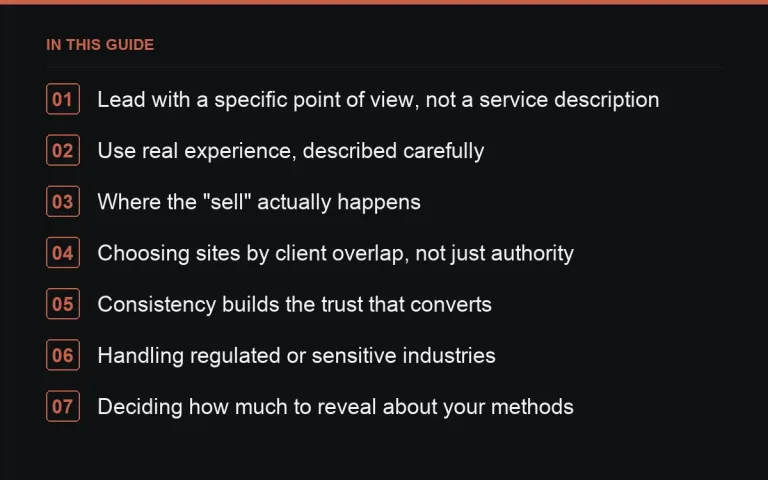
Lead with a specific point of view, not a service description
The strongest consultant guest posts stake out a clear position on how something should be done, ideally one that differs slightly from conventional wisdom in the field. This does more to build credibility than a broad overview of “what consultants like me can help with,” which reads as marketing copy rather than insight.
Use real experience, described carefully
You can draw on client work without naming clients or fabricating specifics you don’t actually have permission to share. Describe a pattern you’ve seen across engagements, a common mistake, or a framework you’ve developed — anonymised and generalised is both more ethical and often more useful to readers than a single named case study would be.
What editors expect from consultant contributors
- Insight that couldn’t have come from a generic content writer
- No direct pitch for services within the body of the piece
- A bio that states expertise without an explicit sales call-to-action
- Willingness to have the piece edited like any other contribution
Where the “sell” actually happens
The author bio, not the body, is where a reader interested in working with you follows through. Keep the body entirely focused on delivering value, and let the bio do the modest work of pointing to your site or contact page. https://successtoroad.com/blog/guest-post-author-bio/ covers how to phrase this without it reading as an ad.
Choosing sites by client overlap, not just authority
A consultant’s ideal guest post site is one your actual prospective clients read, which may be a trade publication or niche industry blog rather than a general marketing site. Filter https://successtoroad.com/marketplace/ by your specific vertical — https://successtoroad.com/niche/business/, https://successtoroad.com/niche/finance/, https://successtoroad.com/niche/marketing/, or your industry — rather than defaulting to the highest-authority generalist options.
Consistency builds the trust that converts
One guest post rarely generates client inquiries on its own. A pattern of appearing regularly with substantive insight on a small number of respected industry sites builds the kind of recognition that eventually does convert. This mirrors the personal-brand logic in https://successtoroad.com/blog/guest-posts-for-personal-brands/, applied specifically to a consulting practice.
Handling regulated or sensitive industries
If you consult in finance, health, legal, or another regulated field, be especially careful about the line between general guidance and specific advice that could be read as professional recommendations to an individual reader. https://successtoroad.com/blog/guest-posting-in-regulated-industries/ covers the general considerations to keep in mind.
Deciding how much to reveal about your methods
Consultants often worry that sharing a genuinely useful framework in a guest post gives away their intellectual property for free. In practice, sharing the “what” and even a fair amount of the “how” rarely replaces the value of hiring someone to actually apply it to a specific, complicated situation — and doing so demonstrates competence far more convincingly than a vague, guarded piece that withholds anything substantive. Reserve genuinely proprietary specifics for paying engagements, but don’t be so protective that the public piece reads as empty.
Writing for a technical versus a business audience
The same consulting expertise often needs two different treatments depending on the publisher: a technical, practitioner-facing site wants depth and precision, while a business-focused site wants the implications and outcomes explained in plainer terms. Recognise which audience a given site serves before adapting your usual material, rather than submitting the same technical depth everywhere regardless of fit.
Avoiding the appearance of conflict of interest
If you’re writing about a category where you or your firm has a direct financial stake beyond general consulting fees — a specific tool you’ve built, a partnership you hold — disclose it plainly rather than presenting the piece as neutral commentary. Readers and editors both respond better to an upfront, brief disclosure than to discovering an undisclosed interest later, which can undo the credibility a well-written piece was meant to build in the first place.
Adjusting your approach across different career stages
An early-career consultant may lean more on frameworks and observed patterns since a long track record isn’t available yet, while a more established consultant can draw on a longer arc of experience across many engagements. Neither position is a disadvantage in guest posting specifically — editors respond well to genuine insight regardless of how many years it took to develop, as long as it’s presented honestly relative to your actual stage.
Where to go next
Once you’ve placed a few pieces, track which ones actually generate inquiries, not just traffic — https://successtoroad.com/blog/measuring-a-guest-posts-traffic/ covers how. And if a particular site’s audience responds well, ask about a recurring arrangement rather than treating each pitch as a one-off; https://successtoroad.com/blog/recurring-guest-post-columns/ explains how that conversation typically goes.
Frequently asked questions
Can I mention my consulting services directly within a guest post's body?
Generally no. Most editors reject content that reads as a direct pitch within the body. Keep that to your author bio, where a modest, non-pushy mention is expected and accepted.
Is it okay to reference client work in a guest post?
Yes, if anonymised and generalised, without naming clients or sharing details you don't have clear permission to disclose. Describe patterns or lessons rather than specific confidential engagements.
Which sites are best for consultant guest posting?
Industry-specific trade publications or niche blogs your actual prospective clients read, generally outperform generic high-authority marketing sites for building consulting credibility.
How many guest posts does it typically take to see business results?
There's no fixed number, and results vary widely. A consistent pattern of substantive contributions over months tends to build the recognition that eventually generates inquiries, rather than any single post.
Put it into practice
Filter 54,483 websites by DR, traffic, niche and price, and order with escrow — you pay only after the link is live.
Browse the marketplace