One Great Guest Post Site or Five Average Ones?
A framework for choosing between one standout placement and several mid-tier ones on the same budget.

Give ten marketers the same guest posting budget and you’ll get two camps: those who put it all behind one exceptional site, and those who spread it across four or five decent ones. Both approaches work, but they solve different problems, and confusing the two is where campaigns go wrong.
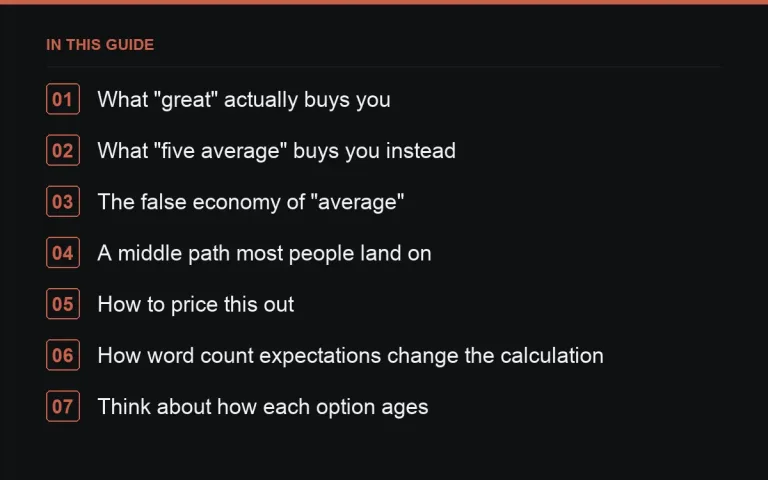
What “great” actually buys you
A genuinely great site — strong real traffic, an engaged audience in your exact niche, high editorial standards — gives you three things a cluster of average sites can’t match individually: durable referral clicks, a link an editor reviewed carefully rather than rubber-stamped, and association with a brand readers already trust. If your goal is one flagship link you’ll point to for years, this is the stronger play. Use compare tools at https://successtoroad.com/compare/ to line up candidates side by side before committing budget.
What “five average” buys you instead
Spreading budget across several average sites trades depth for breadth. You get a more natural-looking backlink profile, exposure to five different audiences instead of one, and faster overall turnaround since you’re not waiting on a single editor’s calendar. This is closer to how https://successtoroad.com/blog/anchor-text-strategy/ describes building a varied profile rather than concentrating everything on one anchor and one domain.
When five average sites make more sense
- You’re building topical coverage across a category, not chasing one keyword
- Your link profile currently leans heavily on one or two domains already
- You need placements this month, not whenever one elite editor has a slot
- The content you’re placing is genuinely useful in several adjacent niches
When one great site makes more sense
- You’re launching something and want a single credible mention to point people to
- The site’s audience overlaps almost exactly with your customer profile
- You have one strong piece of content that deserves a serious home, not a quick placement
The false economy of “average”
Average sites bought purely because they’re cheap and fast can quietly hurt more than they help if their traffic is thin or their content quality is inconsistent. https://successtoroad.com/blog/guest-post-red-flags/ is worth reading before you commit to five sites you haven’t vetted individually — a low price on its own tells you nothing about whether the placement is worth having.
A middle path most people land on
In practice, a mixed approach often wins: one strong anchor placement per quarter, supplemented by several solid mid-tier posts in between. This mirrors how https://successtoroad.com/blog/scaling-guest-posting/ describes sustainable growth — a small number of standout pieces surrounded by consistent, respectable ones, rather than an all-or-nothing bet.
How to price this out
Before deciding, pull actual numbers. Filter https://successtoroad.com/marketplace/ by your niche and compare the total cost of one top-tier site against a bundle of four or five solid ones. https://successtoroad.com/blog/guest-post-pricing/ explains what typically drives the difference in cost between them, which helps you judge whether the premium for the single great site is proportionate.
How word count expectations change the calculation
A great site may also expect a longer, more thoroughly researched piece than an average one would, which changes your effective cost once writing time is factored in, not just the placement fee. Before committing, check https://successtoroad.com/blog/guest-post-word-count/ against each candidate site’s actual requirements — a single 2,000-word feature for one premium site can take as long to produce as three shorter pieces for average sites combined, which shifts the true cost comparison more than the sticker price alone suggests.
Think about how each option ages
A single great placement tends to hold its value for years if the site remains healthy, while a batch of average placements is more exposed to any one of those sites declining, changing ownership, or being deprioritised by the publisher over time. Neither risk is eliminated by picking one strategy over the other, but it’s worth weighing durability alongside upfront cost when you’re deciding where to put your budget.
How your stage of growth should influence the choice
An early-stage brand with little existing authority often benefits more from breadth — several average placements build a foundation of relevance and varied signals faster than waiting for one perfect opportunity. A more established brand with an already healthy link profile can afford to be pickier, holding out for the genuinely great site because the marginal value of another average placement is lower at that stage. Recognising which situation you’re in changes which side of this trade-off makes more sense right now, even if the answer shifts again in a year.
Revisiting the decision as circumstances change
The right answer here isn’t fixed. A brand that spent a year building breadth through average sites may reach a point where a single flagship placement delivers more marginal value than a sixth average one would. Treat this as a decision to revisit periodically rather than a one-time strategic commitment.
Where to go next
Whichever path you choose, don’t decide on gut feel alone. Cross-reference candidate sites against your existing backlink profile, check https://successtoroad.com/blog/how-to-evaluate-a-guest-post-site/ for a full vetting checklist, and revisit the decision every few months as your goals shift from launch visibility to steady authority building.
Frequently asked questions
Is it ever wasteful to pay a premium for one great site over five average ones?
Only if the great site's audience doesn't actually overlap with yours. A premium placement on a site your customers don't read is a worse buy than several relevant average ones, regardless of authority metrics.
Can I combine both approaches in the same quarter?
Yes, and many experienced buyers do exactly that: one flagship placement to anchor the quarter, plus a handful of solid mid-tier posts to keep the link profile active and varied.
Does Google penalise a link profile built from several average sites?
Not inherently. What matters is that the sites carry real traffic and editorial standards, not novelty. A profile built entirely from thin, low-traffic sites is the actual risk, not the number of domains.
How do I compare candidate sites objectively rather than by gut feel?
Use a side-by-side compare tool with DA, DR, traffic, and price columns, and check each site's content quality manually. Numbers alone miss whether the audience is genuinely engaged.
Put it into practice
Filter 54,483 websites by DR, traffic, niche and price, and order with escrow — you pay only after the link is live.
Browse the marketplace