Running a Guest Post Series Across Multiple Sites
A framework for structuring one topic into a coordinated series across multiple sites.
Instead of pitching one disconnected guest post to five different sites, some marketers structure a single broader topic into a coordinated series — related pieces, each tailored to a different publisher’s audience, that reinforce each other without duplicating content.
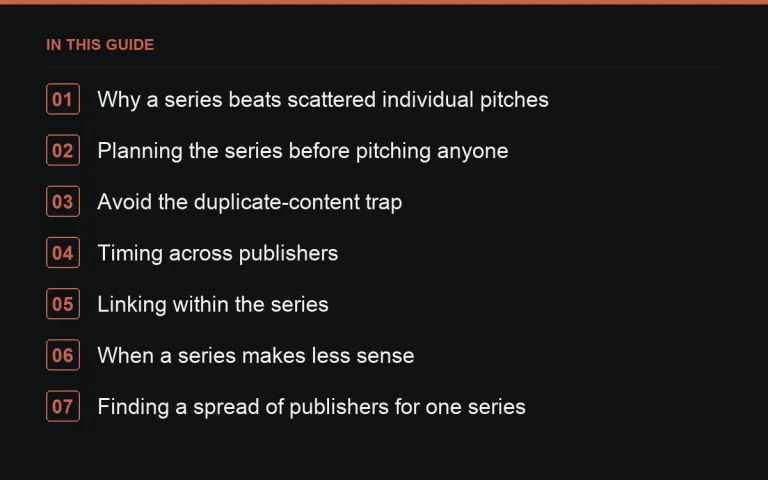
Why a series beats scattered individual pitches
A coordinated series lets you go deeper on a subject than any single post could, while giving each publisher a genuinely distinct angle rather than a version of the same generic piece. It also creates a natural reason to cross-reference your own work — mentioning that a related angle appeared elsewhere, without duplicating the actual content.
Planning the series before pitching anyone
Start by mapping the broader topic into three to five genuinely distinct angles, each suited to a different type of publisher. A series on remote work management, for instance, might split into: a piece on hiring practices for a business site, one on tools and workflow for a tech blog, one on team culture for an HR-focused publication, and one on productivity habits for a general lifestyle site. Each stands alone but shares a common thread.
Steps to structure a series
- Define the overarching theme and three to five distinct sub-angles
- Match each angle to a specific type of publisher and audience
- Pitch each site individually — never mention the “series” framing to publishers unless they ask
- Keep each piece genuinely self-contained, not a chapter that needs the others to make sense
- Track publication order so nothing feels redundant if the same reader sees more than one
Avoid the duplicate-content trap
Each piece needs its own structure, examples, and framing — not the same paragraphs with swapped headlines. Beyond the ethical issue, publishers and search engines can both recognise near-duplicate content across sites, which undermines the whole point of the exercise. Treat each piece as an independent article that happens to share a broader theme, not a reskin of the same draft.
Timing across publishers
Different sites will have different editorial timelines, so a series rarely publishes in a neat, coordinated sequence — accept that and plan for it rather than trying to force simultaneous publication. Use a simple tracker with target angle, target site, pitch date, and status for each piece in the series.
Linking within the series
You generally can’t link from one guest post to another guest post you’ve placed elsewhere — that’s not something most publishers will allow, and it reads as self-promotional. Instead, each piece should link back to your own site or a relevant marketplace resource individually, following the standard guidance in https://successtoroad.com/blog/how-many-links-per-guest-post/.
When a series makes less sense
If you don’t genuinely have three or more distinct angles on a topic, forcing a series produces thin, repetitive pieces. A single strong post, well-placed, beats a stretched series padded to hit an arbitrary number of instalments.
Finding a spread of publishers for one series
A series depends on access to genuinely different types of publishers, which is where broad research pays off. Rather than pitching sites at random, map your sub-angles against categories on https://successtoroad.com/marketplace/ — https://successtoroad.com/niche/business/, https://successtoroad.com/niche/technology/, https://successtoroad.com/niche/marketing/, or whichever verticals match your specific angles — and shortlist two or three realistic candidates per angle before you start pitching, so a single rejection doesn’t stall that part of the series entirely.
Keeping the whole series organised
Beyond a basic tracker, it helps to keep a shared reference document summarising each angle’s core argument and key points, so that as pieces get drafted and edited across different sites and different weeks, the underlying consistency of the broader theme doesn’t drift. This matters more the longer the series runs and the more time passes between the first and last piece going live.
Deciding whether to summarise the series afterward
Once every piece in a series is live, it can be worth writing a short recap on your own site or blog, linking out to each individual placement. This isn’t duplicating the content — it’s a distinct, original piece that helps your own audience discover the full body of work, and it gives you one more place to make the underlying theme’s overall argument in your own words.
Reusing research across the series efficiently
Since every piece in a series shares an underlying topic, research and source material gathered for one angle often informs another, which can meaningfully speed up drafting once the first piece or two is complete. Just make sure each piece still applies that shared research to its own distinct angle rather than repeating the same points across multiple instalments.
Where to go next
Once you’ve placed a series, https://successtoroad.com/blog/measuring-a-guest-posts-traffic/ helps you see which angle and which publisher performed best, which is useful intelligence for planning the next one. If any of the sites respond particularly well, https://successtoroad.com/blog/recurring-guest-post-columns/ covers turning that single relationship into an ongoing arrangement.
Frequently asked questions
Should I tell publishers their piece is part of a wider series?
Generally not necessary, and sometimes better left unmentioned unless asked. What matters to the publisher is that the piece pitched to them is well-suited to their specific audience.
How do I avoid duplicate content across a guest post series?
Give each piece its own structure, examples, and framing built specifically for that angle and audience, rather than reusing paragraphs or a shared skeleton across the series.
Can guest posts in a series link to each other?
Usually not directly, since publishers rarely allow links to another guest post you've placed elsewhere. Link each piece back to your own site or a relevant resource instead.
How many angles does a topic need before a series makes sense?
At least three genuinely distinct angles is a reasonable minimum. Fewer than that, and a single well-developed post is usually a better use of the same effort.
Put it into practice
Filter 54,483 websites by DR, traffic, niche and price, and order with escrow — you pay only after the link is live.
Browse the marketplace