Link Building for Travel Sites
Travel is full of beautiful blogs with no real readers. Here is how travel businesses find links that bring authority and bookings.
Travel is one of the most saturated niches in guest posting — there are more travel blogs offering sponsored placements than almost any other category, and a large share of them exist mainly to sell links rather than to serve readers. That said, travel also offers some of the best genuine linking opportunities around: destination knowledge, seasonal data and local partnerships that competitors in other industries simply can’t replicate.
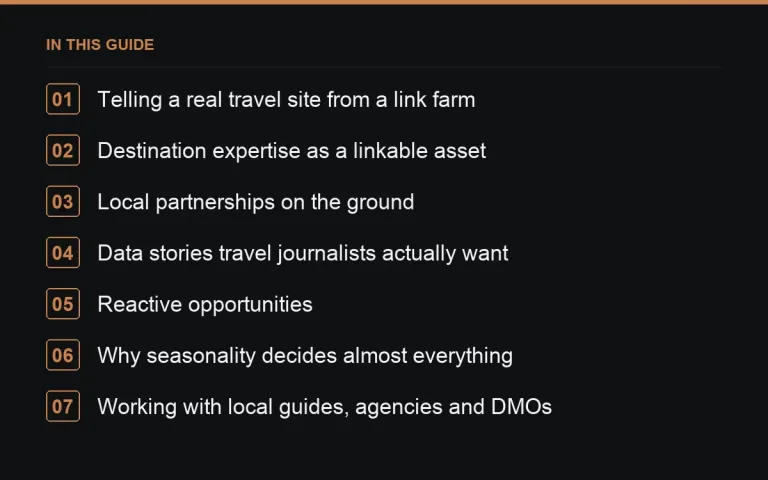
Telling a real travel site from a link farm
When browsing the travel niche, look for first-hand content with original photography rather than stock images, organic traffic actually coming from the markets you sell to, a clear focus that matches your offer — luxury, family, adventure, or a specific region — and a limited amount of obviously sponsored content in the last few months of posts. If every recent article reads like “10 best things to do in…” built around one commercial link, that’s a link farm wearing a travel blog’s clothes.
Destination expertise as a linkable asset
Deep, genuinely first-hand destination guides earn links from other travel writers, forums and local organisations in a way that generic, research-only content never does. If your team has staff who actually live in or regularly visit the destinations you cover, that local knowledge is a real competitive advantage — use it instead of outsourcing to generalist writers.
Local partnerships on the ground
- Hotels, attractions, restaurants and tour guides you work with often maintain a partners or recommended-suppliers page.
- Tourism boards and destination marketing organisations sometimes feature operators they’ve vetted.
- Local events and festivals you sponsor or take part in are a natural, low-effort source of links.
Data stories travel journalists actually want
Cheapest destinations by season, price movements on popular routes, travel trends drawn from your own booking data, accessibility rankings for specific destinations — these are the recurring story types travel desks return to. Timing matters here more than in most niches: pitch summer destination stories in early spring, not in June (running a data PR campaign).
Reactive opportunities
Strikes, new entry requirements, extreme weather and currency swings create constant, recurring demand for a qualified travel voice able to comment quickly (reactive PR).
Why seasonality decides almost everything
Travel demand is seasonal, and editorial planning follows the same rhythm. Journalists commission summer features in early spring and winter-sun roundups in late summer. Build a calendar around your own peak booking periods and work backwards: publish and promote destination content two to three months before demand peaks, giving it time to be crawled, gather links and rank before people start actively searching.
The same discipline applies to placements. A guest post about autumn city breaks that goes live in October has already missed the window — order it in July instead.
Working with local guides, agencies and DMOs
Destination marketing organisations, local tourist boards and regional agencies often maintain resource pages or approved-operator lists that are genuinely valuable links, but access to them usually depends on an actual working relationship rather than a cold outreach email. If you run tours or accommodation in a specific region, attending local tourism board meetings, joining regional trade associations, or simply introducing yourself in person during a quiet season tends to open doors that outreach alone doesn’t. These relationships also feed back into content: local guides and DMO staff are often willing to be quoted or interviewed, which gives your destination content a level of authenticity generic research can’t match.
Independent local guides and small tour operators are worth treating as partners rather than competitors where your offers don’t overlap directly. A cross-referral arrangement — you mention their walking tour, they mention your accommodation — is a natural, low-friction way to build genuinely relevant links between businesses serving the same destination.
None of this scales as quickly as a bulk outreach campaign, and that’s rather the point: a small number of relationships built on actual local knowledge tend to survive algorithm updates and changes in editorial staff far better than a large number of transactional placements bought at speed.
Measuring bookings, not just rankings
Travel sites often chase high-volume, inspirational keywords that rank easily and convert poorly. When you assess results (a framework for measuring link building ROI), look at which destination and product pages actually generate enquiries and bookings, and weight future link building toward the content that supports those, not just the pages that rank.
Where to go next
If you sell to more than one market, build links from sites published in each market’s language, such as German or Spanish publications, to support the corresponding language version of your site. For the retail side of seasonal timing, the same principles show up in ecommerce link building, and for local partnership tactics that translate well to tour operators with a physical base, see link building for local service businesses.
Frequently asked questions
Are travel blog guest posts worth paying for?
From blogs with real, relevant audiences and recent original content, yes. A large share of travel blogs are effectively sponsored-post farms, so vet each one individually before paying.
What kind of content earns links in the travel niche?
First-hand destination guides, practical resources like packing or visa guides, and data stories tied to a specific travel season tend to perform best.
Should travel companies build links in more than one language?
Yes, if they actively sell in more than one market. Links from publishers in each market's language support the equivalent language version of the site.
How far ahead should I pitch seasonal travel content?
Two to three months before the season you're targeting is a reasonable rule of thumb, giving journalists time to plan and your own pages time to rank.
Put it into practice
Filter 54,483 websites by DR, traffic, niche and price, and order with escrow — you pay only after the link is live.
Browse the marketplace