Guest Post SLAs and Delivery Times: What to Expect
A realistic breakdown of guest post delivery timelines and what counts as a fair SLA.

One of the most common sources of frustration in guest posting isn’t quality — it’s timing. Buyers expect a link within days; publishers work on their own editorial calendars. Setting realistic expectations upfront avoids most of the disputes that follow.
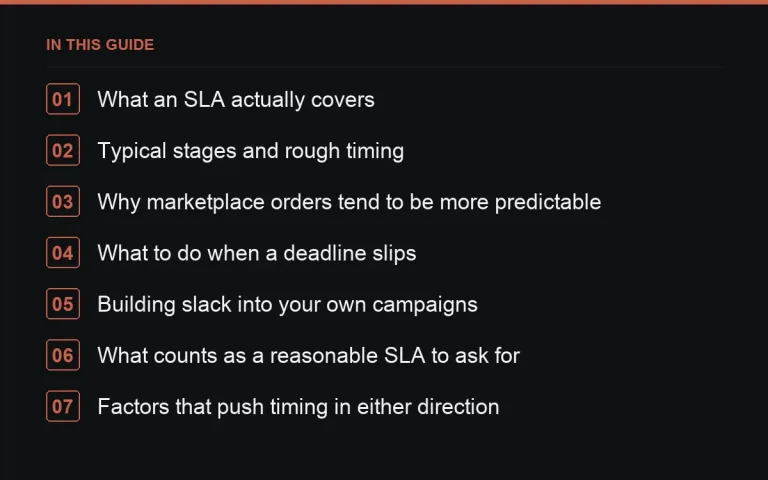
What an SLA actually covers
A service-level agreement for a guest post order should specify at minimum: how long content review takes, when the draft goes live if approved without changes, how revisions affect the timeline, and what happens if the deadline is missed. Marketplace orders often have this built in; direct pitches to publishers usually don’t, which is where most timing disputes originate.
Typical stages and rough timing
| Stage | Typical range |
|---|---|
| Pitch response | A few days to two weeks |
| Draft review | Several days to a week |
| Revisions, if requested | Adds several more days per round |
| Publishing after approval | Same day to a couple of weeks, depending on the site’s calendar |
These ranges vary widely by publisher size and how backed up their editorial calendar is. https://successtoroad.com/blog/guest-post-turnaround-times/ goes deeper on the factors that push timing toward the fast or slow end.
Why marketplace orders tend to be more predictable
Buying through https://successtoroad.com/marketplace/ generally comes with clearer expectations because the listing itself states typical turnaround, and escrow means funds aren’t released until the live URL is approved — which gives both sides a reason to keep the process moving. Direct outreach to publishers who don’t run a formal process can be faster or much slower, with far less predictability either way.
What to do when a deadline slips
- Check whether the delay is on the content review side or the publishing side — they need different follow-ups
- Send one clear, polite check-in rather than repeated messages
- If using order messaging on a marketplace, keep the conversation there so there’s a record
- Set a reasonable new expectation together rather than assuming the worst
Building slack into your own campaigns
If your guest post is tied to a launch date or a time-sensitive campaign, don’t schedule the placement for the exact week you need it live. Build in at least two to three weeks of buffer, especially for a new relationship with a publisher you haven’t worked with before.
What counts as a reasonable SLA to ask for
Asking a publisher to commit to a specific turnaround for review and publishing is reasonable, especially for a paid placement. Asking them to guarantee a same-day turnaround for editorial review, however, usually isn’t — quality review takes time, and rushing it tends to produce worse editorial decisions on both sides.
Factors that push timing in either direction
A publisher’s typical turnaround isn’t fixed — it shifts with the season, their current backlog, and how many people are involved in sign-off. A small blog run by one person can sometimes turn a piece around faster than a larger site simply because there’s no queue to sit in, while a larger site with more traffic and a formal process may take longer but deliver more consistent quality control. Neither pattern is universal, which is why checking a specific publisher’s track record matters more than assuming based on size alone.
Questions worth asking before you commit to a timeline
- How many contributed pieces do they typically publish per week or month?
- Is there a current backlog, and if so, roughly how long is it?
- Who besides the editor needs to sign off before publishing?
- What happens to the agreed timeline if a revision round is needed?
Documenting the agreed timeline in writing
Even an informal email confirming the expected stages and rough dates gives both sides something concrete to refer back to if things slip. This doesn’t need to be a formal contract for most placements, but a short written summary avoids the kind of misremembered expectations that cause frustration on both sides later.
How volume affects a publisher’s typical pace
A publisher juggling many simultaneous contributor relationships will naturally take longer per piece than one working with just a handful of regular writers, simply due to the queue. This isn’t a reflection of how much they value your specific contribution, and it’s worth asking directly about current volume if a normally responsive publisher suddenly seems to be moving more slowly than usual.
Handling multiple concurrent orders across different sites
If you’re running several guest post orders at once across different publishers, each with its own pace, keep the timelines separate in your tracking rather than assuming they’ll move in lockstep. Trying to force a uniform expectation across genuinely different publishers usually just produces frustration when one inevitably moves faster or slower than the others.
Where to go next
If timing keeps slipping across multiple orders, it may be less about individual publishers and more about your own process. https://successtoroad.com/blog/guest-posting-workflow-for-a-team-of-three/ covers how to structure pitching, writing, and follow-up so delays get caught early instead of discovered at the deadline, and https://successtoroad.com/blog/renewing-guest-post-placements/ covers what changes once you’ve built a track record with a given site.
Frequently asked questions
What's a reasonable turnaround time to expect for a guest post order?
It varies by publisher, but most reply to an initial pitch within a week and publish an approved draft within one to two weeks after that, sometimes faster for smaller sites.
Does escrow help with delivery timing disputes?
Yes. Escrow ties fund release to the buyer approving the live URL, which gives publishers a direct incentive to keep the process moving rather than letting it stall indefinitely.
Should I build a time buffer into launch-tied guest post campaigns?
Yes, generally two to three weeks beyond your target date, especially with a new publisher relationship where you don't yet know their typical pace.
What should I do if a publisher goes silent mid-process?
Send one clear, polite check-in referencing the original timeline. If there's still no response after a reasonable wait, it's fair to consider the placement stalled and look elsewhere.
Put it into practice
Filter 54,483 websites by DR, traffic, niche and price, and order with escrow — you pay only after the link is live.
Browse the marketplace