How to Run a Backlink Audit
A backlink audit tells you what your link profile is really made of — and, usually, that it needs less fixing than you feared.
A backlink audit reviews the links pointing to your site to understand quality, spot risks and find missed opportunities. Most audits find that the profile is mostly fine, a little noisy, and missing value in a few fixable places — the value of the exercise is knowing which of those three is true before you spend a budget fixing something that was never broken.
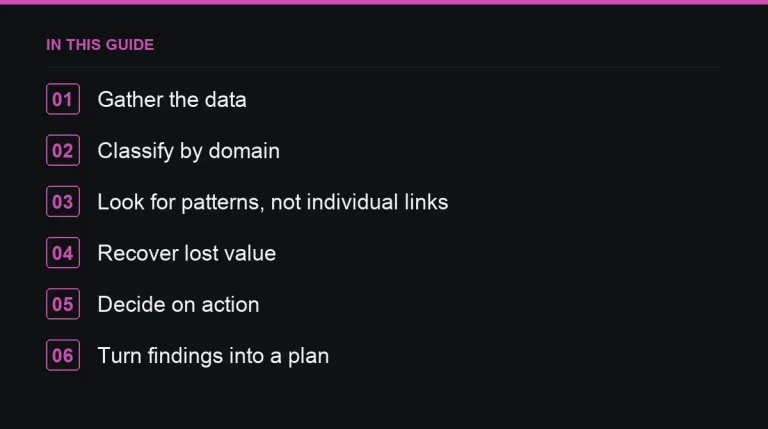
1. Gather the data
Start by exporting links from Search Console and at least one third-party backlink index. They see different parts of the web, and neither is complete on its own (tools compared). Combine both exports and deduplicate by referring domain rather than by individual URL — ten links from one domain usually behave like one signal, not ten (why domains matter more than link count). Keep the raw export; you’ll want to compare against it next time.
If you’ve never pulled this data before, expect the first audit to take longer than later ones. Once you have a baseline spreadsheet, future audits are mostly a diff against it.
2. Classify every domain
Work through the list and put each referring domain into a bucket. This is tedious but it’s the part that actually produces insight — a sorted list of DR scores tells you almost nothing on its own.
| Category | Examples | Action |
|---|---|---|
| Strong editorial | Press, relevant blogs, partners | Protect; learn from them |
| Neutral / noise | Scrapers, auto-generated directories | Ignore |
| Manipulative, built by you | Networks, paid keyword links | Stop; consider removal |
| Broken targets | Links to your 404s | Redirect |
Most sites with no history of aggressive link building find the “manipulative” bucket is nearly empty, and the bulk of the profile splits between strong editorial links and harmless noise. That’s a healthy pattern — don’t manufacture work by treating neutral links as a threat.
3. Look for patterns, not individual links
A single odd-looking link rarely matters. What matters is a pattern across many links pointing the same direction:
- Anchor text distribution heavy on exact-match commercial terms (anchor text strategy).
- Clusters of links from sites that look related to each other — same template, same registrar pattern, same tiny audience (spotting PBN footprints).
- Sudden spikes in referring domains without a clear cause, such as a viral mention or press cycle (link velocity: how fast is too fast).
- A high proportion of sitewide or footer links, which read very differently to an algorithm than one editorial mention per domain.
Comparing against competitors
An audit in isolation only tells you about your own site. Running the same classification over a competitor’s profile shows whether your “noise” ratio and anchor mix are typical for your space or unusual (competitor backlink analysis).
4. Recover lost value
Two categories of value are usually sitting unclaimed in every audit. First, redirect old URLs that still carry external links pointing at them — a site redesign three years ago often leaves dozens of links pointing at pages that now 404 (reclaiming 404 links). Second, search for your brand name and product names to find mentions that never got linked, then ask politely for the link to be added (turning unlinked mentions into links). Both are usually faster wins than building anything new.
5. Decide on action
The classification work in step two should point you toward one of three positions. Don’t skip straight to disavowing or requesting removals before you’ve actually done the classification — most sites don’t need either.
- No manual action, mostly noise — usually no clean-up needed. Focus your time on building good links instead of chasing bad ones.
- Clear history of manipulative links you built — consider removal requests to the linking sites and, only if that fails and the pattern is serious, a disavow file (when to use the disavow tool).
- Existing manual action — follow Search Console’s guidance and the standard recovery process rather than guessing (manual actions for unnatural links).
6. Turn findings into a forward plan
An audit that only produces a cleanup list has wasted half its value. Your strongest existing links usually reveal what kind of content and outreach actually works for your site — which publishers replied, which content format got picked up, which angle earned a link without you asking. Feed that back into your link building strategy for the next quarter, and set a KPI so the next audit has something to measure against (link building KPIs that mean something).
Where to go next
If the audit turned up broken links to fix, start with 404 reclamation. If it turned up patterns that look risky, read about PBN footprints before you act. And if you decide the profile needs new, high-quality links rather than cleanup, browse vetted publisher sites in the marketplace rather than restarting outreach from zero.
Frequently asked questions
How often should I audit backlinks?
Once or twice a year for most sites, and after any major traffic drop.
Should I disavow toxic links flagged by tools?
Not automatically. Tool scores are estimates. Disavow mainly for manipulative links you built or under a manual action.
What's the most common audit finding?
Lost value from links pointing to old 404 URLs, which redirects can recover.
Put it into practice
Filter 54,483 websites by DR, traffic, niche and price, and order with escrow — you pay only after the link is live.
Browse the marketplace