Planning Follow-Up Outreach Waves for Digital PR Campaigns
Why the second and third outreach waves of a campaign often earn links the first wave never could.
Most digital PR campaigns get one concentrated push at launch and then quietly stop. That leaves coverage on the table, because journalists who missed or ignored the first pitch aren’t necessarily uninterested — they may have been on deadline, on another story, or simply never opened the email. A planned sequence of follow-up waves recovers a meaningful share of that missed opportunity.
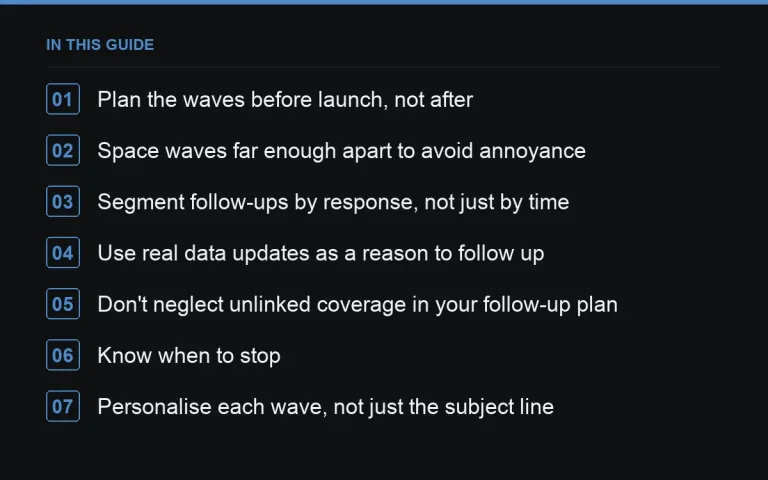
Plan the waves before launch, not after
Decide in advance what each wave will contain: the first wave carries the main national angle, a second wave a few weeks later carries a https://successtoroad.com/blog/regional-angles-from-national-data/ or a secondary finding from https://successtoroad.com/blog/pitching-angles-from-one-dataset/, and a further wave might target a different contact type entirely, such as newsletter writers or trade press who work on longer lead times.
Space waves far enough apart to avoid annoyance
Two or three weeks between waves is a reasonable default, long enough that the earlier pitch isn’t still fresh in an inbox but short enough that the campaign’s news value hasn’t fully faded. Sending a genuinely different angle each time, rather than the same email resent, also reduces the risk of the follow-up reading as spam.
Segment follow-ups by response, not just by time
Contacts who opened but didn’t reply deserve a different follow-up from contacts who never opened at all. A simple structure:
- No open: resend with a different subject line, same core pitch.
- Opened, no reply: a brief, low-pressure nudge with one new detail added.
- Replied but didn’t run it: a thank-you and an offer to help with anything else needed, keeping the relationship open for future campaigns.
Use real data updates as a reason to follow up
A generic “just checking in” follow-up is weak. A follow-up built around genuinely new information — an added data point, a regional detail, expert commentary gathered after launch — gives the journalist an actual reason to look again, rather than just a reminder.
Don’t neglect unlinked coverage in your follow-up plan
Where the first wave produced coverage without a link, a polite follow-up requesting a source link is a legitimate and often successful use of a later wave — see https://successtoroad.com/blog/unlinked-brand-mentions/ for the specifics of how to phrase this well.
Know when to stop
Three waves is a reasonable ceiling for most campaigns; continuing to chase a story well beyond that point usually yields diminishing returns and risks damaging the relationship for future pitches. Track this using the timelines in https://successtoroad.com/blog/measuring-campaign-links-and-coverage/ to decide when a campaign has run its course.
Personalise each wave, not just the subject line
A follow-up that only changes the subject line while keeping an identical body copy is easy for an experienced journalist to spot, and it reads as a mass-send rather than a genuine reconsideration. Rewrite at least the opening line of each wave to reference what’s new, and vary the specific data point or example you lead with across waves so the pitch feels like a considered update rather than a repeated nudge.
Coordinate waves across a team without duplicating effort
On larger campaigns with more than one person doing outreach, a shared tracker showing who has been contacted, when, and with which wave prevents the awkward situation of two team members following up with the same journalist independently within days of each other. This coordination matters as much as the content of the follow-up itself.
Recognise when silence means no, not just not yet
Not every non-response is a delayed yes. If a contact has ignored two or three follow-ups across different angles, further pursuit is unlikely to change the outcome and risks souring the relationship for future campaigns. Move that contact to a longer-term nurture list rather than a fourth immediate follow-up, and focus remaining effort on contacts still showing some engagement.
Learn the outlet’s own rhythm before assuming silence is final
Some publications run on longer editorial cycles than others, and a lack of reply within a week means something different for a daily news desk than for a monthly trade magazine. Where you know a contact’s typical publishing cadence, weight your follow-up timing accordingly rather than applying the same schedule to every recipient regardless of how their outlet actually operates.
Vary the channel, not just the message, for a final attempt
If email has produced no response across two or three waves, a different channel — a brief, professional message through another appropriate platform, or a warm introduction through a mutual contact — sometimes succeeds where repeated email has not. Use this sparingly, on your most valuable remaining targets, rather than as a standard step for every unresponsive contact.
Where to go next
Once your waves are exhausted, consider whether the campaign has a future as a https://successtoroad.com/blog/repurposing-old-campaigns/ asset later in the year. https://successtoroad.com/marketplace/ can supplement organic follow-up with additional relevant placements once direct outreach has run its course.
Frequently asked questions
How many follow-up waves should a typical campaign plan for?
Two to three beyond the initial send is a practical default. Each should ideally carry something new — a different angle, a regional cut, or fresh data — rather than simply repeating the same pitch.
How long should we wait between outreach waves?
Around two to three weeks is a reasonable spacing for most campaigns, balancing enough distance from the previous pitch against the risk of the story's news value fading too far.
Should follow-ups go to everyone on the original list?
No — segment by whether the contact opened, replied, or ignored the first email, and tailor the follow-up accordingly rather than sending an identical blanket resend to the whole list.
Is it worth following up on coverage that didn't include a link?
Yes, a polite, specific request for a source link is a reasonable use of a follow-up wave and succeeds often enough to be worth the effort, particularly soon after the coverage was published.
Put it into practice
Filter 54,483 websites by DR, traffic, niche and price, and order with escrow — you pay only after the link is live.
Browse the marketplace