How to Measure Digital PR Campaign Links and Coverage
A framework for measuring digital PR campaigns properly, without judging a slow-burn asset by a one-off campaign's yardstick.

Measurement in digital PR often defaults to a single number — total links earned — checked once, a few weeks after launch. That approach undercounts slower campaigns and overcounts campaigns that got a burst of low-value coverage. A proper measurement plan separates several distinct signals and sets a timeline appropriate to the campaign type.
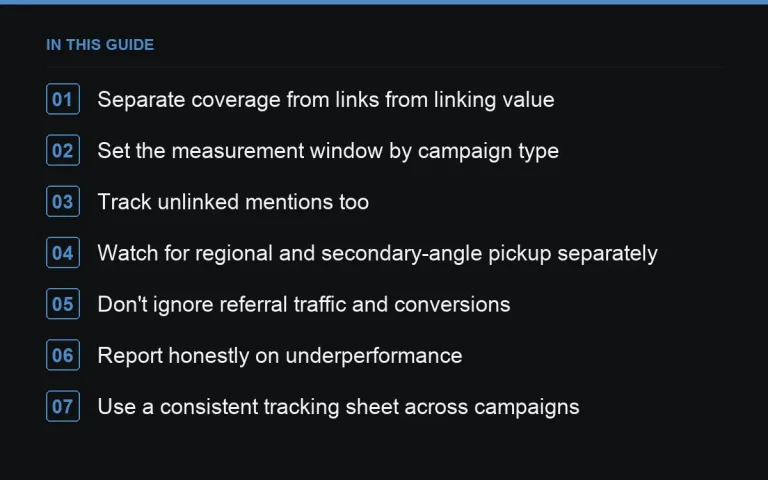
Separate coverage from links from linking value
These are three different things. Coverage counts any mention, linked or not. Links count how many of those mentions actually included a link back. Linking value considers the quality and relevance of the sites doing the linking, not just the count — see https://successtoroad.com/blog/digital-pr-metrics/ for the deeper metrics conversation this feeds into. Track all three separately rather than collapsing them into one headline figure.
Set the measurement window by campaign type
| Campaign type | Realistic measurement window |
|---|---|
| Reactive / news-hook campaign | Days to a couple of weeks |
| Planned survey or index campaign | 4–8 weeks, plus a later check |
| Evergreen calculator or tool | Several months to a year, ongoing |
See https://successtoroad.com/blog/evergreen-vs-one-off-campaigns/ for why these differ so much in shape.
Track unlinked mentions too
Coverage that mentions your brand or campaign without a link is not wasted — it can often be converted into a link later. Build unlinked-mention tracking into your measurement process from the start, and see https://successtoroad.com/blog/unlinked-brand-mentions/ for how to follow up on these systematically rather than letting them go untouched.
Watch for regional and secondary-angle pickup separately
If you ran https://successtoroad.com/blog/pitching-angles-from-one-dataset/ or a https://successtoroad.com/blog/regional-angles-from-national-data/, measure each angle’s performance separately rather than lumping everything into one total. This tells you which angle types are worth repeating in future campaigns, feeding back into https://successtoroad.com/blog/campaign-ideation-workshops/.
Don’t ignore referral traffic and conversions
Links matter for SEO, but some campaigns also drive direct referral traffic and downstream conversions worth tracking on their own terms, especially for commercially-oriented campaigns like those in https://successtoroad.com/blog/seasonal-campaigns-for-ecommerce/ or https://successtoroad.com/blog/campaigns-for-finance-brands/ niches. A campaign with modest link volume but strong referral traffic and engagement may still be a clear success.
Report honestly on underperformance
Not every validated, well-built campaign lands the coverage expected. Honest post-mortems on what fell short — angle saturation, poor timing, weak journalist targeting — feed directly into better decisions next time, and belong in https://successtoroad.com/blog/post-campaign-reporting/ rather than being quietly dropped from the record.
Use a consistent tracking sheet across campaigns
Rather than building a bespoke tracking document for every campaign, maintain one consistent template recording outlet, date, link status, angle used, and estimated authority tier. Consistency here is what makes it possible to compare campaigns meaningfully over time — a differently structured spreadsheet for every campaign makes historical comparison, and therefore genuine learning, much harder than it needs to be.
Decide who owns ongoing monitoring after the initial push
Coverage sometimes appears weeks or months after the main outreach effort has wound down, particularly for content that gets picked up by a resource page or referenced in a later, unrelated article. Assign someone to run a periodic check for new mentions well beyond the active outreach window, rather than assuming all measurable coverage arrives within the first month.
Distinguish correlation from causation in your own reporting
It’s tempting to attribute every subsequent ranking improvement or traffic increase entirely to a single campaign, but other factors are almost always in play too. Present measurement results with appropriate caution about what the campaign specifically caused versus what simply followed it in time, since overclaiming internally sets an unrealistic bar for the next campaign’s expected performance.
Check for duplicate or near-duplicate coverage
Wire-style syndication means a single piece of coverage sometimes appears, word for word, across several outlets under different bylines. Decide how you’ll treat these in your count — as separate placements, since each carries its own domain and audience, or grouped as one underlying story with several distribution points — and apply the same rule consistently across every campaign you measure.
Whichever rule you choose, note it explicitly in your reporting template so anyone reading the figures later understands exactly what’s being counted, rather than assuming a raw total means something more precise than it actually does.
Set a benchmark using your own past campaigns, not industry folklore
Vague external benchmarks about “typical” digital PR results are rarely specific enough to be useful and often reflect a very different niche or budget than yours. Build your own benchmark from your team’s own historical campaigns of a similar type and scale, and treat that internal baseline as the most relevant comparison point for judging whether a new campaign performed well.
Over time this internal benchmark becomes more valuable than any external comparison, since it reflects your specific niche, outreach list quality, and typical campaign scale rather than an average drawn from unrelated markets and budgets.
Share results transparently, including the disappointing ones
A measurement culture only works if underperforming campaigns get reported with the same honesty as strong ones. Teams that only circulate their best results internally lose the ability to spot real patterns, since the full picture, weak results included, is what actually reveals which formats and approaches are worth repeating.
Where to go next
Once your measurement plan is set, decide how findings feed into https://successtoroad.com/blog/repurposing-old-campaigns/ decisions. For extending reach where organic pickup falls short of target, https://successtoroad.com/marketplace/ offers a direct route to additional relevant placements.
Frequently asked questions
How soon after launch should we take a first measurement snapshot?
Around one to two weeks for most planned campaigns, followed by a fuller check at four to eight weeks. Evergreen or calculator-style campaigns need a much longer initial window before drawing conclusions.
Should unlinked mentions count as a campaign success?
They're a partial success — brand visibility without direct SEO value from that mention. Track them separately and follow up where appropriate rather than either ignoring them or counting them the same as a link.
What's a reasonable way to compare two different campaigns' performance?
Compare like campaign types against each other — a reactive news-hook campaign against other reactive campaigns, an evergreen tool against other evergreen tools — rather than comparing across fundamentally different formats and timelines.
Is total link count the most important metric?
It's one important metric, but the relevance and authority of the linking sites, plus any referral traffic or conversions, often matter more for the campaign's actual business impact than raw count alone.
Put it into practice
Filter 54,483 websites by DR, traffic, niche and price, and order with escrow — you pay only after the link is live.
Browse the marketplace