Seasonal Digital PR Campaigns for Ecommerce Brands
How to build a seasonal campaign calendar for an ecommerce brand that earns genuine editorial coverage, not just listicle mentions.

Ecommerce brands have an obvious advantage for seasonal digital PR: known shopping periods with predictable press interest. The challenge is building campaigns around those moments that earn genuine editorial coverage rather than the brand simply appearing in a “best gifts” roundup with no lasting link value.
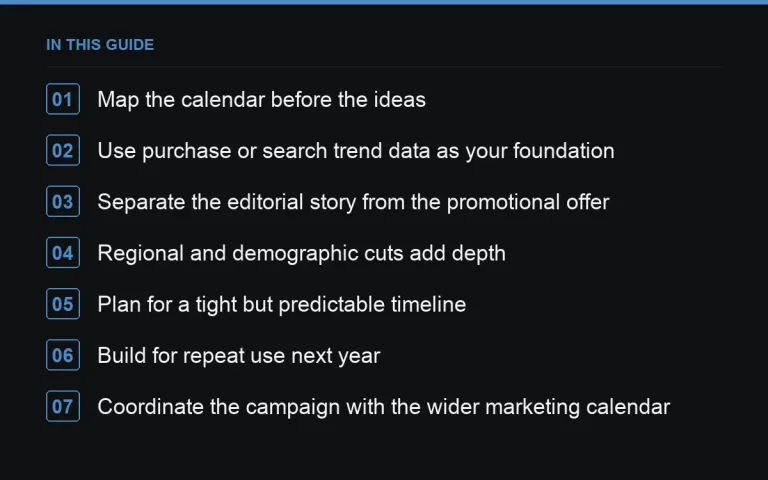
Map the calendar before the ideas
Identify the key seasonal windows relevant to your category — major shopping events, gifting seasons, back-to-school periods, seasonal transitions specific to your product type — and work backwards from each date using the planning approach in https://successtoroad.com/blog/campaign-timelines/. Data-driven campaigns tied to a known date need lead time for sourcing and outreach well before the moment itself.
Use purchase or search trend data as your foundation
Aggregated, anonymised trend data — what people search for or buy more of ahead of a season — makes a more defensible campaign than a purely promotional seasonal push. Present trends honestly, without inflating figures to fit a punchier headline, following the same discipline covered in https://successtoroad.com/blog/survey-design-pitfalls/.
Separate the editorial story from the promotional offer
A pitch that leads with a discount or sale is a marketing email, not a PR pitch, and most journalists will treat it accordingly. Keep the newsworthy data or trend as the headline, and let any commercial angle sit separately, if it needs to appear at all, in the landing page footer rather than the pitch itself.
Regional and demographic cuts add depth
Seasonal shopping behaviour often varies meaningfully by region or demographic group, giving you the material for https://successtoroad.com/blog/regional-angles-from-national-data/ and a wider set of pitches per https://successtoroad.com/blog/pitching-angles-from-one-dataset/, rather than one generic national trend story.
Plan for a tight but predictable timeline
Unlike reactive campaigns, seasonal ecommerce campaigns have a known deadline, which removes one major source of uncertainty. Use that predictability to plan a proper https://successtoroad.com/blog/follow-up-outreach-waves/ strategy in advance, rather than a single rushed send in the days immediately before the season peaks.
Build for repeat use next year
A well-structured seasonal campaign is a strong candidate for https://successtoroad.com/blog/repurposing-old-campaigns/ — the calendar slot, the landing page, and the outreach list can all largely carry over, with fresh data swapped in each cycle rather than starting from scratch.
Coordinate the campaign with the wider marketing calendar
Seasonal PR sits alongside paid media, email marketing, and on-site promotions during the same period, and these efforts compete for the same internal resources and the same customer attention. Share the campaign’s key dates with the wider marketing team early, so the PR push doesn’t land in the same week as an unrelated major site promotion that dilutes attention from both.
Consider a smaller mid-season follow-up
Beyond the main pre-season push, a smaller update partway through the season — an early trend read, a shift from initial expectations — can support a genuine https://successtoroad.com/blog/follow-up-outreach-waves/ rather than a repeat of the same pitch. This works particularly well where you have some form of ongoing internal data to reference, even informally.
Watch shipping and fulfilment deadlines in your framing
If any part of the campaign implies a purchase deadline for seasonal delivery, make sure this is accurate and clearly caveated rather than a generic marketing claim, since a journalist referencing an incorrect deadline in good faith reflects poorly on both parties once readers notice the discrepancy.
Segment by product category rather than treating the store as one entity
A large ecommerce catalogue rarely shows uniform seasonal trends across every category, and a campaign that averages everything together tends to produce a blander story than one focused on the two or three categories showing the clearest seasonal pattern. Picking a specific, well-supported category angle usually beats a broad, store-wide claim that doesn’t hold up to closer inspection.
Give the campaign a life beyond the press cycle
A seasonal trend page can continue attracting search traffic from shoppers researching the category well after the immediate press cycle ends, provided the page isn’t written in a way that reads as dated once the season passes. Frame the copy so it remains useful as background reading even after the specific seasonal peak, extending its value quietly in the background.
A simple update to the introduction each year, noting the new season’s headline figure while leaving the rest of the explanatory content largely intact, is often enough to keep the page feeling current without a full rebuild each cycle.
Watch for accessibility of the offer during peak traffic
A page that performs well under normal traffic can slow down noticeably during a genuine seasonal spike if it wasn’t built or hosted with that surge in mind. Check hosting capacity ahead of the campaign’s expected peak, since a page that becomes slow or unreliable exactly when interest is highest undermines both the PR effort and the commercial opportunity behind it.
Where to go next
Check your landing page follows https://successtoroad.com/blog/campaign-landing-page-design/ principles, since seasonal traffic spikes reward a fast-loading, mobile-friendly page. https://successtoroad.com/niche/e-commerce/ and https://successtoroad.com/niche/shopping/ publishers on https://successtoroad.com/marketplace/ are a natural fit for supporting placements around key seasonal windows.
Frequently asked questions
How far in advance should a seasonal ecommerce campaign be planned?
Several weeks to a couple of months, depending on whether the data needs commissioning or sourcing from public data. Journalists covering seasonal roundups often plan their own content calendars well ahead of the date.
How do we keep a seasonal campaign from looking purely promotional?
Lead with genuinely interesting trend data rather than a discount or offer, and keep any commercial messaging separate from the core editorial pitch so journalists don't dismiss it as an advertisement.
Can small ecommerce brands run seasonal campaigns without big budgets?
Yes — a focused trend story built from your own aggregated sales or search data, presented honestly and simply, can work well without a large commissioned survey behind it.
Should the same seasonal campaign repeat every year?
Often yes, if the underlying data can be refreshed reliably each cycle. Treat each year's version as a genuine update with new figures, not a reused page with only the date changed.
Put it into practice
Filter 54,483 websites by DR, traffic, niche and price, and order with escrow — you pay only after the link is live.
Browse the marketplace