Using Freedom of Information Requests for Digital PR Campaigns
How to plan a request-based campaign, from choosing the right public body to building in enough lead time for a reply.
Requests to public bodies for information they hold are one of the few ways a PR team can generate genuinely exclusive data without commissioning a survey. The trade-off is time: replies can take weeks, and the answer you get back may not be the one you hoped for. Treat this as a long-lead-time mechanic, not a quick-turnaround one.
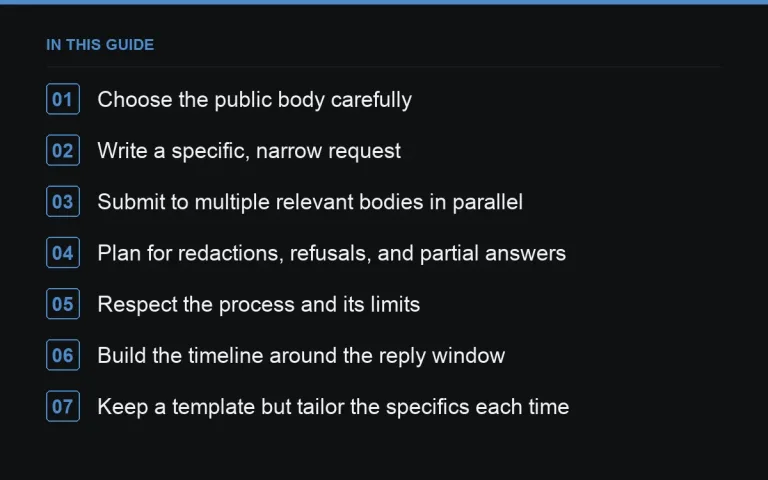
Choose the public body carefully
Not every public authority holds the data you’re imagining, and requests to the wrong body waste weeks. Before submitting anything, check whether the information might already be published, since many authorities now proactively release commonly requested data — saving you the wait entirely and letting you move straight to https://successtoroad.com/blog/using-public-datasets-for-pr/.
Write a specific, narrow request
Broad requests are more likely to be refused, delayed, or answered with data that doesn’t match what you needed. Specify the exact time period, geographic area, and format you want. A request phrased as “all data relating to X” invites a costs-based refusal; a request for “the number of Y recorded between these two dates, by region” is answerable in a standard reply.
Submit to multiple relevant bodies in parallel
If several regional or local authorities might hold comparable data, send the same request to all of them at once rather than sequentially. This is what makes a https://successtoroad.com/blog/map-based-pr-campaigns/ or a https://successtoroad.com/blog/regional-angles-from-national-data/ possible — you need consistent, comparable answers across multiple areas, and staggered requests mean staggered, inconsistent response windows.
Plan for redactions, refusals, and partial answers
Expect that some recipients will refuse, redact, or answer only part of the request. Build your campaign timeline assuming a 60–80% usable response rate, not 100%, and decide in advance how you’ll present gaps honestly rather than papering over them. A table showing “no data held” alongside actual figures is more credible than silently dropping non-responding areas.
Respect the process and its limits
These requests exist for legitimate public-interest access to information, not as a free data-mining tool for every marketing idea. Avoid mass speculative requests that clog up a public body’s resources for angles you haven’t validated are newsworthy — validate first, per https://successtoroad.com/blog/validating-a-campaign-idea/, then request.
Build the timeline around the reply window
A typical response window runs to several weeks, sometimes longer with extensions or appeals. Fold this into your overall https://successtoroad.com/blog/campaign-timelines/ from the outset — teams that plan a launch date before requests are even submitted routinely have to delay everything downstream.
Keep a template but tailor the specifics each time
A reusable request template covering the standard boilerplate — the legal basis for the request, your contact details, the format you’d like data returned in — saves time across multiple submissions. But the substantive part, the exact question being asked, needs individual attention for each recipient, since a copy-pasted request that doesn’t match a specific authority’s data structure is more likely to come back as a clarification request that costs another two weeks.
Combine the results with other sourcing methods
Data from these requests is often strongest when combined with a public dataset covering the same topic at a different level of detail, following https://successtoroad.com/blog/using-public-datasets-for-pr/, or with a short survey that adds context the official figures can’t provide on their own. Treat the request as one input into the campaign rather than the whole story by itself.
Store and organise responses as they arrive
Replies often come back in inconsistent formats — a PDF from one authority, a spreadsheet from another, a plain-text email from a third. Set up a simple, consistent process for logging each response as it arrives, converting it into a common format immediately rather than leaving that work until every reply is in. Doing this as responses trickle in, rather than all at once at the deadline, makes the eventual analysis stage considerably faster.
Keep a paper trail of every request sent
Save a copy of the exact wording submitted to each body, along with the date and any reference number given in acknowledgement. If a response seems inconsistent with another body’s answer to what should be the same question, having the original wording on hand makes it much easier to spot whether the inconsistency comes from a genuine difference in the data or simply a difference in how the request was interpreted.
Be ready to publish partial results if needed
If a subset of authorities respond well within budget-friendly timelines while others lag significantly, consider whether a partial release, clearly labelled as covering only the responding areas, still tells a worthwhile story on its own. Waiting indefinitely for every single recipient to reply before publishing anything can mean missing a relevant news window entirely.
Where to go next
Once responses arrive, treat the analysis stage the same as any other original dataset — see https://successtoroad.com/blog/pitching-angles-from-one-dataset/ for turning it into multiple pitchable stories. https://successtoroad.com/marketplace/ and https://successtoroad.com/niche/public-service/ or https://successtoroad.com/niche/news-and-media/ publishers suit stories built on this kind of primary, official data well.
Frequently asked questions
How long does a typical information request take to answer?
Statutory deadlines vary by jurisdiction but commonly run around 20 working days, with possible extensions. Build in extra buffer time for follow-up, clarification requests, or appeals against a refusal.
What happens if a body refuses part of the request?
You can often narrow the request and resubmit, or appeal the decision through the relevant process. Either route adds time, so factor a possible refusal into your campaign schedule from the start.
Can we submit requests to multiple authorities at once?
Yes, and for regional or comparative campaigns this is usually necessary. Just make sure the wording is identical across all recipients so the answers are genuinely comparable when you analyse them.
Is this approach suitable for time-sensitive campaigns?
Generally not for tight deadlines. The reply window alone often exceeds a typical campaign sprint, so this mechanic suits planned, longer-lead campaigns rather than reactive or seasonal ones.
Put it into practice
Filter 54,483 websites by DR, traffic, niche and price, and order with escrow — you pay only after the link is live.
Browse the marketplace