How to Repurpose an Old Digital PR Campaign a Year Later
A practical process for deciding which past campaigns deserve a second life, and how to avoid simply repeating what already happened once.
A campaign that performed well a year or two ago is often an underused asset. The idea has already been validated by real coverage, the landing page infrastructure may still exist, and the underlying question is frequently still relevant — but repurposing it well requires more than swapping in new numbers and resending the same email.
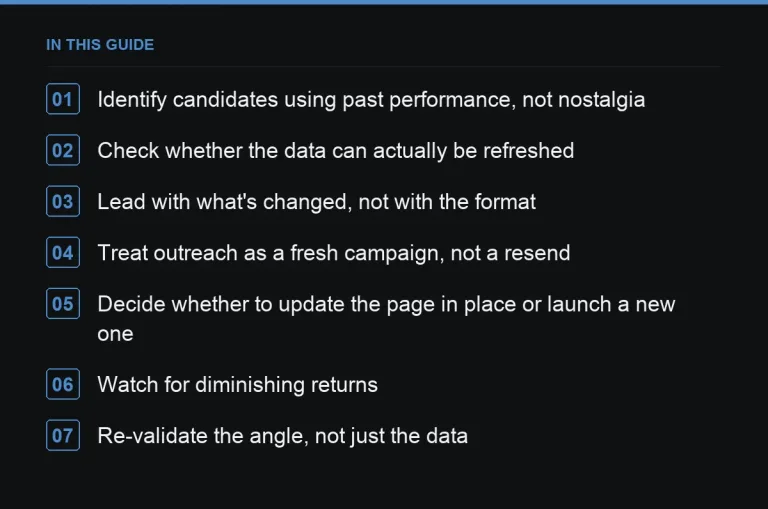
Identify candidates using past performance, not nostalgia
Look back through your https://successtoroad.com/blog/measuring-campaign-links-and-coverage/ for campaigns that earned solid coverage, rather than campaigns the team simply remembers fondly. A campaign that performed modestly the first time rarely improves dramatically on a repeat unless something about the underlying story has genuinely changed.
Check whether the data can actually be refreshed
Confirm the original data source still exists, still publishes on a comparable basis, and hasn’t changed its methodology in a way that breaks year-on-year comparison. A repurposed campaign built on inconsistent data is worse than not repurposing at all, since it invites exactly the scrutiny covered in https://successtoroad.com/blog/index-and-ranking-campaigns/.
Lead with what’s changed, not with the format
The story this time round should be the change — what moved up, what moved down, what’s different from last year — not just “here’s this year’s edition of our annual thing.” A pitch that only says the campaign is back, without a genuine new finding, gives journalists no fresh reason to cover it.
Treat outreach as a fresh campaign, not a resend
Build a new contact list and new headline variants using https://successtoroad.com/blog/headline-writing-for-campaigns/, rather than reusing last year’s list unchanged. Journalists move roles, beats shift, and a genuinely new pitch — even for a returning campaign — performs better than a mail-merge of an old email with a new year in the subject line.
Decide whether to update the page in place or launch a new one
Updating the existing landing page in place preserves any SEO value the original page has accumulated, and suits campaigns you intend to treat as https://successtoroad.com/blog/evergreen-vs-one-off-campaigns/ going forward. A completely new page suits a campaign where the previous version’s framing or design has dated badly and needs a genuine rebuild.
Watch for diminishing returns
Not every campaign deserves a third or fourth annual repeat. If year-on-year coverage has been declining despite reasonable outreach effort, it may be time to retire the format and let the underlying question inform a fresh idea in your next https://successtoroad.com/blog/campaign-ideation-workshops/ instead of forcing another repeat.
Re-validate the angle, not just the data
A year is long enough for the news environment around a topic to shift meaningfully. Run the refreshed concept through a lighter version of https://successtoroad.com/blog/validating-a-campaign-idea/ before committing to a full relaunch — check whether competitors have since covered similar ground, and whether the original headline framing still holds up given anything that’s changed in the wider conversation around the topic.
Consider a secondary angle unique to the repeat
A returning campaign has one advantage a first edition doesn’t: a genuine year-on-year comparison. Build at least one angle specifically around what’s changed since last time, following https://successtoroad.com/blog/pitching-angles-from-one-dataset/, since “what changed” is often more interesting to a journalist than either year’s absolute figures on their own.
Check whether the original contacts still cover the beat
Journalists move roles frequently, and a contact list from a year or two ago is often meaningfully out of date. Verify current bylines and beats before resending, rather than assuming last year’s list is still accurate — a pitch sent to someone who’s moved on reads as poorly researched and can quietly damage the impression of an otherwise strong repeat campaign.
Compare methodology consistency across editions carefully
If any part of the data collection or calculation method changed between editions, even for good reasons like an improved sample, note this explicitly rather than presenting the year-on-year comparison as if the two editions are perfectly consistent. A methodology change that isn’t disclosed is exactly the kind of detail that undermines a repeat campaign’s credibility if a careful reader spots it.
Archive each edition separately for future reference
Keep a clear, dated archive of each year’s version of the campaign, including the exact data, page copy, and outreach list used. Beyond satisfying your own curiosity about how the story evolved, this archive becomes genuinely useful evidence if a reader or journalist later asks how a particular year-on-year figure was calculated.
This archive also makes it much faster to brief a new team member who inherits the campaign in a future year, since they can see exactly what changed and why across every prior edition rather than reconstructing that history from scattered emails and old files.
Recognise the compounding value of a well-maintained repeat
A repurposed campaign that’s been run carefully for several consecutive years often develops a reputation of its own, with journalists actively watching for the next edition rather than needing to be reintroduced to the concept from scratch each time. That reputation is a genuine asset worth protecting through consistent quality control.
Where to go next
Plan the refreshed https://successtoroad.com/blog/campaign-timelines/ and https://successtoroad.com/blog/campaign-budgets/ as if it were a new campaign, not a quick update, and use https://successtoroad.com/marketplace/ to extend reach if last year’s outreach list has aged.
Frequently asked questions
How do we know if a campaign is worth repeating annually?
Check whether the underlying data source updates reliably and whether last year's coverage held up in quality, not just volume. A campaign with declining relevance or a shaky data source is a poor repeat candidate.
Should we reuse the same landing page URL each year?
Generally yes, if you intend the campaign to become an evergreen, updated asset — this preserves accumulated search value. Build a new page only if the previous design or framing genuinely needs a rebuild.
Do journalists get tired of seeing the same annual campaign?
They can, if the pitch doesn't lead with something genuinely new each time. Framing the outreach around what's changed this year, rather than the campaign's return, keeps it feeling fresh rather than repetitive.
When should we retire a repeating campaign format?
When year-on-year coverage keeps declining despite reasonable outreach effort, or when the underlying data source becomes unreliable or discontinued. At that point, the format has likely run its useful course.
Put it into practice
Filter 54,483 websites by DR, traffic, niche and price, and order with escrow — you pay only after the link is live.
Browse the marketplace