How to Pitch Multiple Angles From One Dataset
Why the most efficient digital PR campaigns treat one dataset as a source for several different stories, not one.

Commissioning or sourcing data is usually the most expensive part of a campaign, so the return on that investment depends on how many genuinely different stories you can pull from it. Teams that send the same generic pitch to every journalist on their list are leaving coverage on the table.
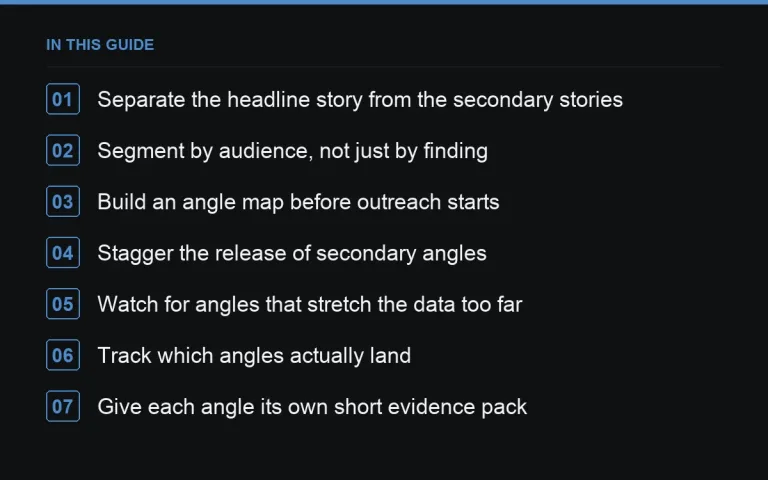
Separate the headline story from the secondary stories
Your primary angle is the one built for widest appeal — the national top-line finding. But most datasets also contain smaller, sharper angles buried in the detail: the biggest year-on-year mover, the outlier that goes against the overall trend, the category nobody expected to top the list. Each of these can support its own pitch to a different journalist or desk.
Segment by audience, not just by finding
The same underlying number can be reframed for different readerships:
- A national outlet gets the overall trend and its broad implications.
- A regional title gets the https://successtoroad.com/blog/regional-angles-from-national-data/ for their specific area.
- A trade publication gets the angle most relevant to their industry’s practical concerns.
- A personal finance or consumer section gets the “what this means for your budget” framing.
Build an angle map before outreach starts
List every plausible angle in a simple document, next to the journalist type it suits and the headline it would use, drawing on https://successtoroad.com/blog/headline-writing-for-campaigns/. This turns outreach from “who might like this” guesswork into a targeted list where each contact gets the angle most relevant to them.
Stagger the release of secondary angles
Don’t send every angle in the same week. Hold back one or two strong secondary findings for a https://successtoroad.com/blog/follow-up-outreach-waves/ a few weeks after the initial push, once the first wave of coverage has run its course. This extends the campaign’s earning window well beyond the initial launch.
Watch for angles that stretch the data too far
Not every combination of variables in a dataset supports a defensible claim. If an angle requires cherry-picking a small subset or ignoring contradicting data elsewhere in the set, it’s not a legitimate secondary angle — it’s overreach that risks the credibility of the whole campaign, echoing the caution in https://successtoroad.com/blog/survey-design-pitfalls/.
Track which angles actually land
After outreach, note which angle each piece of coverage picked up. Over several campaigns, this builds a picture of which angle types perform best for your niche, informing how you plan the next https://successtoroad.com/blog/campaign-ideation-workshops/.
Give each angle its own short evidence pack
For every angle on your map, prepare a short bullet list of the exact figures that support it, the caveat that applies to it, and a one-line suggested headline drawing on https://successtoroad.com/blog/headline-writing-for-campaigns/. This means a team member sending a pitch doesn’t need to re-derive the angle from the raw dataset each time — they can work directly from a prepared evidence pack, which speeds up outreach and reduces the risk of a figure being misquoted under time pressure.
Be wary of angle fatigue within your own team
After the first two or three pitches go out, it’s tempting to reuse the strongest angle repeatedly because it’s the easiest to write about. Resist this — sending the same angle to every remaining contact reduces the campaign’s overall reach compared with matching each remaining contact to the angle most relevant to them, even where that takes a little longer to prepare.
Reserve one angle purely for reactive opportunities
Keep one lower-priority angle in reserve, unused in the initial outreach, specifically to offer if a relevant news event breaks unexpectedly during the campaign window. Having a ready-made, data-backed comment prepared in advance means you can respond to a journalist’s reactive request within the hour rather than scrambling to build a new angle from scratch under time pressure, a discipline that also underpins https://successtoroad.com/blog/reactive-pr/.
Check each angle survives being read in isolation
A secondary angle drafted while deeply immersed in the full dataset can rely on context a journalist receiving only that single pitch won’t have. Before sending, read each angle as if it’s the only thing the recipient will ever see from the campaign, and add back any background detail needed for it to make sense entirely on its own.
Assign responsibility for each angle to a named person
When several angles are being pitched at once, unclear ownership means some angles quietly never get sent while effort concentrates on whichever felt easiest to write first. Assign each angle in the map to a specific team member with a target send date, so the full range of prepared angles actually reaches the market rather than only the strongest one or two.
Where to go next
Once your angle map is built, plan timing carefully — see https://successtoroad.com/blog/campaign-timelines/ — and consider whether some angles are strong enough to justify their own dedicated landing page. https://successtoroad.com/marketplace/ and relevant niche publishers can extend reach for angles your direct outreach list doesn’t fully cover.
Frequently asked questions
How many distinct angles should we plan per campaign?
Three to six is a practical range for most datasets — enough to segment by audience without diluting effort on angles too thin to support a full pitch.
Should secondary angles get their own landing page?
Not always. A short dedicated section on the main campaign page, or a brief standalone summary linked from the pitch email, is often enough without the overhead of building separate pages for every angle.
How do we avoid an angle looking like data manipulation?
Make sure every angle is a genuine, verifiable read of the data rather than a selective slice designed to fit a predetermined headline. If in doubt, have someone uninvolved in the campaign sanity-check the framing.
Can one dataset support both a ranking and a regional map?
Often yes, if the underlying data has enough geographic and category granularity. Treat these as two separate assets with two separate pitches rather than cramming both into one crowded landing page.
Put it into practice
Filter 54,483 websites by DR, traffic, niche and price, and order with escrow — you pay only after the link is live.
Browse the marketplace