How to Plan a Realistic Digital PR Campaign Timeline
Where digital PR campaign timelines actually slip, and how to build in enough buffer to avoid a rushed, weaker launch.

Campaign timelines fail most often not because any single stage takes too long, but because teams estimate each stage optimistically and then stack those optimistic estimates end to end. A campaign quoted as a four-week project regularly takes eight, and the extra four weeks usually come out of the outreach phase — the part that actually earns links.
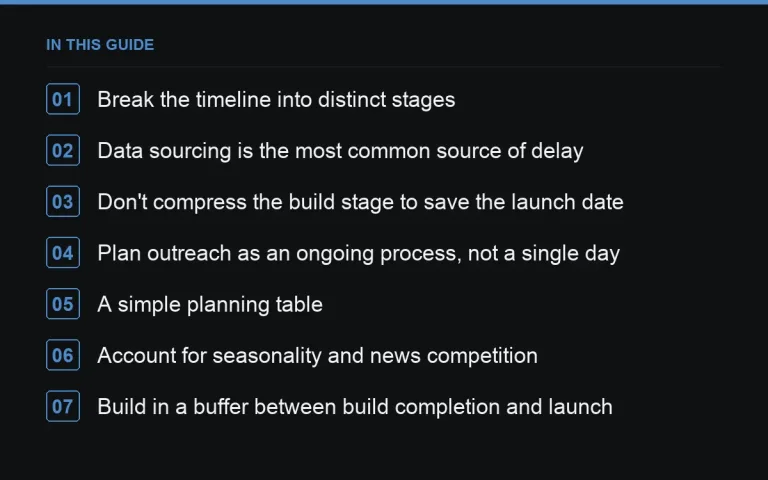
Break the timeline into distinct stages
A realistic plan separates:
- Ideation and https://successtoroad.com/blog/validating-a-campaign-idea/ (days, not weeks, if done properly).
- Data sourcing or commissioning — the least predictable stage, especially for https://successtoroad.com/blog/foi-requests-for-campaigns/.
- Build — design, development, landing page.
- Outreach — the initial wave plus planned https://successtoroad.com/blog/follow-up-outreach-waves/.
Data sourcing is the most common source of delay
Surveys can take longer than expected to field if response rates are slow; public data releases sometimes get delayed; requests to authorities can take weeks longer than planned. Build the rest of your timeline around the data stage’s realistic worst case, not its best case, especially if the data underpins a scheduled launch date.
Don’t compress the build stage to save the launch date
A landing page or visual asset rushed in the final days before a planned launch is usually the weakest part of the whole campaign — see https://successtoroad.com/blog/campaign-landing-page-design/ for what a rushed page tends to get wrong. If the data stage overruns, move the launch date rather than cutting build time short.
Plan outreach as an ongoing process, not a single day
The initial send is only the start. Budget time for follow-ups, for a secondary wave using different angles per https://successtoroad.com/blog/pitching-angles-from-one-dataset/, and for regional-specific outreach that often happens on a slightly delayed schedule relative to the national push.
A simple planning table
| Stage | Typical range | Common overrun cause |
|---|---|---|
| Ideation & validation | Days | Indecision, too many stakeholders |
| Data sourcing | 1–6+ weeks | Slow survey fielding, request delays |
| Build | 1–3 weeks | Design revisions, late scope changes |
| Outreach | Ongoing, weeks–months | Treating it as a single day, not a process |
Account for seasonality and news competition
Launching into a week dominated by major unrelated news reduces your odds of coverage regardless of how good the campaign is. Check the broader news calendar before finalising a launch date, and keep flexibility to shift by a few days if something major breaks unexpectedly — a consideration shared with https://successtoroad.com/blog/reactive-pr/.
Build in a buffer between build completion and launch
A short gap between finishing the landing page and sending the first pitch gives the team time to proofread, test links, check the page on mobile, and confirm every https://successtoroad.com/blog/visual-assets-for-journalists/ exports cleanly. Launching the moment the build is technically finished, with no buffer for this final check, is a common cause of embarrassing last-minute fixes made under pressure while journalists are already receiving the pitch.
Communicate the timeline clearly across the team
A shared, visible timeline — even a simple one — prevents the common failure where the data team assumes outreach starts a week later than the outreach team assumes it does. Review the timeline together at each major milestone, not just at kick-off, since assumptions drift as individual stages run early or late relative to the original plan.
Decide who has authority to move the launch date
Without a clear decision-maker, a slipping timeline tends to drift silently rather than triggering an honest conversation about the new realistic date. Name one person with the authority to formally move the launch date when a stage overruns, so the decision is made deliberately and communicated to the whole team, rather than the date quietly becoming aspirational while everyone privately assumes it will move.
Build in a short post-launch review point
A brief check-in a week or two after launch, comparing what actually happened against the original timeline, captures useful lessons while they’re still fresh. Note which stage ran closest to plan and which slipped most, and feed that pattern into the estimate for the next campaign rather than starting each new timeline from an optimistic blank slate.
Keep a visible list of dependencies between stages
Some stages can genuinely run in parallel, such as outreach list-building alongside data analysis, while others strictly depend on a prior stage finishing first, such as design waiting on final data. Map these dependencies explicitly rather than assuming a simple straight-line schedule, since misunderstanding which stages can overlap is a common cause of an otherwise reasonable-looking timeline running longer than planned.
A simple dependency map, even hand-drawn, also makes it obvious to the whole team where a delay in one stage will and won’t cascade into others, which helps everyone judge quickly whether a slipping deadline is actually a crisis or simply absorbed by existing slack elsewhere in the plan.
Where to go next
Pair your timeline with a matching https://successtoroad.com/blog/campaign-budgets/ so resourcing doesn’t run out before outreach is finished, and set measurement checkpoints in advance using https://successtoroad.com/blog/measuring-campaign-links-and-coverage/. https://successtoroad.com/marketplace/ can extend reach if your organic outreach window is shorter than planned.
Frequently asked questions
How long does a typical digital PR campaign take from idea to launch?
For a straightforward campaign with existing public data, four to six weeks is common. Campaigns involving commissioned surveys or requests to public bodies often need two to three months.
What's the most common cause of timeline overruns?
Data sourcing — slow survey response rates, delayed public data releases, or longer-than-expected replies to information requests all push the schedule back more often than design or development delays.
Should we set a fixed launch date in advance?
Set a target date but hold it loosely until the data stage is confirmed complete. Publicly committing to a fixed date before data is in hand creates pressure to rush the weakest, most visible part of the campaign.
How long should outreach continue after launch?
Active outreach often continues for several weeks beyond the initial send, with follow-up waves planned deliberately rather than as an afterthought once the first response rate starts to slow.
Put it into practice
Filter 54,483 websites by DR, traffic, niche and price, and order with escrow — you pay only after the link is live.
Browse the marketplace