Using Public Datasets for Digital PR Campaigns
A practical approach to mining government and open data for campaign angles that don't require a survey budget.
Not every campaign needs a commissioned survey. Public datasets — government statistics, open transport data, planning records, published health or economic indicators — offer a cheaper starting point and, because the source is official, often a more credible one. The skill is in finding an angle nobody else has already published.
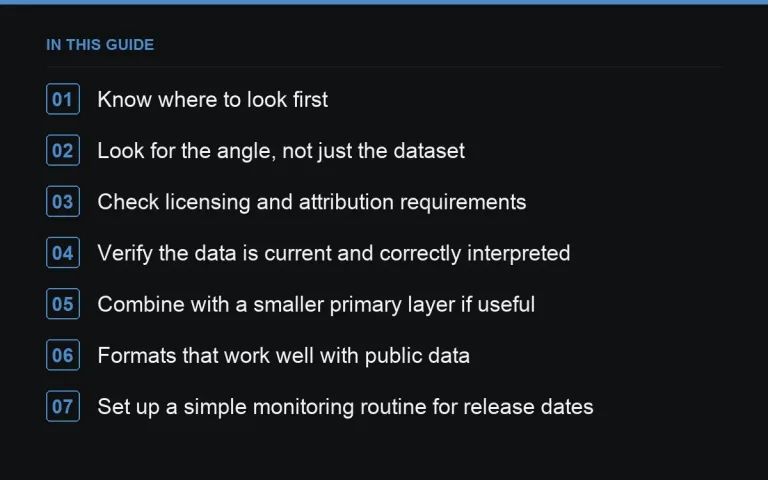
Know where to look first
National statistics agencies, local authority open data portals, transport authorities, and regulator publications are consistently underused by PR teams who default to commissioning new surveys. These sources update on predictable schedules, which also makes them useful for planning https://successtoroad.com/blog/campaign-timelines/ around a release date you know in advance.
Look for the angle, not just the dataset
A raw dataset is not a story. The work is in finding the comparison, trend, or outlier that makes it newsworthy: a year-on-year change, an unexpected regional gap, or a correlation between two public datasets nobody has combined before. Cross-referencing two separate public sources often produces a more original angle than either alone.
Check licensing and attribution requirements
Most open government data is published under permissive licences, but always confirm attribution requirements before publishing derived figures. Some datasets require you to credit the source explicitly; others restrict commercial redistribution of the raw data itself, even if analysis is fine. This check takes minutes and avoids a takedown request later.
Verify the data is current and correctly interpreted
Public datasets are sometimes revised, contain methodology changes between releases, or use definitions that differ from common assumptions (a “household” defined differently across two surveys, for instance). Read the accompanying documentation, not just the spreadsheet, before drawing conclusions — misreading a footnote is the most common source of embarrassing corrections.
Combine with a smaller primary layer if useful
Public data gives you the credible skeleton; a small addition — a short expert comment, a handful of case examples, or a light survey — can add colour without the cost of full original research. This hybrid approach often produces a stronger pitch than either element alone, and ties naturally into https://successtoroad.com/blog/pitching-angles-from-one-dataset/.
Formats that work well with public data
- Ranking or index campaigns, per https://successtoroad.com/blog/index-and-ranking-campaigns/, built entirely from official figures.
- Regional maps, per https://successtoroad.com/blog/map-based-pr-campaigns/, using geographically broken-down public statistics.
- Trend stories showing change over multiple years of the same published series.
Set up a simple monitoring routine for release dates
Many valuable public datasets are published on a fixed, pre-announced schedule. Keep a shared calendar of upcoming release dates for the two or three sources most relevant to your niche, and assign someone to check each release within a day or two of publication. Being among the first to spot an angle in a freshly published dataset matters more than almost any other factor in this format, since the same source is available to every competitor at the same moment.
Keep a record of sources you’ve already mined
Over time, a team working this way accumulates a working knowledge of which public sources are reliable, which are frequently revised, and which have confusing definitions that caused problems before. Write this down somewhere shared rather than relying on one person’s memory — it saves the next campaign from repeating a data-interpretation mistake the team has already made once.
Archive your raw data and workings
Keep the original downloaded files, your analysis spreadsheet, and notes on every transformation you applied, even after the campaign launches. If a journalist or a member of the public later questions a figure, being able to trace it back to the exact original source file and calculation step within minutes is far more reassuring than trying to reconstruct the analysis from memory weeks or months after the fact.
Watch for revisions to previously published figures
Some public bodies revise earlier releases as better information becomes available, which can quietly invalidate a comparison you built weeks or months ago. Check the latest version of a source shortly before publishing your campaign, not just when you first downloaded it, particularly for any figures spanning several years where an early data point might have been revised since you first pulled it.
Cross-check unusual figures against a second source
A striking outlier in a public dataset is sometimes a genuine finding and sometimes a data entry error or a definitional quirk specific to one region or period. Before building a headline around an unusually large or small figure, check whether a second, independent source shows a broadly similar pattern — this simple sanity check avoids building an entire campaign around what turns out to be a data artefact.
This same diligence pays off again during outreach: a journalist who has covered the same public dataset before may ask a sharp question about a detail you hadn’t considered, and having already stress-tested the outlier means you can answer confidently rather than needing to go back and re-check the source mid-conversation.
Where to go next
Once you’ve found a genuine angle, plan the write-up with https://successtoroad.com/blog/headline-writing-for-campaigns/ and consider whether a https://successtoroad.com/blog/foi-requests-for-campaigns/ could add a proprietary layer the public dataset alone doesn’t offer. https://successtoroad.com/marketplace/ and https://successtoroad.com/niche/public-service/ publishers are a good fit for stories rooted in official data.
Frequently asked questions
Do we need permission to publish figures from government data?
Usually not beyond following the stated licence's attribution terms, but always check the specific dataset's licence page before publishing derived claims or republishing raw tables.
How do we find an original angle in a well-known dataset?
Look for combinations — cross-referencing two separate public datasets, or applying a regional or time-based cut that hasn't been published before, tends to surface angles competitors missed.
Can public data campaigns still get significant coverage?
Yes. Official sourcing often makes journalists more comfortable running the story quickly, since they can verify the underlying figures themselves rather than relying solely on your framing.
What's the risk of relying only on public data?
Every other PR team has access to the same source, so timing and angle-finding become the main competitive advantage rather than data exclusivity. Moving quickly after a data release matters.
Put it into practice
Filter 54,483 websites by DR, traffic, niche and price, and order with escrow — you pay only after the link is live.
Browse the marketplace