Digital PR Campaigns for Boring Industries
Why the least glamorous industries often have the easiest access to genuinely original data, and how to find it.

Every industry has someone convinced their sector is too dull for digital PR. In practice, unglamorous industries — logistics, waste management, industrial components, business insurance, facilities services — often sit on data nobody else has bothered to analyse, which is a real advantage over saturated consumer categories.
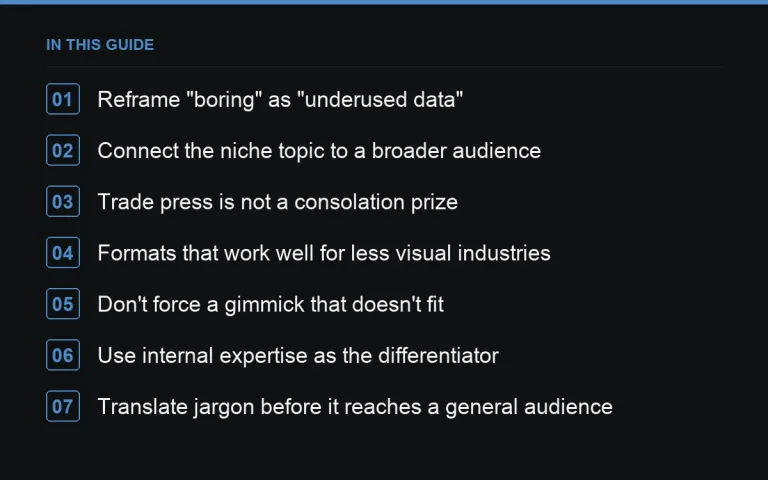
Reframe “boring” as “underused data”
A sector with limited existing PR activity means the competitive bar for originality is lower. Operational data your business already collects — regional demand patterns, seasonal variation, cost trends — may never have been published in an accessible form before, which makes it inherently more interesting to a journalist than another version of a well-covered consumer topic.
Connect the niche topic to a broader audience
The trick with less consumer-facing industries is finding the angle that matters to people outside the trade. Industrial waste data can become a story about regional environmental trends; freight and logistics data can become a story about regional economic activity or the cost of goods. Use https://successtoroad.com/blog/using-public-datasets-for-pr/ to find a public dataset that bridges your niche data to a wider public interest angle.
Trade press is not a consolation prize
Coverage in a trade or industry publication carries real authority within that niche, and often converts into links from other industry sites and forums over time. Don’t treat trade coverage as a fallback for failing to land consumer press — for a genuinely B2B-facing campaign, it may be the more valuable outcome, a point developed further in https://successtoroad.com/blog/campaigns-for-b2b-software/.
Formats that work well for less visual industries
- Cost or pricing trend data — see https://successtoroad.com/blog/campaign-timelines/ releases tied to known reporting cycles.
- A simple https://successtoroad.com/blog/index-and-ranking-campaigns/ of regions, suppliers, or practices by an operational metric.
- Expert commentary combined with a small dataset, rather than relying on visual appeal alone.
Don’t force a gimmick that doesn’t fit
A forced “fun” angle bolted onto a genuinely dry topic — a quiz, a meme-style graphic — often reads as incongruous and undermines credibility rather than adding appeal. A plain, well-sourced data story usually outperforms a stretched attempt at levity in these sectors.
Use internal expertise as the differentiator
Where data is thin, subject-matter expertise within the business can carry a campaign — original commentary on a trend, explained clearly for a general audience, following the https://successtoroad.com/blog/expert-commentary/ process. This works especially well when combined with even a small amount of original or public data.
Translate jargon before it reaches a general audience
Industry terminology that feels perfectly natural internally can be a real barrier to a general-audience journalist understanding, and therefore covering, the story. Have someone outside the industry read the pitch and flag any term they had to guess the meaning of — those terms need either a plain-English substitute or a one-line explanation woven naturally into the copy.
Don’t underestimate the visual challenge
A topic with no obvious visual hook still needs a clear chart or graphic, following https://successtoroad.com/blog/visual-assets-for-journalists/, even if the subject itself photographs poorly. A well-designed data chart carries a dry topic further than an attempt to manufacture an artificial visual gimmick that doesn’t fit the subject naturally.
Look for the human angle within the operational data
Even the driest operational dataset usually touches people somewhere — workers, local communities, downstream customers, or the environment. Finding that human thread and giving it a sentence or two of context, without overstating the connection, often makes the difference between a story a general news desk passes on and one it picks up alongside the trade press coverage.
Build relationships with a small number of trade contacts
Niche industries typically have a small, well-defined set of relevant trade publications and specialist journalists. Investing time in a genuine working relationship with this smaller group, rather than treating trade press as a mass outreach exercise, tends to pay off more reliably here than in broader consumer categories with hundreds of loosely relevant contacts.
Revisit the same operational dataset annually if it renews
Where the underlying operational data your business holds refreshes on a predictable internal cycle, treat this as a candidate for a repeatable annual story rather than a single one-off release, following the same logic covered in https://successtoroad.com/blog/repurposing-old-campaigns/. Familiarity with the format over successive years often builds a stronger relationship with the small set of trade journalists who cover it each time.
Over several editions, this repeated cadence often becomes one of the more reliable sources of coverage a less glamorous business has access to, precisely because so few competitors bother to build the same kind of consistent annual reporting habit.
Don’t apologise for the industry’s lack of glamour
Pitches that open by acknowledging how “boring” the topic supposedly is undercut the story before a journalist has even read the finding. Present the data confidently on its own merits, and let the journalist decide whether it’s interesting rather than pre-emptively signalling low expectations yourself.
Where to go next
Once you have an angle, plan headline framing carefully with https://successtoroad.com/blog/headline-writing-for-campaigns/ — general audiences need extra context that a trade audience wouldn’t. https://successtoroad.com/niche/manufacturing/ and https://successtoroad.com/niche/business/ publishers on https://successtoroad.com/marketplace/ suit this kind of coverage well.
Frequently asked questions
Can a business-to-business industry get consumer press coverage?
Yes, if the data or angle connects to something consumers experience indirectly — pricing, regional economic activity, environmental impact. The connection needs to be made explicit in the pitch rather than assumed.
Is trade press coverage worth as much as consumer press?
For a B2B-facing business, often yes — the linking domains are more relevant to the audience that matters commercially, even if the raw traffic or prestige is lower than a national consumer title.
What if our industry genuinely has no interesting public data?
Look at operational data your own business already holds, even informally. A modest internal dataset, combined with clear expert commentary, can still support a legitimate campaign without needing external data.
Should less glamorous industries avoid ranking or index formats?
No — rankings often work particularly well here precisely because so few competitors have published a comparable index in the space, making originality easier to achieve than in saturated consumer categories.
Put it into practice
Filter 54,483 websites by DR, traffic, niche and price, and order with escrow — you pay only after the link is live.
Browse the marketplace