25 Digital PR Campaign Ideas You Can Adapt
Stuck for a PR angle? These formats have earned coverage across niches. Adapt one with your own data.
Most successful digital PR campaigns aren’t wildly original — they reuse a small number of proven formats with a fresh dataset and a genuine angle. Knowing the formats well enough to recognise which one fits your data, your niche and your timing is most of the work. Here are twenty-five, grouped by type, with notes on adapting each. Every one needs honest data and a clear, statable methodology (building a data-driven campaign).
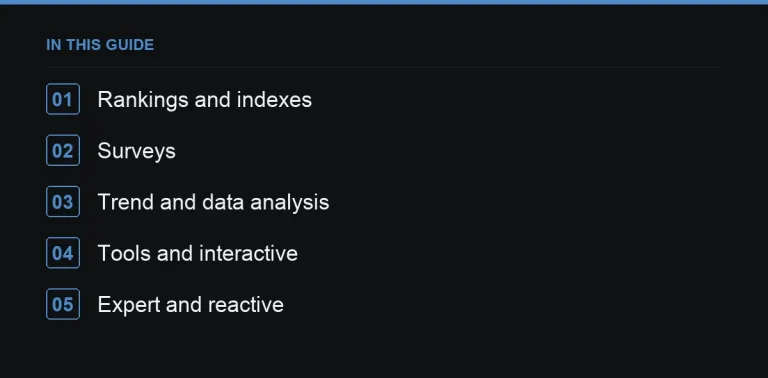
Rankings and indexes
- Best/worst places for X — cities ranked for remote workers, dog owners, cyclists, or any lifestyle your brand relates to.
- Cost index — the true cost of a hobby, a wedding, a pet, or a life event, broken down by region.
- Most affordable X — countries, cities or months to make a particular purchase or trip.
- Brand or product rankings — reliability, running costs, or resale value across a category.
- Salary or earnings index — by role and region, useful across many B2C and B2B niches (recruitment link building).
Surveys
- Habits and attitudes within your specific audience (survey-based PR campaigns).
- Generational comparisons on a topic your brand understands well.
- Regional differences in opinion, spending or behaviour.
- Common myths and misconceptions people believe, tested and corrected.
- Annual “state of the industry” reports built from repeat surveys over time.
Trend and data analysis
- Search trend analysis — what people search for most, by region or season.
- Price change tracking over time, for a category you have visibility into.
- Anonymised platform data — what your own customers actually do, aggregated.
- Public data remixed — official datasets combined in a way nobody’s done before.
- Seasonal peaks — when interest in a topic spikes and why.
Tools and interactive formats
- Calculators readers can personalise with their own numbers (free tools for links).
- Quizzes with shareable, personalised results.
- Interactive maps that let readers explore a dataset themselves (visual assets).
- Generators — names, ideas, plans, tailored to your niche.
- Side-by-side comparison tools for products, places or options.
Expert and reactive formats
- Expert predictions for the year ahead, credited to a named spokesperson.
- Reaction to official data releases as they happen (reactive PR).
- Plain-language explainers of new rules or laws relevant to your audience.
- Seasonal safety or money-saving tips from a genuine in-house expert.
- Myth-busting delivered by someone actually qualified to bust the myth.
Choosing between formats
| You have… | Best-fit formats |
|---|---|
| Internal usage or transaction data | Trend analysis, indexes, anonymised platform data |
| A budget for primary research | Surveys, state-of-the-industry reports |
| Design or development resource | Calculators, interactive maps, generators |
| A credible in-house spokesperson | Predictions, reactive comment, myth-busting |
Combining formats for a bigger release
The strongest campaigns often combine two formats rather than sticking to one — a ranking or index paired with a short survey that explains why the pattern exists, for instance, or a trend analysis paired with an interactive tool that lets readers check their own city or situation against the national picture. This gives journalists more than one way into the story: a data journalist might want the raw ranking, while a features writer wants the human angle from the survey, and a tech-focused outlet might cover the interactive tool on its own merits.
Matching formats to publication types
National news desks tend to favour clean, single-number headlines from rankings and indexes; feature writers and lifestyle sections respond better to survey findings about attitudes and behaviour; trade press wants industry benchmarks and expert predictions specific to their sector. Pitching the same format to every publication type wastes effort — tailor which finding leads depending on who you’re sending it to.
From idea to campaign
Picking a format is the easy part; the real work is choosing a genuine angle within it, gathering data you can defend, and building a landing page that keeps its authority even after coverage fades. Combine format selection with a realistic content calendar (newsjacking calendar) and a clear plan for pitching regional variations of a national story (pitching regional press).
Building the campaign brief before production starts
Before commissioning data collection, design or development, write a one-page brief covering the intended headline, the audience it’s aimed at, the format chosen, roughly how it’ll be measured, and who needs to approve it before release. This single document saves considerable time later — it catches misalignment between what stakeholders expect and what’s actually being built, well before any real production cost has been incurred, and gives everyone a shared reference point when the campaign inevitably evolves during production.
Where to go next
Once you’ve picked a format, see how to run it properly — starting with survey design (survey-based PR campaigns) and creative, non-data formats (creative digital PR campaigns) — and how to avoid the most common reasons campaigns get no coverage at all (why PR campaigns fail). If you’d rather supplement PR with steady, predictable placements, browse the Digital PR marketplace by niche.
Frequently asked questions
What makes a digital PR idea work?
Relevance to a topic journalists already cover regularly, genuinely credible data, and enough angles to serve national, regional and trade press separately.
Do I need original data?
Original data, or an original analysis of existing public data, makes a campaign far more likely to be covered than a purely opinion-based pitch.
How many campaign ideas should I test?
Brainstorm widely across formats, then validate a shortlist against real news interest and data availability before committing resources to production.
Can the same dataset produce more than one campaign?
Yes — a single dataset often supports a national headline, several regional breakdowns, and a follow-up piece months later using the same source refreshed.
Put it into practice
Filter 54,483 websites by DR, traffic, niche and price, and order with escrow — you pay only after the link is live.
Browse the marketplace