Why Digital PR Campaigns Fail (and How to Fix Them)
Most failed PR campaigns fail for predictable reasons. Here they are, with fixes.
Every digital PR team has campaigns that land nowhere despite real effort going into them. The causes are usually predictable and repeat across teams and niches, which means most of them can be caught and fixed before launch rather than diagnosed afterward.
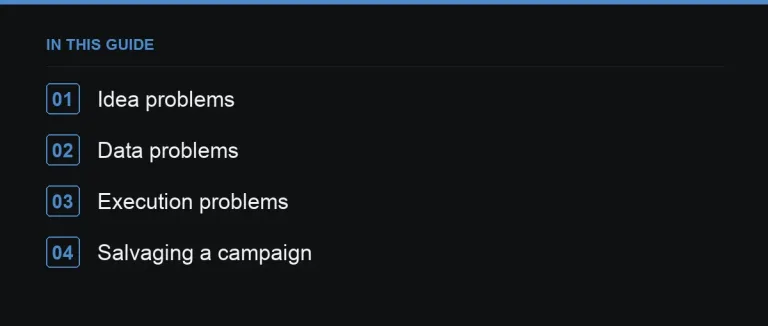
Idea problems
- No real news value — interesting to the team that built it, not to the readers it’s aimed at. Test headlines with someone genuinely outside the project before launch.
- Too brand-focused — the piece reads as an advert rather than a story, with the brand mentioned more than the actual finding.
- Already done recently — check whether a similar story ran in the last year before investing in research and production.
Data problems
- Weak underlying data — samples too small or unrepresentative to support the headline claim (survey-based campaigns).
- Unclear methodology — journalists can’t verify the claim, so they simply pass on it rather than risk publishing something unverifiable.
- No regional or segment angles — a single national number limits pickup to a handful of national outlets instead of dozens of regional ones (pitching regional press).
Execution problems
- Bad timing — launching on a day dominated by unrelated major news, or out of season for a seasonal topic (newsjacking calendar).
- Generic pitching — the identical email sent to every journalist on a list, regardless of what they actually cover (journalist outreach).
- Wrong journalists — pitching people who don’t cover the topic at all, wasting the pitch and the relationship.
- Poor supporting assets — no clear headline finding, no usable images, no quote ready for a journalist to drop straight into a story.
A quick self-audit before launch
| Check | Fix if it fails |
|---|---|
| Would this headline stop a scrolling reader? | Sharpen the angle or find a more surprising finding in the data |
| Can a journalist verify the claim in under a minute? | Publish a clear, complete methodology on the landing page |
| Does the pitch name the journalist’s own recent work? | Personalise every pitch rather than mass-sending |
| Is there a ready quote and image for immediate use? | Prepare both before the send, not after the first reply |
Internal politics as a hidden failure cause
Some campaigns fail for reasons that have nothing to do with the idea or the data — approval delays that push a launch past its relevant news window, a legal or compliance review that strips the interesting finding out of caution, or a rebrand mid-campaign that forces a relaunch under new messaging. These aren’t PR problems in the traditional sense, but they’re common enough that building in buffer time for internal sign-off, and getting legal and compliance involved early rather than at the last minute, prevents a genuinely good idea from failing purely on process.
Salvaging a campaign that’s already underperformed
A campaign that lands nowhere on first release isn’t necessarily dead. Re-angle the same underlying data for a different audience, add a regional or local breakdown you hadn’t pitched initially, tie the same finding to an upcoming news moment, or pitch trade press specifically instead of national media that already passed on it once (B2B digital PR).
Learning from repeated failure patterns
If several campaigns in a row fail for the same reason — weak methodology, say, or consistently poor timing — that’s a process problem worth fixing directly rather than treating each failure as a one-off. Keeping a simple internal log of what didn’t work and why, reviewed after every campaign, surfaces these patterns faster than relying on memory alone.
Distinguishing a slow burn from a genuine failure
Some campaigns that look like failures in the first week pick up coverage weeks or months later, particularly when a piece of data becomes newly relevant to an unrelated story a journalist is writing. Before writing off a campaign entirely, keep the landing page live and occasionally re-pitch the strongest finding to journalists covering a newly relevant angle, rather than assuming the initial quiet response is the final verdict.
Post-mortems that actually change behaviour
A post-mortem that simply lists what went wrong without assigning a concrete fix to try next time rarely changes anything — the same mistake tends to repeat a few campaigns later. A useful post-mortem ends with one or two specific, testable changes for the next campaign, rather than a general resolution to “do better research” or “pitch more journalists”, which are too vague to actually act on.
Setting realistic expectations before launch
Part of avoiding the feeling of “failure” is calibrating expectations before a campaign launches rather than after — sharing a realistic range of likely outcomes with stakeholders up front, based on similar past campaigns, prevents a genuinely reasonable result from being perceived internally as a disappointment purely because expectations were set too high at the start.
Where to go next
Avoiding these failure modes gets easier with a bank of proven formats to choose from (25 digital PR campaign ideas) and disciplined survey or data design from the outset (survey-based PR campaigns). Steady placements through the Digital PR marketplace keep link building moving even during a run of underperforming PR campaigns.
Frequently asked questions
How many PR campaigns fail?
A meaningful share of campaigns underperform; most experienced teams judge success across a portfolio of campaigns rather than expecting every single one to land.
Can a failed campaign be relaunched?
Often, yes — with a new angle, a localisation you hadn't tried, or a tie-in to an upcoming, relevant news moment.
What's the most common cause of failure?
An idea that lacks real news value for the target publication's actual readers, regardless of how much production effort went into it.
Should I keep a record of failed campaigns?
Yes — a simple log of what didn't work and a likely reason helps spot repeated patterns, like consistently weak methodology or poor timing, that are worth fixing at the process level.
Put it into practice
Filter 54,483 websites by DR, traffic, niche and price, and order with escrow — you pay only after the link is live.
Browse the marketplace