Finding Regional Angles From National Data
Why regional breakdowns of national data often outperform the national story itself in total link volume.

National data rarely gets covered by every regional outlet in a market on its own — a national top-line finding competes with dozens of other national stories for a limited number of slots. A regional breakdown of the same data, sent to the right local desk, faces far less competition and often converts at a higher rate.
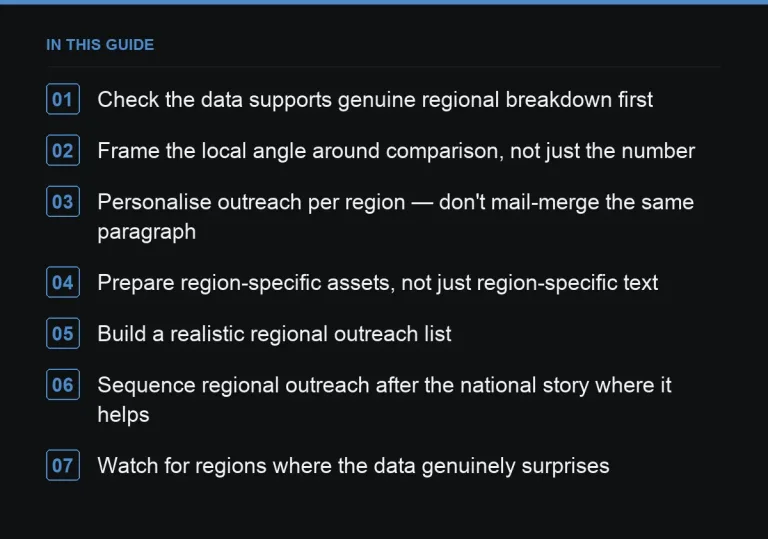
Check the data supports genuine regional breakdown first
Before promising regional angles in your outreach plan, confirm the underlying dataset actually has regional-level granularity, not just a national aggregate. Data collected at national level often cannot be broken down reliably without introducing statistical noise — check sample sizes per region if the source is a survey, following the guidance in https://successtoroad.com/blog/survey-design-pitfalls/.
Frame the local angle around comparison, not just the number
A raw regional figure (“Region X recorded a value of Y”) is far less interesting to a local journalist than a comparison: how the region ranks against the national average, how it compares to neighbouring regions, or how it’s changed relative to previous data. Comparison creates the “so what” that a standalone number lacks.
Personalise outreach per region — don’t mail-merge the same paragraph
Sending an identical email to fifty regional contacts with only the region name swapped out is easy to spot and easy to ignore. Reference something locally specific if possible — a known regional characteristic, a nearby comparison point, or a locally relevant framing of why the finding matters there.
Prepare region-specific assets, not just region-specific text
A cropped chart or map focused on one region, as covered in https://successtoroad.com/blog/visual-assets-for-journalists/, makes it far easier for a local journalist to publish quickly. Pair every regional pitch with an image built for that region specifically, not a national graphic they’d have to crop themselves.
Build a realistic regional outreach list
Regional press lists require more maintenance than national ones — titles merge, close, or change contacts more frequently. A simple structure helps keep this manageable:
| Region | Primary contact | Best angle |
|---|---|---|
| Region A | Local news desk | Above-average result |
| Region B | Business desk | Below-average, improving trend |
Sequence regional outreach after the national story where it helps
Sometimes leading with the national story first, then following with regional pitches referencing “the national data that’s already been covered,” adds credibility to the regional pitch. Other times, especially for https://successtoroad.com/blog/reactive-pr/ timing, going straight to regional outlets first works better. Decide based on the story’s shape rather than a fixed rule.
Watch for regions where the data genuinely surprises
The strongest regional angle is often not the region with the highest or lowest value but the one that contradicts a common assumption about that place. A region widely assumed to be affluent showing an unexpectedly weak result, or a region with a reputation for one thing showing the opposite, tends to outperform a straightforward “top of the table” framing precisely because it challenges what local readers think they already know, which is exactly the kind of angle worth prioritising in https://successtoroad.com/blog/pitching-angles-from-one-dataset/.
Keep a running record of regional media relationships
Regional campaigns work best when they build on relationships rather than starting cold each time. Note which regional contacts responded well to a previous campaign, what tone or format they preferred, and revisit that record before the next regional wave. This turns regional outreach into a compounding asset rather than a one-off list rebuilt from scratch for every campaign, and it pairs naturally with the follow-up planning in https://successtoroad.com/blog/follow-up-outreach-waves/.
Handle areas with genuinely small or no data separately
Some regions will inevitably have too little data for a reliable individual figure, particularly with survey-based sources. Rather than force a shaky number into the table, either group small areas into a wider region for reporting purposes or note plainly that data was insufficient for that area. A gap acknowledged honestly reads as more credible than a suspiciously precise figure built on too few respondents.
Reference well-known local landmarks or context sparingly
A pitch that ties a regional figure to a locally recognisable reference point can help a journalist see the relevance quickly, but overdoing this can feel forced or poorly researched if the reference doesn’t actually connect meaningfully to the data. Use local context only where it genuinely illuminates the figure, not as a generic device bolted onto every regional email.
Consider a short regional explainer alongside the figures
Where a region’s result seems puzzling without context, a brief, neutral explanatory note — noting a relevant local factor without overreaching into speculation — helps a journalist and their readers make sense of the number without you overstating what the data itself can support. This is particularly useful for a region that sits as a clear outlier relative to its neighbours.
Where to go next
Combine regional angles with a proper https://successtoroad.com/blog/map-based-pr-campaigns/ where the data supports it, and plan the https://successtoroad.com/blog/campaign-timelines/ to allow for staggered regional sends. Make sure the underlying figures hold up under the scrutiny described in https://successtoroad.com/blog/survey-design-pitfalls/ before committing to a regional claim. https://successtoroad.com/niche/news-and-media/ publishers on https://successtoroad.com/marketplace/ are a strong complement to direct regional outreach.
Frequently asked questions
How many regions do we need for a viable regional campaign?
Enough that comparisons are meaningful — a handful of regions can work if the contrast between them is genuinely interesting, but very small counts limit how many separate pitches you can realistically send.
Should regional pitches go out before or after the national story?
Either can work. Leading nationally then following regionally can lend credibility; going straight to regional press first can work well for stories with limited national appeal but strong local relevance.
What's the biggest mistake in regional digital PR outreach?
Sending an identical mail-merged pitch to every regional contact with only the place name changed. Local journalists notice, and it reduces open and reply rates compared to a genuinely tailored pitch.
Can small businesses use this approach, not just national brands?
Yes — regional and local angle-finding is often more accessible to smaller teams than national campaigns, since local press has more available space and less competition for regional stories.
Put it into practice
Filter 54,483 websites by DR, traffic, niche and price, and order with escrow — you pay only after the link is live.
Browse the marketplace