Digital PR for Ecommerce Brands
Ecommerce brands have sales data journalists would love. Here's how to turn it into coverage and links.
Ecommerce brands have a genuine advantage in digital PR that many underuse: real data about what people actually buy, when, and where. Anonymised and aggregated properly, that data produces the kind of trend stories journalists actively want, alongside the more classic retail PR formats like gift guides and seasonal roundups.
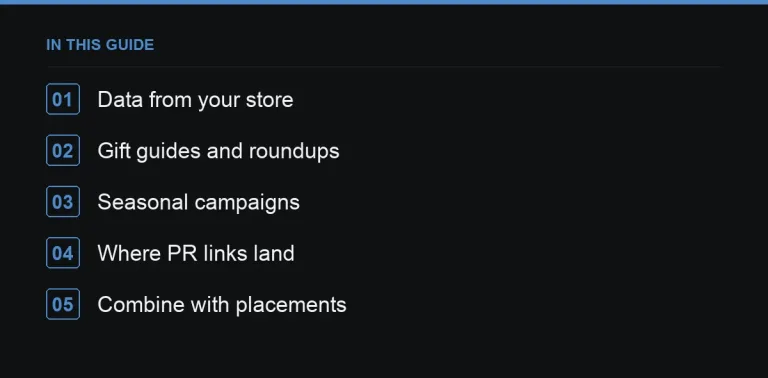
Turning your own store data into a story
- Trending products by region or season, drawn from real purchase patterns rather than assumptions.
- Genuine changes in buying behaviour over time — what’s grown or shrunk as a share of sales.
- Most popular colours, sizes or styles, broken down by city or region for local angles.
Always aggregate and anonymise customer data properly before using it in any campaign, and be explicit about how the figures were derived (data-driven PR campaigns).
Gift guides and seasonal roundups
Pitch specific products for seasonal gift guides months ahead of the season itself, with images, prices and confirmed stock levels ready to go — editors plan these features well in advance and have little patience for late submissions (ecommerce link building).
Planning around the retail calendar
Build campaigns around the predictable retail calendar: major holidays, sales events, back-to-school, and summer travel season, rather than treating each moment as a fresh scramble (newsjacking calendar). Knowing these dates a year ahead lets you prepare data and assets properly instead of rushing them out at the last minute.
Where PR links should actually land
PR coverage usually links to your homepage or a dedicated campaign page by default, which isn’t always where you need the authority most. Link deliberately from that campaign page to the relevant product categories so the authority PR earns actually reaches pages that sell, rather than sitting on a page that converts nobody (internal linking and backlinks).
A simple campaign-to-category map
| Campaign type | Where to link internally |
|---|---|
| Regional buying trend story | Relevant product categories mentioned in the trend |
| Seasonal gift guide feature | Seasonal collection or gift guide page on your own site |
| Sizing/style popularity data | Category or style-specific landing pages |
Combining PR with steady placements
PR coverage is inherently unpredictable — some months land big features, others land nothing. Relevant guest post and niche edit placements supporting your buying guides and category content give steadier, more predictable progress between PR wins, and are easier to plan a budget around (Digital PR marketplace).
Working with influencers and affiliate reviewers
Product seeding to relevant bloggers and reviewers overlaps with PR but runs on a different timeline — reviewers often need weeks with a product before publishing, longer than a typical PR pitch cycle. Building this into your calendar separately from press outreach avoids the common mistake of treating them as the same activity and running out of stock or samples for one while focusing on the other.
Honest disclosure in seeded reviews
Where products are seeded free of charge or reviewers are compensated, the same disclosure expectations that apply to sponsored guest posts apply here too — readers should be able to tell a review was prompted by a free product or payment. Reviewers who disclose honestly tend to retain more reader trust over time than those who don’t, which is worth factoring into who you choose to work with (disclosure rules for sponsored content).
Refreshing evergreen data campaigns annually
A trend or pricing campaign built once can often be refreshed with updated figures the following year at a fraction of the original research cost, giving you a near-annual story with minimal extra work. This works particularly well for cost-index or trend-tracking formats where the underlying data source updates regularly, turning a single campaign into a recurring content asset rather than a one-time effort.
Timing gift guide pitches around editorial deadlines
Print and larger online gift guides are frequently planned months before publication, meaning a pitch sent even a few weeks before the guide is due to publish can already be too late. Building a simple annual pitching calendar specific to your product categories — noting roughly when major gift guide editors historically open pitching for each season — avoids missing the window entirely and having to wait a full year for the next opportunity.
Planning stock and logistics around a campaign
A PR campaign that succeeds unexpectedly well can create its own operational problem — a surge in demand for a specific product a piece of coverage highlighted, with stock unable to keep up. Checking stock depth for any product likely to be featured before a campaign launches, and having a plan for what happens if a specific SKU sells out mid-campaign, avoids turning a PR win into a customer service problem.
Where to go next
Ecommerce PR benefits from a wider bank of campaign ideas to rotate through (25 digital PR campaign ideas) and from making sure PR and SEO goals are aligned from the planning stage (aligning PR with SEO). Browse relevant publishers in the shopping niche to support your category pages directly.
Frequently asked questions
What data can ecommerce brands use for PR?
Aggregated, anonymised trends in what, when and where customers buy — never individual customer-level data.
When should I pitch gift guides?
Months before the relevant season, since editors plan seasonal roundups and gift guides well in advance.
How do PR links help category pages?
Through deliberate internal links from the campaign or coverage-linked page to the relevant product categories, rather than leaving authority stranded on the homepage.
Should ecommerce brands rely on PR alone?
No — PR coverage is unpredictable month to month, so pairing it with steady guest post and niche edit placements gives more consistent progress.
Put it into practice
Filter 54,483 websites by DR, traffic, niche and price, and order with escrow — you pay only after the link is live.
Browse the marketplace