Headline Writing for Digital PR Campaigns
The difference between a headline that gets forwarded to an editor and one that gets deleted after the first sentence.
The headline is the first and sometimes only part of your pitch a journalist reads properly. Everything else — the data, the design, the outreach list — can be excellent and still underperform if the headline doesn’t communicate the story fast enough.
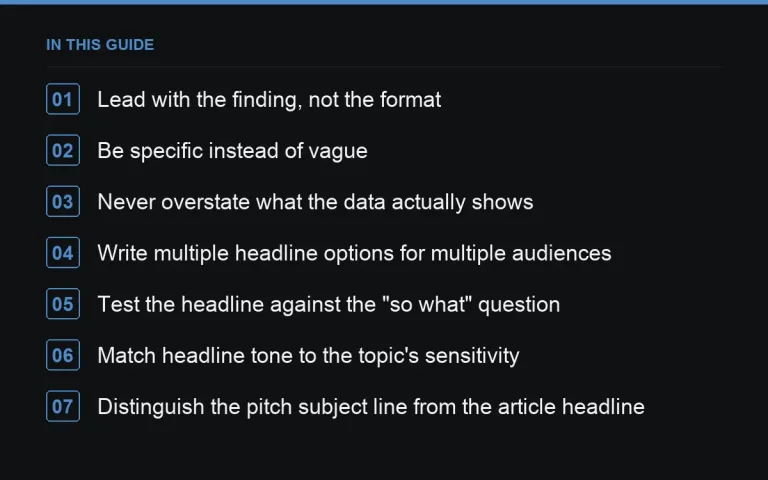
Lead with the finding, not the format
“New Survey Reveals…” tells the reader nothing about what was found; it just describes your research method. Replace format-first headlines with finding-first ones: state the actual number, comparison, or surprising fact directly. The method can go in the body copy or the methodology note, not the headline.
Be specific instead of vague
Compare these two approaches:
- Vague: “The Surprising Truth About How Much Britons Spend”
- Specific: “Average Household Spend on X Rose by [amount] This Year”
The specific version tells a busy journalist immediately whether the story fits their beat, which increases the odds they open the full pitch rather than skim and move on.
Never overstate what the data actually shows
A headline claiming causation when your data only shows correlation, or generalising a narrow sample to a whole population, is the fastest way to damage credibility — and to get a correction request after publication. Keep the headline as accurate as the most careful line in your methodology note, not more dramatic than it.
Write multiple headline options for multiple audiences
A national desk, a regional title, and a trade publication often need different headline framings of the same underlying data, following the logic in https://successtoroad.com/blog/pitching-angles-from-one-dataset/. Draft two or three variants before outreach begins rather than sending one generic headline to every contact on your list.
Test the headline against the “so what” question
Read the draft headline and ask: so what does this mean for the reader? If the answer isn’t obvious within the headline itself, add the implication directly rather than assuming the journalist will infer it. “X Costs Rose 12%” is weaker than “X Costs Rose Enough to Add [amount] to the Average Bill” if your data supports the second framing.
Match headline tone to the topic’s sensitivity
Playful or punchy headlines work for lighter consumer topics but can misfire badly on health, finance, or safety subjects — see https://successtoroad.com/blog/responsible-health-campaigns/ and https://successtoroad.com/blog/campaigns-for-finance-brands/ for where extra restraint is warranted. When in doubt, favour a plainer, more descriptive headline over a punchier one.
Distinguish the pitch subject line from the article headline
An email subject line and a published article headline serve different purposes and can afford to be written slightly differently. The subject line needs to earn an open in a crowded inbox, so it can be a touch more direct about why the story matters right now; the suggested article headline you offer in the body of the pitch should read like something the outlet’s own house style would actually publish, since a headline that sounds like marketing copy signals the whole pitch was written without the outlet in mind.
Learn from what already ran
Keep a simple log of which headline framings, from past campaigns, ended up being used closely by the journalists who covered the story versus which got rewritten entirely. Over several campaigns this becomes a useful reference for which phrasing patterns this particular set of publications tends to adopt as-is, and which ones they habitually rework — a signal worth folding into the next https://successtoroad.com/blog/campaign-ideation-workshops/.
Watch for words that quietly overclaim
Words like “proves,” “reveals,” or “confirms” imply a stronger evidentiary basis than most single campaigns can support. Softer, still confident alternatives — “suggests,” “shows,” “points to” — are usually more accurate and rarely weaken the headline’s impact in practice, since the underlying finding is doing the real work, not the verb describing it.
Read the headline out loud before sending it anywhere
A headline that reads smoothly on a screen sometimes reveals an awkward rhythm, an ambiguous phrase, or an unintended double meaning once spoken aloud. This takes seconds and catches a surprising number of small issues that a purely visual read-through misses, especially for wordplay-heavy or pun-based headline attempts.
Keep the length appropriate to where it will appear
A headline destined for an email subject line needs to work within a much shorter character count than one destined for a full article, and a suggested headline that’s too long for either context puts extra editing burden on the journalist. Draft a short version and a slightly fuller version, and offer both so the recipient can pick whichever fits their format.
Where to go next
Once headlines are drafted, build the supporting page around them — see https://successtoroad.com/blog/campaign-landing-page-design/ — and check the underlying data will survive scrutiny with https://successtoroad.com/blog/survey-design-pitfalls/ or https://successtoroad.com/blog/using-public-datasets-for-pr/ depending on your source. https://successtoroad.com/services/writing/ can help draft and test headline variants at scale, and https://successtoroad.com/marketplace/ gives you a way to place supporting content once your strongest headline framing is confirmed by early coverage.
Frequently asked questions
Should headlines include numbers or spell them out?
Numerals (12%, not twelve percent) are generally easier to scan quickly in a pitch subject line or article headline, and most style guides favour them for statistics specifically.
How many headline variants should we prepare per campaign?
Two or three is usually enough — one general-audience version, one regional variant, and one trade or niche-specific angle if your data supports it.
Is it ever fine to use a question as a headline?
Occasionally, but question headlines work best when the answer is genuinely uncertain or surprising. Overused rhetorical questions can read as clickbait and undercut a data-led campaign's credibility.
What's the biggest headline mistake in digital PR pitches?
Stating the research method instead of the finding — 'new study reveals' style openers waste the most valuable words in the email without telling the journalist anything specific.
Put it into practice
Filter 54,483 websites by DR, traffic, niche and price, and order with escrow — you pay only after the link is live.
Browse the marketplace