Survey Design Pitfalls That Sink Digital PR Campaigns
The recurring mistakes that turn a promising survey campaign into one a journalist can pick apart in a single reply.
Surveys are one of the most common digital PR mechanics because they’re relatively cheap to commission and can generate data on almost any topic. They’re also one of the easiest formats to get wrong in ways that don’t show up until a skeptical journalist — or a competitor — starts asking questions about methodology.
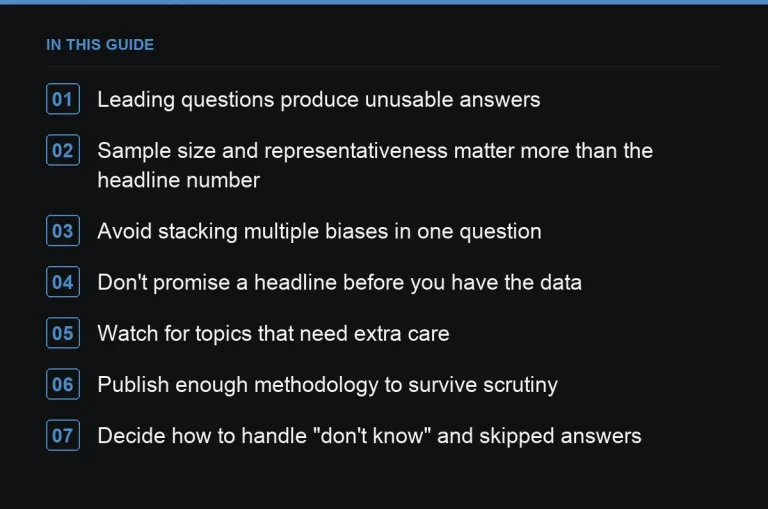
Leading questions produce unusable answers
A question phrased as “how much do you enjoy X” assumes the respondent enjoys it at all, and skews every downstream statistic. Write questions the way a neutral researcher would, not the way a marketer hoping for a specific headline would. If you can predict the answer before asking, the question is probably leading.
Sample size and representativeness matter more than the headline number
A survey of 200 people cannot support a claim about “UK adults” without heavy caveats, and a self-selecting online panel skews toward people willing to take surveys, not a random cross-section. State your sample size, method, and any weighting plainly in the methodology note — vague sourcing is the fastest way to lose credibility with a journalist who checks.
Avoid stacking multiple biases in one question
Common compounding errors include:
- Double-barrelled questions asking about two things at once (“do you worry about cost and safety”).
- Unbalanced scales that offer three positive options and one negative.
- Order effects, where earlier questions prime the respondent’s answer to a later one.
Pilot the survey on a handful of colleagues before fielding it properly — a five-minute read-through catches most of these issues.
Don’t promise a headline before you have the data
Teams sometimes write the press release headline before the survey closes, then feel pressure to interpret ambiguous results to match it. Commission the survey with an open question in mind, not a predetermined answer, and let https://successtoroad.com/blog/pitching-angles-from-one-dataset/ guide angle development after the data comes in, not before.
Watch for topics that need extra care
Surveys touching health, finances, or sensitive personal behaviour carry more reputational risk if the methodology is shaky. See https://successtoroad.com/blog/responsible-health-campaigns/ and https://successtoroad.com/blog/campaigns-for-finance-brands/ for the additional caution those subjects need — a poorly worded question here isn’t just an ethics issue, it’s a coverage risk if a journalist or reader flags it publicly.
Publish enough methodology to survive scrutiny
Include sample size, field dates, respondent demographics, and the exact question wording for headline claims. This is often the single detail that separates a survey story a broadsheet will run from one it declines because it can’t verify the claim quickly enough on deadline.
Decide how to handle “don’t know” and skipped answers
Excluding non-responses from a percentage calculation without saying so can quietly inflate a headline figure. Decide upfront whether “don’t know” counts as part of the base, and state whichever choice you make plainly next to any percentage that depends on it. This single decision is one of the most common places a seemingly solid survey figure falls apart under a careful read.
Consider commissioning through a recognised panel provider
A well-known panel provider brings established sampling controls and a level of independent credibility that a self-built online poll usually can’t match. It costs more than an ad hoc survey tool, but for a campaign relying on a single headline statistic to carry national coverage, that additional credibility is often worth the extra spend, and it gives you a firmer answer when a journalist asks how respondents were recruited.
Review the questionnaire as a whole, not question by question
Individual questions can each look reasonable in isolation while the questionnaire as a whole still nudges respondents toward a particular answer through ordering, framing, or repetition of a theme. Read through the full survey in one sitting, ideally out loud, before fielding it, imagining you are a respondent with no stake in the outcome — this whole-document read catches compounding bias that a question-by-question review misses.
Keep the raw data even after publishing the summary
Retain the anonymised raw response data for a reasonable period after the campaign, not just the summary statistics used in the release. If a journalist or a member of the public asks a follow-up question the published summary doesn’t directly answer, being able to check the raw data quickly is far more useful than having only the headline figures to work from.
Consider running a short qualitative follow-up
A handful of open-ended follow-up questions or brief interviews with a small subset of respondents can add texture and quotable colour to what would otherwise be a purely numerical release. This qualitative layer often gives journalists something more distinctive to write around than the raw percentages alone, without requiring a second full-scale survey.
Where to go next
Once the data is clean, plan the release using https://successtoroad.com/blog/headline-writing-for-campaigns/ and consider whether a regional cut works, per https://successtoroad.com/blog/regional-angles-from-national-data/. For distribution beyond your own outreach list, https://successtoroad.com/marketplace/ and https://successtoroad.com/services/seo/press-release-distribution/ can extend reach to publishers who cover survey-based stories regularly.
Frequently asked questions
What sample size is usually considered credible for a national survey?
There's no fixed threshold, but around 1,000–2,000 respondents is a common benchmark for national claims in most markets. Smaller samples can still be useful for niche or regional claims if framed accordingly.
Should we test the survey before fielding it fully?
Yes, always pilot with a small group first. A five-minute read-through by colleagues who weren't involved in writing the questions reliably catches leading language and confusing wording.
Is it fine to survey our own customer base instead of a general panel?
Yes, but the headline framing must reflect that — describe results as reflecting your customers, not the general population, unless the sample is genuinely representative of the wider group.
How much methodology detail is too much for a press release?
Include a short summary in the release itself and link to a fuller methodology note on the landing page. Journalists want the key facts fast but appreciate being able to verify details if they choose to.
Put it into practice
Filter 54,483 websites by DR, traffic, niche and price, and order with escrow — you pay only after the link is live.
Browse the marketplace