How to Validate a Digital PR Campaign Idea Before You Build It
A short, repeatable checklist for deciding whether a campaign concept deserves a build budget.
The most expensive mistake in digital PR is not a bad pitch email — it’s building a full campaign around an idea that was never going to land coverage. Validation is the step between “this sounds interesting” and “let’s brief the designer,” and it should take a day or two, not a gut-feel five minutes.
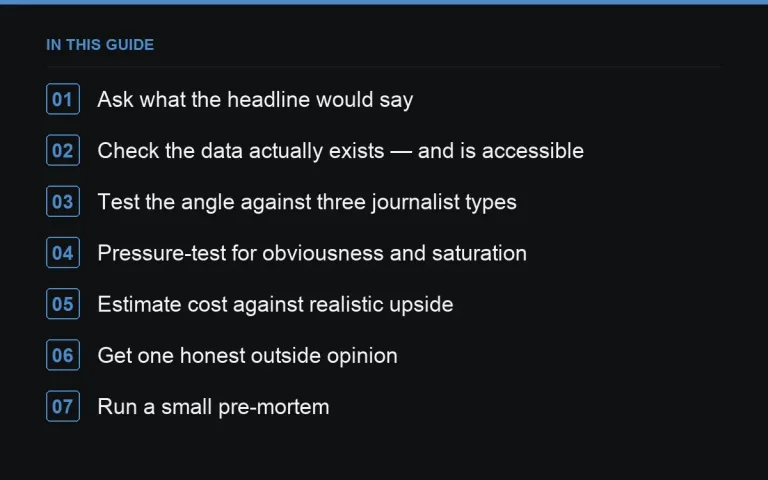
Ask what the headline would say
Before any data is pulled, write the headline you want a journalist to publish. If you can’t write a plausible headline in one sentence, the idea is still too vague to build. “UK Cities Ranked by X” or “How Much the Average Household Spends on Y” are testable headlines; “a fun campaign about Z” is not. This single exercise kills more weak ideas than any other step, and it feeds directly into https://successtoroad.com/blog/headline-writing-for-campaigns/.
Check the data actually exists — and is accessible
Search for the underlying data before committing to the concept. Confirm the source is public, or that a https://successtoroad.com/blog/foi-requests-for-campaigns/ is realistic within your timeline. A campaign built on data you cannot legally publish, or that the source might change access rules on later, is a dead end you find out about too late.
Test the angle against three journalist types
Picture three different publications: a national desk, a regional title, and a trade or niche outlet. Ask whether each would plausibly run a version of the story. An idea that only works for one of the three is narrower than it looks and will need a bigger volume of https://successtoroad.com/blog/pitching-angles-from-one-dataset/ to reach a reasonable number of links.
Pressure-test for obviousness and saturation
Search recent coverage for similar campaign formats in your niche. If three competitors ran an almost identical “index of best places for X” in the last year, journalists have likely already covered the format and will pass. This doesn’t mean avoid rankings entirely — see https://successtoroad.com/blog/index-and-ranking-campaigns/ — it means find the angle that’s genuinely new within that format.
Estimate cost against realistic upside
Put a rough number on design, data, and outreach time, and compare it honestly against the likely number of linking placements. A simple table like this keeps expectations grounded:
| Mechanic | Typical build effort | Realistic link range |
|---|---|---|
| Single-question survey | Low | Small, regional-heavy |
| Multi-source ranking index | Medium-high | Medium, some national |
| Interactive calculator | High | Long-tail, ongoing |
For budget-constrained validation, https://successtoroad.com/blog/small-budget-digital-pr-campaigns/ covers cheaper ways to test an angle before a full build.
Get one honest outside opinion
Show the one-sentence headline and the proposed data source to someone outside the immediate team — ideally someone who deals with journalists directly. A flat “I wouldn’t cover that” from one person is more useful than five internal thumbs-up, because internal teams are biased toward ideas they already spent time developing.
Run a small pre-mortem
Before committing budget, spend fifteen minutes imagining the campaign has already failed and asking why. Common answers cluster into a short list: the data source changed access terms, a competitor published something similar first, the angle turned out to be too regional for the national pitch you planned, or the build took twice as long as expected and missed the seasonal window. Writing these down doesn’t prevent every failure mode, but it forces the team to name the specific risk rather than a vague sense that “it might not land,” which is much harder to plan around.
Decide the kill criteria in advance
Set a clear threshold for walking away before validation starts, not during it. If the data turns out to require a paid licence beyond budget, if three separate people can’t write a plausible headline, or if the topic is already saturated in recent coverage, the idea should be parked rather than pushed through on momentum. Deciding this in advance removes the awkwardness of killing an idea the team has already grown attached to.
Document the validation outcome, even for rejected ideas
Whatever the outcome, write down what you checked and why the idea passed or failed. A rejected idea with a documented reason is genuinely useful later — data availability might change, a competitor might vacate the space, or a new angle might solve the original problem. Without a record, teams tend to either forget the idea entirely or, worse, revisit it from scratch a year later and repeat the same validation work that already produced a clear answer.
Validate the outreach list alongside the concept
An idea can pass every other check and still underperform because the team assumed a strong journalist list existed without actually confirming it. As part of validation, sketch a rough list of the ten or so contacts you’d realistically pitch first. If that list is thin or full of contacts who’ve gone quiet on previous pitches, that’s a real signal about the campaign’s likely reach, and it’s cheaper to discover during validation than after the full build is finished and outreach has already begun.
Where to go next
Once an idea survives validation, move into build planning with https://successtoroad.com/blog/campaign-timelines/ and https://successtoroad.com/blog/campaign-budgets/. If the validated angle turns out to be strong but resource-heavy, https://successtoroad.com/services/writing/ and https://successtoroad.com/marketplace/ can help you scale the outreach and placement side once the asset is ready.
Frequently asked questions
How long should validation take?
One to three working days for most ideas. If validation is taking longer than the campaign build itself would, the idea is probably too complicated or the data too hard to source.
Who should be involved in validating an idea?
At minimum, the person who will write the outreach pitch and someone with a realistic view of the data source. Involving too many people slows the decision without improving its quality.
What's a reliable early warning sign an idea will fail?
Struggling to write a one-sentence headline. If the pitch needs a paragraph of setup before the newsworthy part appears, journalists will not read past the first line.
Should we validate ideas we're excited about differently?
No — excitement is exactly when validation matters most. Enthusiasm for a concept has no correlation with whether a data source exists or whether the angle is already saturated.
Put it into practice
Filter 54,483 websites by DR, traffic, niche and price, and order with escrow — you pay only after the link is live.
Browse the marketplace