SEO Competitor Research Beyond Backlinks
Backlinks are one part of why competitors outrank you. Here's how to research the rest.
Competitor research often stops at backlinks, because backlink data is easy to pull and compare. Links matter, but competitors frequently outrank a site because of better content, clearer site structure, or stronger topical coverage that has nothing to do with links. A full review across all four areas tells you what to actually fix first, rather than defaulting to more outreach.
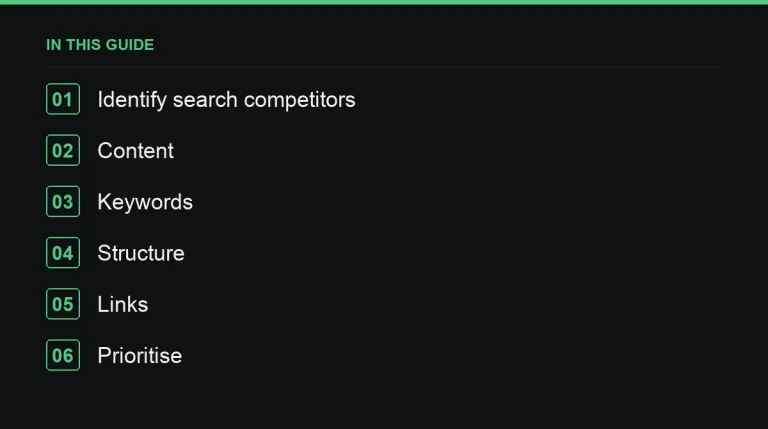
1. Identify your real search competitors
For each target keyword, list the sites that repeatedly rank above you. These are often different from the companies you think of as business competitors — a well-established blog or a niche publisher can outrank a direct commercial rival for informational queries.
2. Review their content
- What formats are ranking — long guides, tools, comparison pages, videos?
- How deep and how current is the content, compared to yours?
- What do they cover that you don’t cover at all?
3. Find keyword gaps
Run a keyword gap report to surface queries competitors rank for that you don’t. Group the results by topic rather than reviewing them as a flat list — isolated keywords are easy to miss the pattern in, but a missing cluster is obvious once grouped (see content clusters and links).
4. Check site structure
How is the competing site organised? Do their most important pages receive strong internal links from elsewhere on the site, or are they relying entirely on external links to carry them (see internal links and backlinks)?
5. Analyse their links
Look at referring domains to the specific ranking pages, not just the domain overall, along with where those links come from and how quickly they were acquired. A full walkthrough is in competitor backlink analysis.
Putting it together: a scoring approach
| Area | Question to ask | If you’re behind |
|---|---|---|
| Content | Is theirs more comprehensive or current? | Fix content before anything else |
| Keywords | Do they cover topics you’re missing entirely? | Plan new cluster pages |
| Structure | Do their key pages get strong internal links? | Fix internal linking |
| Links | Do they have meaningfully more relevant referring domains? | Prioritise link building |
6. Prioritise honestly
If content is the real gap, fix content first — more links to a thinner page rarely closes a content gap. If structure is weak, fix internal linking before spending on outreach, since new links will do less for a poorly connected page. If links are genuinely the differentiator once content and structure are comparable, that’s when to focus effort there. Most sites need some mix of all three, usually in roughly that order.
A note on tools
Whichever backlink or keyword tool you use, treat its numbers as directional rather than exact — different tools crawl different portions of the web and will disagree on totals. What matters is the relative comparison between you and a specific competitor, tracked consistently over time with the same tool.
Turning research into a written brief
Raw findings scattered across spreadsheets rarely get acted on. Turn the research into a short brief for each priority area: what the gap is, which specific competitor pages illustrate it, and what the recommended fix looks like in practice. A content gap becomes a list of new cluster pages with target intents; a structural gap becomes a specific internal linking plan; a link gap becomes a shortlist of publisher types to target.
Revisiting after you act
Competitor research isn’t a one-time report — after implementing changes, check back in a quarter to see whether the gap actually closed, whether the competitor has moved on to a new advantage, and whether new competitors have entered the search results entirely. Search results for competitive terms rarely stay static for long, and treating this as a recurring process rather than a single project keeps your priorities current.
Avoiding a copycat strategy
Research should inform priorities, not produce a page-for-page clone of a competitor’s site. Copying their structure and topics without your own angle or original value rarely outranks the original, since you’re competing on a dimension where they already have a head start in age, links and internal signals. Use the gaps you find as a starting point for something better or more current, not a template to replicate exactly.
Keeping the research proportionate
For a small site with limited resources, a lightweight version of this process — a spreadsheet with three or four real competitors, reviewed twice a year — delivers most of the benefit without the overhead of a full quarterly programme. Match the depth of the research to the size of the opportunity; an extremely thorough process is wasted if there’s no capacity to act on more than one or two findings at a time.
Where to go next
Once you know the real gap, use seasonal SEO and links or algorithm updates and your links to check whether timing or a recent update explains part of the difference, and revisit this research quarterly rather than once. To close a genuine link gap, browse https://successtoroad.com/marketplace/ for sites relevant to your specific niche.
Frequently asked questions
What should I analyse besides backlinks when researching competitors?
Content depth and format, keyword coverage across the topic, and how strongly the competitor's own site links internally to its key pages.
How do I find my real search competitors?
List the sites that repeatedly rank above you for your specific target keywords, since these are often different from your direct business competitors.
What should I fix first if I'm behind on all four areas?
Usually the biggest and most fixable gap first — often content depth or missing topic coverage, before spending heavily on additional link building.
How often should competitor research be repeated?
Quarterly is a reasonable rhythm for most sites, since content, structure and link profiles all shift gradually rather than overnight.
Put it into practice
Filter 54,483 websites by DR, traffic, niche and price, and order with escrow — you pay only after the link is live.
Browse the marketplace