Seasonal SEO: Timing Links for Peak Demand
If you start building links when the season starts, you're already late. Here's the timeline that works.
Seasonal pages — holiday gift guides, summer travel content, back-to-school offers, tax-season tools — need to be ranking by the time demand peaks, not just published by then. Links take time to have an effect, so the whole point of a seasonal link building plan is working backwards from the peak rather than reacting to it (see how long backlinks take to work for why the lead time matters).
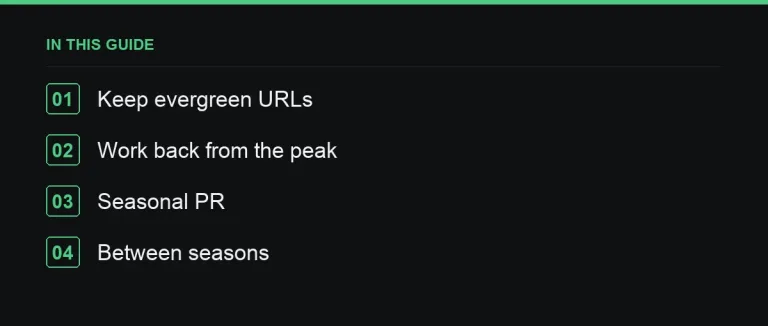
Keep one evergreen URL
The single most common mistake with seasonal content is creating a new URL every year — “/christmas-gifts-2025/”, then “/christmas-gifts-2026/”. Every year the page starts from zero: no accumulated links, no ranking history, no indexed age. Use one evergreen URL (“/christmas-gifts/”) and update the content in place each year. Links and authority then compound across seasons instead of resetting.
Working back from the peak
- 3–4 months before: refresh the content, fix any technical issues, and make sure the page is in good shape before outreach starts.
- 2–3 months before: build placements and pitch seasonal digital PR angles — journalists and bloggers plan seasonal features well ahead of the date (see building a newsjacking calendar).
- At the peak: reinforce with internal links from the homepage, navigation and relevant blog posts so the page gets maximum visibility while demand is live.
- After the peak: keep the page live and linked; don’t remove or noindex it. Note what worked so next year’s push starts from a plan, not a blank page.
Seasonal digital PR has its own calendar
Gift guides, “best of the year” roundups and seasonal feature planning happen on editorial calendars set months in advance. Pitching a seasonal angle the week the season starts means you’ve missed most of the publications that would have included you. This is especially true for e-commerce brands chasing gift-guide inclusion — see digital PR for ecommerce for how that outreach differs from evergreen link building.
What to do in the off-season
Keep seasonal pages indexed, internally linked and occasionally referenced from related evergreen content. Removing a seasonal page after the season, or letting it drop out of navigation entirely, throws away the links and ranking signals it accumulated — you’d be starting over next year instead of building on what you have.
Measuring a seasonal campaign properly
Because seasonal traffic is naturally cyclical, compare performance year over year rather than month over month, and separate branded from non-branded queries where you can (see measuring organic traffic in analytics). A page that ranked two positions higher than last year, with more referring domains, is a success even if raw traffic looks similar to the prior peak.
A short checklist for next season
- Is the URL still the same one from previous years?
- Has the content been refreshed with current information?
- Has outreach started at least two months before the peak?
- Are internal links from high-traffic pages pointing at it during the peak window?
Building a repeatable seasonal playbook
The first year you run a seasonal push, expect some of the timing to be a guess. Keep notes on when pitches were sent, when placements went live, and when rankings and traffic actually moved. By the second or third year, you’ll have a fairly reliable internal benchmark for your specific niche — some categories need a four-month lead time, others can move in six weeks. Treat this as data worth keeping in a shared document rather than institutional memory that leaves with one team member.
Handling multiple seasonal peaks in one year
Many sites have more than one seasonal moment — a retailer might have back-to-school, a winter holiday period and a summer sale window, each needing its own lead time and its own outreach angle. Stagger these in your calendar so outreach efforts don’t compete for the same journalists’ attention at the same time, and so your team isn’t trying to launch three pushes simultaneously with the same resources.
What happens if you miss the window
If outreach starts too late, don’t abandon the push entirely — a placement that lands during the season still helps for the following year, since the link and the page’s authority carry forward. Treat a late start as an investment in next year’s earlier, stronger position rather than a wasted effort, provided the URL stays the same.
Coordinating content, links and internal promotion
A seasonal push works best when three things move together: the page itself is refreshed and technically sound, outreach has secured a reasonable number of relevant placements, and internal promotion — homepage banners, navigation, email, related-article links — kicks in as the peak approaches. Doing only one of these rarely produces the result on its own; a beautifully refreshed page with no promotion sits invisible, and a page with placements but no internal reinforcement fails to capture the traffic those placements start sending.
Budgeting time realistically
Seasonal outreach competes for journalists’ attention with every other brand chasing the same calendar moment, which usually means lower reply rates than evergreen pitches sent at a quieter time of year. Budget for this by starting outreach earlier than feels necessary and by pitching more publishers than you would for a non-seasonal campaign, since a smaller share of them will have space or interest by the time your pitch lands in a crowded inbox.
Where to go next
Fold seasonal deadlines into your broader SEO editorial calendar so they don’t get planned in isolation, and see content clusters and links if your seasonal page should sit inside a broader topic cluster. To find publishers who cover your seasonal niche, browse https://successtoroad.com/marketplace/ or check https://successtoroad.com/niche/shopping/ and https://successtoroad.com/niche/travelling/.
Frequently asked questions
When should I start building links for a seasonal page?
Roughly two to three months before demand peaks, since links and content need time to take effect and journalists plan seasonal features well ahead.
Should seasonal pages have a new URL each year?
No. Keep a single evergreen URL so links, rankings and indexed history accumulate across seasons instead of resetting every year.
Should I remove seasonal pages after the season ends?
No. Keep them live, indexed and internally linked so they retain their accumulated value going into next year's peak.
How do I measure a seasonal campaign fairly?
Compare year over year rather than to the off-season, and separate branded from non-branded traffic so the comparison reflects real demand.
Put it into practice
Filter 54,483 websites by DR, traffic, niche and price, and order with escrow — you pay only after the link is live.
Browse the marketplace