Building an FAQ Hub That Earns Links From Forums and Q&A Sites
How a well-organised FAQ hub becomes the page people link to when answering the same recurring question elsewhere.
FAQ sections on product or service pages mostly help conversion and on-site SEO. A separate FAQ hub, built and promoted specifically to answer the recurring questions your audience asks on forums, Quora-style Q&A sites, and Reddit threads, is a different tool aimed at getting linked to from those very discussions.
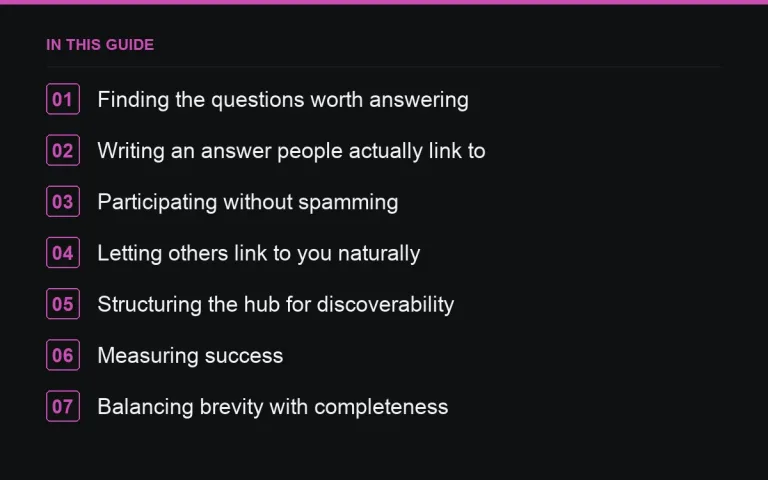
Finding the questions worth answering
- Search your niche’s most common “how do I…” and “what is the difference between…” questions on Q&A sites
- Note which questions get asked repeatedly across different threads and communities
- Check which existing answers are thin, outdated, or link to broken resources
The best candidates are questions asked often enough that a solid, linkable answer will get reused repeatedly rather than serving just one thread.
Writing an answer people actually link to
| Gets linked | Gets ignored |
|---|---|
| Direct answer in the first two sentences | Answer buried under a long introduction |
| Specific, concrete detail | Vague generalities that restate the question |
| Updated when the underlying facts change | Left stale for years with outdated information |
Participating without spamming
Answering your own FAQ questions directly on Reddit or Quora with a link back can work, but only if the answer itself is genuinely helpful on its own and the link is a supplement, not the entire point of the post. Communities are quick to flag accounts that only ever show up to drop a link, so read the specific etiquette of https://successtoroad.com/blog/community-and-forum-links/ before posting.
Letting others link to you naturally
Rather than posting the answer yourself every time, aim to become the resource other community members reach for when they answer the same question. This happens when your FAQ hub is genuinely the best available explanation — thorough, current, and easy to skim — so regular contributors start linking to it unprompted because it saves them the effort of writing a full answer themselves.
Structuring the hub for discoverability
- Group questions by topic cluster, not alphabetically, so related questions sit near each other
- Use descriptive, question-style headings that match how people actually search or ask
- Link between related questions within the hub to keep visitors browsing
- Keep a clear, stable URL structure so links to individual questions do not break over time
Measuring success
Track referral traffic from Q&A and forum domains specifically, alongside any backlinks that appear from those platforms or from blogs that cite your answers. A hub that only gets internal SEO traffic but no external citations has not yet achieved the link-earning goal, even if it performs well in search.
Balancing brevity with completeness
An answer that is too short can feel unhelpful even if it is technically correct, while one that is too long loses the skimmable quality that makes it worth linking to in the first place. Aim for enough detail to fully resolve the question, with any deeper nuance placed after the core answer so a reader can stop early if that is all they needed.
Deciding on a URL and answer structure upfront
Plan a consistent URL pattern for individual FAQ entries before you have dozens of them live, since restructuring URLs later breaks any external links that have already accumulated. A predictable pattern also makes it easier for you to reference specific entries quickly in future outreach without having to search your own site to find the right link.
Handling questions that change over time
Some FAQ answers are stable for years; others depend on facts that shift — pricing norms, regulations, best practices in a fast-moving field. Flag which category each entry falls into internally, and set a review reminder for the ones that age quickly. An answer that was accurate two years ago but has quietly gone stale is worse than no answer at all, since it can mislead the reader who trusted it enough to click through from a forum link.
Encouraging your own team to reference the hub
If you have a support or community team fielding the same questions repeatedly through other channels, encourage them to link to the relevant FAQ hub entry in their responses rather than retyping an answer from scratch each time. This is a low-effort way to generate consistent internal usage of the hub and, over time, to surface which entries are actually the most useful in practice based on how often they get referenced.
Avoiding duplicate competition with your own content
If you already have a detailed blog post covering the same ground as a planned FAQ entry, do not build a competing page that fragments your own authority on the topic — link the FAQ entry to the fuller post instead, and keep the FAQ answer itself short and pointed. This keeps the hub lightweight and fast to scan while still directing deeper interest to your best existing resource.
Where to go next
This tactic pairs naturally with https://successtoroad.com/blog/glossary-link-building/ for definitional questions and with https://successtoroad.com/blog/quora-answer-link-building/ for the platform-specific mechanics. See https://successtoroad.com/blog/community-and-forum-links/ for the broader etiquette of participating in the communities you are trying to earn links from. Revisit https://successtoroad.com/blog/link-building-checklist/ periodically, and if you want help drafting a large FAQ hub efficiently, https://successtoroad.com/services/writing/ on https://successtoroad.com/marketplace/ is worth a look.
Frequently asked questions
Is this different from the FAQ section on my product page?
Yes. A product-page FAQ mainly supports conversion and on-site search visibility, while a link-earning FAQ hub is built and promoted specifically to be the answer other people cite on forums and Q&A sites.
Can I post my own FAQ answers directly on Reddit or Quora?
You can, as long as the answer stands on its own as genuinely useful and the link is secondary. Communities are strict about accounts that only ever post to promote a link.
How do I know if a question is worth building a page around?
Check whether it comes up repeatedly across multiple threads or communities rather than appearing once. Recurring questions justify the investment of a dedicated, well-maintained answer.
How often should FAQ hub content be updated?
Whenever the facts behind the answer change, and at minimum an annual review to catch anything that has quietly gone out of date.
Put it into practice
Filter 54,483 websites by DR, traffic, niche and price, and order with escrow — you pay only after the link is live.
Browse the marketplace