Statistics Pages: The Most Reliable Linkable Asset
Writers constantly need a number to back up a point. A well-maintained statistics page becomes the place they find it.
A statistics page collects the key numbers on a topic — “email marketing statistics”, “remote work statistics” — in one place, sourced and kept current. Writers searching for a figure to support their article find it, cite it and link to it. Done properly, it’s one of the most reliable passive link earners on the web, because the demand for it never really stops: every new article on the topic needs a number, and your page is sitting in the search results waiting to supply one.
Why statistics pages work so well
Most content earns links once, around publication, then fades. A statistics page keeps earning because it answers a recurring need rather than a one-off question. A journalist writing about remote work in March and another writing about it in November both need the same kind of figure, and both will search for it the same way. If your page is the best answer at both points, you collect two citations from two unrelated pieces of coverage, without doing any additional outreach. This compounding effect is what makes statistics pages worth the setup effort, and it’s also why competitors keep building them — the format rewards being first and being maintained, not being clever.
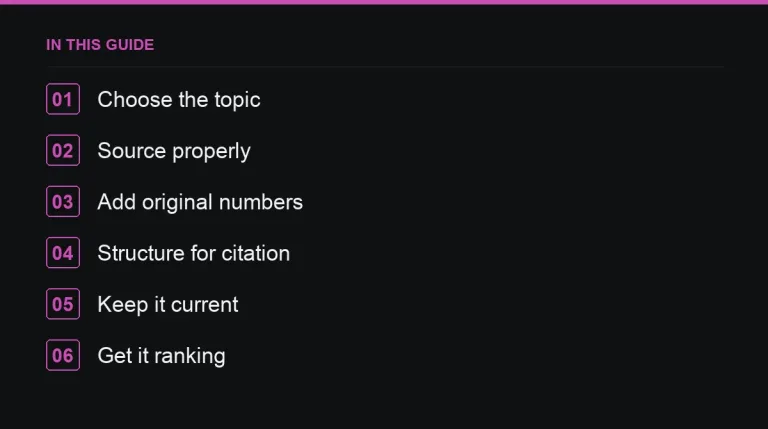
Choosing the topic
- Pick something close to your business, so the page can carry internal links into commercial pages without feeling forced.
- Pick a topic people write about constantly and need numbers for — the more evergreen the beat, the longer the page earns links.
- Check what already ranks. If existing statistics pages are outdated, poorly sourced or thin on detail, that’s your opening.
- Narrow rather than broad topics often perform better: “B2B email open rates” beats “email marketing statistics” for actual citation quality, even if it has less search volume.
Sourcing properly
Every statistic needs a primary source: the original study, survey or dataset, linked directly rather than through an intermediary. Don’t cite other statistics roundups that cite other roundups — numbers get distorted in the chain, decimal points move, sample sizes get dropped, and careful writers will check your source before citing you. Include the year of the data and the sample size or methodology where it’s available, because that context is often what a journalist needs to judge whether the figure is still usable.
Where a source is paywalled, dead, or vague about methodology, either skip the statistic or flag the uncertainty rather than presenting it as more solid than it is. A page with fewer, well-sourced numbers beats one with a hundred numbers of unknown provenance.
Adding original numbers
The strongest statistics pages include data nobody else has: your own survey, anonymised platform data, or a small original analysis (see building a data-driven PR campaign for how to run one properly). That’s what turns your page from a compilation into a source in its own right — other statistics pages start citing you, and so do the same journalists you’d otherwise be pitching directly.
Structuring for citation
- Group statistics by subtopic with clear h2/h3 headings, so a writer can jump straight to the section they need.
- Write one statistic per line, phrased as a complete, citable sentence rather than a fragment.
- Put the source link right next to each number, not bundled in a reference list at the bottom.
- Show a visible “last updated” date near the top — it’s one of the first things a careful writer checks before citing.
- Add jump links or a short table of contents on longer pages, so it reads well even skimmed.
Formatting numbers for skimming
| Element | Why it helps |
|---|---|
| Bolded figure at the start of the line | Lets a skimming writer spot the number instantly |
| Short context sentence after the figure | Gives the number meaning without a click-through |
| Source link on the figure or a “source” tag | Builds trust and speeds up verification |
| Year tag | Signals freshness at a glance |
Keeping it current
Review the page at least yearly: replace outdated figures, remove dead sources, and add new studies as they’re published. An outdated statistics page loses citations quickly once a fresher one overtakes it in search — see refreshing old content to recover rankings for the general process, which applies here just as much as to any other evergreen page. Keep a simple internal changelog so you know which sections were last checked and when.
Getting it ranking and cited
A statistics page only earns links once writers can find it, so treat the launch like any other linkable asset. Reach out to writers who currently cite outdated stats pages and let them know a fresher, better-sourced version exists (see linkable assets that earn links on their own for the wider approach). A handful of relevant placements early on, sourced through a curated marketplace of publisher websites, helps the page establish enough authority to rank and start pulling in citations on its own.
Once it ranks, monitor who links to it. Some of those sites will be writing about adjacent topics you could also serve — feeding your next content brief (see SEO content briefs) and your next round of journalist outreach.
Where to go next
A statistics page rarely stands alone — it works best alongside other linkable assets and a system for refreshing them. Look at running original research on a small budget if you want to generate your own numbers, and reporting on digital PR beyond link counts to track whether the page is actually earning citations over time.
Frequently asked questions
Why do statistics pages earn links?
Writers need figures to support their points and link to the source where they found them.
Can I cite other statistics roundups?
Cite primary sources wherever possible. Chains of roundups distort numbers.
How often should a statistics page be updated?
At least once a year, with a visible last-updated date.
Put it into practice
Filter 54,483 websites by DR, traffic, niche and price, and order with escrow — you pay only after the link is live.
Browse the marketplace