Original Research on a Small Budget
Original data is the strongest link magnet — and it doesn't have to be expensive.
Original research earns links because nobody else has it — a journalist or blogger citing your finding has to link back to the source, since there’s nowhere else to point readers. Many teams assume producing original data requires a large survey budget or a dedicated research department. Often it doesn’t; some of the most-cited findings come from careful, low-cost analysis rather than expensive fieldwork.
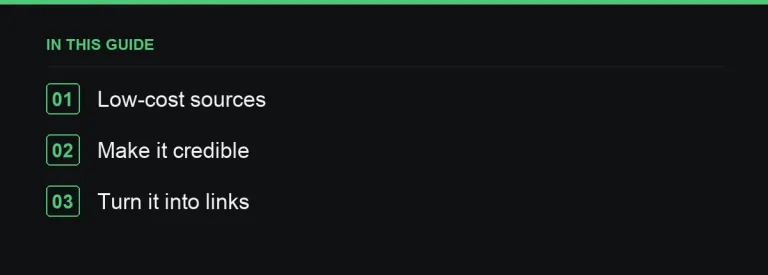
Low-cost sources worth exploring
- Public datasets — government statistics and open data portals, combined or reanalysed in a way nobody else has published.
- Your own data — anonymised, aggregated product, sales or support data that reveals a pattern relevant to your industry.
- Manual analysis — reviewing a meaningful sample, such as several hundred job listings, product pages or company websites, for a specific pattern.
- Small surveys — of your own customers or community, clearly labelled as a small, self-selected sample rather than presented as broader than it is (see survey-based PR campaigns).
- Simple experiments — testing something specific and reporting the results transparently, including when the result is inconclusive.
Making the research credible
- Publish your methodology alongside the findings, not just the headline number.
- State the limitations honestly — sample size, potential bias, what the data can’t tell you.
- Credit original data sources clearly, both because it’s the right thing to do and because it makes your analysis easier to verify.
Avoiding the credibility traps of small-sample research
The biggest risk with budget-friendly research is overstating what a small sample actually shows. A survey of eighty customers can reveal a genuinely interesting pattern, but presenting it as representative of an entire industry invites exactly the kind of scrutiny that damages trust once someone checks the numbers. Frame findings proportionately to the sample: “in our survey of X customers” rather than implying a broader claim the data doesn’t support.
Turning a finding into a linkable asset
- Publish the full findings on a dedicated page with clear methodology, not buried in a blog post about something else.
- Pitch it to relevant journalists and bloggers as a specific, citable data point (see data-driven PR campaigns).
- Add the headline figure to an ongoing statistics page if you maintain one, so it keeps earning citations long after the initial pitch (see statistics pages for links).
Repeating research over time
A single research piece earns a wave of links once. The same research repeated annually — tracking the same metric year over year — earns links every time it’s refreshed, and becomes progressively more valuable as a multi-year trend emerges that nobody else has tracked as consistently.
Handling a null or unremarkable result honestly
Not every piece of research turns up a striking finding, and reporting a null or unremarkable result honestly is still more valuable to your credibility than quietly shelving it and only publishing when the numbers look dramatic. Sometimes the unremarkable finding — “prices were actually stable this year” against an assumption they’d risen — is itself the interesting story a journalist wants, precisely because it contradicts an assumption people already hold.
Involving a subject specialist even on a small budget
You don’t need a full-time statistician to add credibility to small-scale research — a brief review from someone with relevant analytical background, even an informal one, can catch a sampling issue or an overstated conclusion before it goes public. This costs little relative to the reputational risk of publishing a flawed finding a competitor or critic later picks apart.
Presenting research for skimmers and for scrutiny at once
Journalists and readers who arrive from a citation often only want the headline figure, while anyone checking your credibility will dig into the methodology. Serve both: lead with a clear, prominent summary of the finding, then provide full methodology and data further down the same page rather than in a separate, harder-to-find document.
Timing a research release around the news cycle
A piece of research pitched with no connection to current events competes purely on its own merit, which is a harder sell. Where a genuine, honest connection exists to something already in the news, timing the release to align with that moment tends to improve pickup — though this only works when the connection is real, not forced for the sake of relevance.
A simple framework for choosing a topic
| Question | Why it matters |
|---|---|
| Is there existing public data nobody has combined this way? | Lower cost, still original |
| Do we have internal data that reveals something about the industry, not just our business? | Genuinely unique, hard for others to replicate |
| Would a journalist writing about this topic actually want this number? | Determines whether it’s worth pitching at all |
Where to go next
Original research supports both case studies and broader outreach; see writing content search and AI can cite for why original data specifically is what AI-generated answers need to cite, as opposed to summaries of common knowledge. To pitch a finished piece of research, https://successtoroad.com/services/seo/press-release-distribution/ and https://successtoroad.com/marketplace/ are both worth exploring.
Frequently asked questions
Can small companies realistically publish original research?
Yes, using public datasets, their own aggregated data, manual analysis of a meaningful sample, or small clearly-labelled surveys — none of which require a large budget.
Is analysing existing public data really 'original research'?
A new analysis or combination of public data that reveals something not previously published counts as original, provided the original sources are credited clearly.
What makes small-sample research credible rather than dismissible?
A clear methodology, honest limitations, and framing the findings proportionately to the sample size rather than overstating how broadly they apply.
Does research need to be repeated to keep earning links?
Not strictly, but repeating the same study annually tends to earn a fresh wave of citations each time and builds an increasingly valuable multi-year trend.
Put it into practice
Filter 54,483 websites by DR, traffic, niche and price, and order with escrow — you pay only after the link is live.
Browse the marketplace