Link Building Myths That Won’t Go Away
Some link building beliefs are years out of date; some were never true. Here's what the evidence and Google's guidance say.
Link building attracts myths because results are slow, indirect and hard to attribute to any one action. A campaign either works over months or it doesn’t, which leaves plenty of room for folklore to fill the gap. Here are ten beliefs that keep circulating, with what’s actually true.
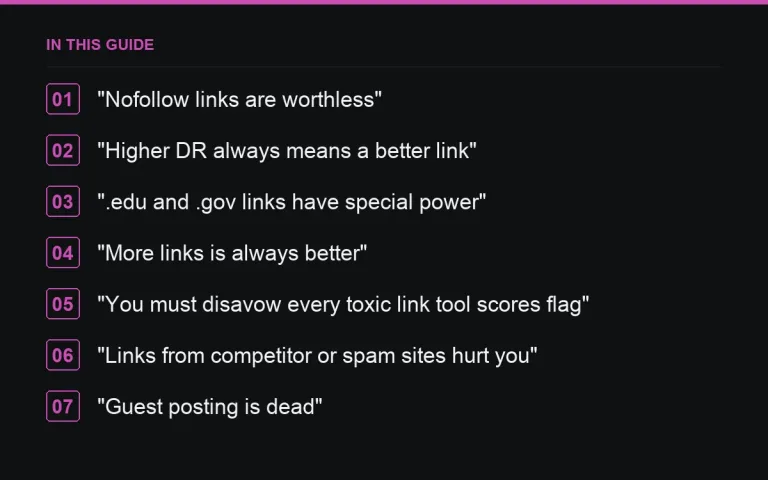
1. “Nofollow links are worthless”
Google has said for years that it treats nofollow as a hint rather than an absolute instruction, and nofollow links still bring referral traffic, brand visibility and, occasionally, indexing help. Dismissing every nofollow opportunity means walking away from real value (what link attributes actually mean).
2. “Higher DR always means a better link”
Domain Rating and similar scores are third-party estimates, not something search engines calculate, and they can be inflated by low-quality links pointing at the site itself. A relevant site with real traffic and a modest score is usually worth more than a generalist site with an impressive number (Domain Rating vs Domain Authority).
3. “.edu and .gov links have special power”
Google doesn’t rank domains higher because of their extension. Educational and government sites are often valuable because they’re trusted and well-linked, not because of the suffix — the same site would carry the same weight on a different extension (link building for education websites).
4. “More links is always better”
A hundred low-quality links from unrelated, thin sites do less than a handful of relevant ones. Referring domains, relevance and quality matter far more than raw counts (referring domains vs backlinks).
5. “You must disavow every toxic link tool scores flag”
Search engines are generally good at ignoring spammy links aimed at your site without any action from you. Disavowing is for specific situations — a history of links you built yourself, or under an active manual action — not a routine maintenance task (when to use the disavow tool).
6. “Links from competitor or spam sites hurt you”
Negative SEO fears are usually overblown. Search engines aim to ignore spam pointed at a site rather than penalise the target for it, though it’s still worth keeping an eye on sudden, unexplained spikes as part of a routine backlink audit.
7. “Guest posting is dead”
Mass, low-quality guest posting at scale lost its value years ago, but relevant placements on real publications with genuine audiences still help rankings, referral traffic and brand visibility (what is guest posting).
8. “Links work within days”
Crawling, indexing and re-evaluation take time, and effects usually show up over months rather than days (how long backlinks take to work).
9. “Great content alone is enough”
Content earns links when people find it. Without promotion — outreach, PR, distribution — even excellent content can sit unseen (linkable assets).
10. “AI search makes links irrelevant”
Authority signals, including links, still shape which sources get retrieved, trusted and cited by AI-powered search results, even where the presentation looks different from a traditional results page (links in the age of AI search).
A quick reference table
| Myth | Reality in short |
|---|---|
| Nofollow is worthless | A hint, and still useful for traffic and visibility |
| DR is the main quality signal | Relevance and real traffic matter more |
| Guest posting is dead | Mass low-quality guest posting is; relevant placements aren’t |
Why myths like these spread so easily
Link building has no single, transparent scoreboard the way paid advertising does with click-through and conversion data reported in real time. Results lag by months, third-party tools disagree with each other, and search engines don’t publish exactly how signals are weighted. Into that gap flow simplified rules of thumb, some outdated, some that were never accurate, repeated in forums and comment sections until they harden into conventional wisdom.
A better default: check the primary source
Where possible, check what search engines themselves have published in their webmaster guidelines and spam policies rather than relying on secondhand summaries. It won’t answer every question, since plenty of specifics are deliberately unpublished, but it separates confirmed guidance from folklore for the myths that matter most, like link schemes and nofollow treatment.
Where these myths tend to cluster
New in-house SEOs are more likely to overweight authority scores and .edu domains, since they’re the easiest metric to see at a glance. Teams under budget pressure are more likely to believe “more links is always better,” since it justifies buying in bulk. Agencies under client pressure are more likely to lean on “links work within days” language in a pitch, even when they know better. Recognising which pressure is pushing a myth into a conversation is often the fastest way to counter it.
Myths worth retiring from your own reporting too
- Presenting DR growth as a headline result rather than context.
- Treating a single month’s link count as a success metric on its own.
- Promising clients or stakeholders ranking movement within weeks.
Where to go next
If any of these myths shaped a past campaign, it’s worth revisiting the common link building mistakes they tend to cause, and checking your current standards against the marketplace‘s transparent metrics rather than folklore.
Frequently asked questions
Are nofollow links completely useless?
No. They're hints Google may use, and they bring traffic and visibility.
Do .edu links rank you higher?
Not because of the extension. Trusted, relevant sites are valuable regardless of domain type.
Is guest posting still effective?
Relevant placements on real publications with audiences still help; mass low-quality guest posting doesn't.
Put it into practice
Filter 54,483 websites by DR, traffic, niche and price, and order with escrow — you pay only after the link is live.
Browse the marketplace