Running a Product Review Programme That Earns Real Links
How to structure a review programme so it produces genuine coverage and links rather than one-off mentions that vanish.
Sending a product to a reviewer works, but most programmes fail because they are run as a one-time mailout rather than a repeatable process. A well-run review programme treats reviewers as an ongoing channel: the same list gets pitched again for updates, seasonal roundups, and comparison pieces, compounding the value of every relationship built.
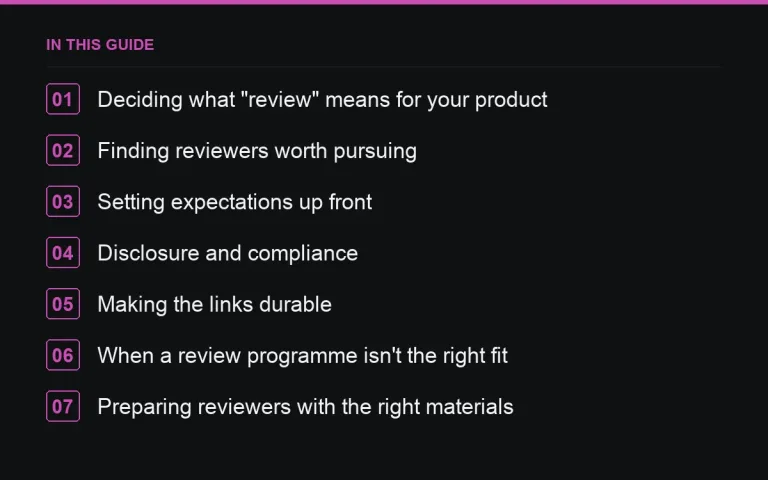
Deciding what “review” means for your product
Physical products, software trials, and services all need different review formats. A software company might offer an extended free tier instead of shipping anything; a physical product needs a fulfilment process; a service business might offer a comped engagement in exchange for a documented case write-up. Match the format to what the reviewer’s audience actually wants to read.
Finding reviewers worth pursuing
- Bloggers who already review comparable products, not just anyone with traffic
- Publications with a disclosed review policy, which signals they take integrity seriously
- YouTube or newsletter reviewers whose past coverage reads as genuinely critical, not uniformly glowing
A reviewer who only ever writes positive coverage is less valuable than one whose readers trust their opinion, because trust is what makes the resulting link and mention actually drive clicks.
Setting expectations up front
State clearly that you are not paying for a positive review, only for their time and honest opinion. Reviewers who write disclosed, honest coverage build reader trust that reflects well on your brand even in a mixed review, while a program known for buying five-star coverage attracts the wrong kind of participant and can damage the reviewer’s credibility along with yours.
A simple structure
| Step | What happens |
|---|---|
| 1. Shortlist | Identify 15–30 reviewers who genuinely fit your category |
| 2. Outreach | Personal note explaining why you thought of them specifically |
| 3. Fulfilment | Send product/access with no strings beyond an honest review |
| 4. Follow-up | Check in once, politely, after a reasonable window |
| 5. Amplify | Share the review (with permission) once it is live |
Disclosure and compliance
Reviewers in most jurisdictions are required to disclose that a product was provided free of charge. Build this into your pitch rather than leaving it to chance — it protects the reviewer and keeps your programme above board. Avoid asking reviewers to remove a disclosure or downplay it in exchange for future products.
Making the links durable
A single review post is good, but the goal is a relationship that produces repeat mentions: annual “still using it a year later” updates, inclusion in the reviewer’s future best-of lists (see https://successtoroad.com/blog/best-of-list-inclusion/), and comparison mentions when their readers ask about alternatives. Treat the first review as the start of the relationship, not the end of it.
When a review programme isn’t the right fit
If your product is difficult to demo, has a long sales cycle, or is B2B and niche, a broader outreach or https://successtoroad.com/blog/testimonial-link-building/ approach may produce links faster than trying to build a consumer-style review list. Match the tactic to how your audience actually makes buying decisions.
Preparing reviewers with the right materials
A reviewer who receives your product with no context is left to guess at what matters most. A short briefing document — the key use cases, common questions, and where to go for support during the review period — helps them write a more informed, specific review without steering their opinion. This is different from scripting the review itself; it simply removes friction so their honest assessment is better informed.
Budgeting for the programme realistically
Factor in the cost of product, shipping, and the time spent on outreach and fulfilment against the number of usable placements you expect. A programme that ships to fifty reviewers but only produces five published pieces still has value if those five are well matched and genuinely engaged, but you should track the full cost per placement honestly rather than only counting units shipped. This helps you decide whether to expand the list, narrow it, or shift budget toward a different tactic altogether.
What to do with reviews that never get returned
Not every reviewer who accepts a product will publish. Some get busy, some decide the product is not a fit for their audience after all, and some simply lose track of the commitment. A single polite check-in after a reasonable window is appropriate; beyond that, chasing repeatedly tends to damage the relationship rather than salvage the placement. Treat unreturned product as a normal cost of running the programme rather than a failure that needs to be fixed every time.
Building a repeatable cadence
The strongest review programmes run on a schedule — a wave of outreach each quarter, or aligned to major product updates — rather than a single burst that is never repeated. This lets you refine your reviewer list over time, dropping people who never engage and adding new candidates who fit the pattern of your best-performing past reviewers.
Where to go next
Pair a review programme with https://successtoroad.com/blog/outreach-follow-ups/ to know how hard to push after sending product, and read https://successtoroad.com/blog/link-building-for-shopify-stores/ if you are running this for an ecommerce brand specifically. See https://successtoroad.com/blog/tool-roundup-inclusion/ for a lighter-weight alternative that does not require sending physical product. Browse https://successtoroad.com/niche/technology/ publishers on https://successtoroad.com/marketplace/ if you want to find review-friendly outlets directly.
Frequently asked questions
Do I have to send a free product to get a review?
Not always — software and services can offer extended access instead. What matters is giving the reviewer enough real usage to write a credible, specific review rather than a generic summary.
What if the review is negative?
Accept it. A programme with only glowing reviews looks staged, and a fair, mixed review from a trusted reviewer often carries more weight with readers than uniformly positive coverage would.
Should reviewers disclose the product was provided for free?
Yes, and you should make that expectation part of your pitch. Clear disclosure protects both parties and keeps the programme compliant with advertising standards most jurisdictions enforce.
How many reviewers should I approach at once?
A focused batch of 15–30 well-matched reviewers usually produces better results than a mass mailout to hundreds, since fulfilment and follow-up quality drop once the list gets too large to manage personally.
Put it into practice
Filter 54,483 websites by DR, traffic, niche and price, and order with escrow — you pay only after the link is live.
Browse the marketplace