Embeddable Widgets: A Slow-Burn Link Building Tactic That Still Works
How small embeddable widgets, installed by other sites, generate a steady trickle of credited backlinks over time.
An embeddable widget is a small piece of functionality — a badge, a live counter, a mini calculator, an interactive map — that other site owners install on their own pages, usually with a small “powered by” credit that links back to you. It is a slower tactic than direct outreach, but the links it produces tend to be durable because removing the widget breaks something the installing site wants to keep.
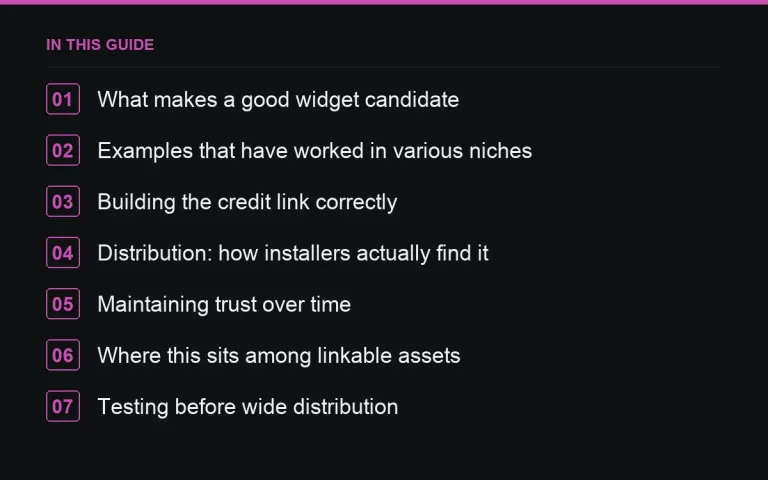
What makes a good widget candidate
- Solves a narrow, recurring problem for a specific type of site
- Requires no ongoing maintenance from the site that installs it
- Displays useful, changing information rather than a static graphic
- Is genuinely free, with the link credit as the only cost to the installer
Badges that only exist to carry a link, with no real function, get stripped out quickly once a site owner notices. Widgets that do something the installer actually values tend to stay.
Examples that have worked in various niches
| Widget type | Who installs it |
|---|---|
| Live exchange-rate or price ticker | Ecommerce and finance blogs |
| Review or rating badge | Local businesses displaying third-party trust signals |
| Simple embeddable calculator | Advice sites in finance, health, or real estate |
| Weather or air-quality snippet | Travel and outdoor-activity blogs |
Building the credit link correctly
Keep the attribution link small, clearly labelled, and honest about what it links to — your homepage or a relevant landing page, not an unrelated affiliate redirect. A widget that quietly injects several hidden links or keyword-stuffed anchor text is the kind of thing that gets flagged by both site owners and search engines, and it undermines an otherwise legitimate tactic.
Distribution: how installers actually find it
- Publish a page describing the widget, its use case, and the install snippet
- Reach out directly to site owners in the relevant niche who would plausibly want it
- List it on relevant directories or resource pages for that widget category
- Mention it in guest posts or interviews where it is genuinely relevant, not shoehorned in
Maintaining trust over time
If your widget relies on a data feed or external API, keep it running. A broken widget left installed on dozens of sites reflects badly on you and gives the installer a reason to remove it — losing you the link. Treat ongoing reliability as part of the link-building investment, not a separate engineering concern.
Where this sits among linkable assets
Widgets are one entry in the broader category of https://successtoroad.com/blog/content-that-earns-links/, alongside tools and calculators covered in https://successtoroad.com/blog/calculators-and-tools-for-links/. The difference is installation: a calculator lives on your own site and pulls visitors in, while a widget lives on other people’s sites and pushes a credit link out. Both are worth running if you have the resources.
Testing before wide distribution
Before pitching the widget broadly, install it on a handful of friendly sites or your own secondary properties to catch layout conflicts, mobile display issues, and loading-speed problems. A widget that breaks a host page’s layout or slows it down noticeably will get removed quickly regardless of how useful the underlying function is, so this testing step protects the investment you have already made in building it.
Pricing the free option correctly
Some teams worry that giving a widget away for free undercuts a potential product line. In most cases the calculus works the other way: a free, well-distributed widget builds brand awareness and inbound links at a scale a paid version never would, and you can still offer a premium, white-labelled version without the credit link for site owners who would rather pay than display attribution. Running both tiers side by side lets the free version do the link-building work while the paid version covers the sites that prefer not to carry a visible credit.
Handling support requests from installers
Even a simple widget generates occasional support questions — installation issues, styling conflicts with the host site’s theme, requests for configuration options. Decide upfront how much support you are willing to provide for a free tool. A basic FAQ page and a simple contact form is usually enough; you do not need to offer the same support level you would for a paid product, but leaving installers with no way to get help at all will lead to abandoned installs.
Tracking which sites have installed it
Where technically feasible, track referral traffic or embed counts so you know roughly how many sites are running your widget at any given time. This data is also useful in future outreach: being able to say a widget is already running on a meaningful number of sites in a niche adds credibility when pitching new installers who are deciding whether to trust an unfamiliar tool.
Where to go next
Once your widget has a handful of installs, monitor them the way you would any other backlink using the process in https://successtoroad.com/blog/monitoring-lost-links/, since widget links can disappear silently during a site redesign. Read https://successtoroad.com/blog/free-templates-for-links/ for a lower-effort alternative that does not require ongoing technical maintenance. If you’d rather commission the technical build than do it in-house, https://successtoroad.com/services/writing/ and related services on https://successtoroad.com/marketplace/ can help scope the content side of the launch page.
Frequently asked questions
Do widgets still work as a link tactic in 2026?
Yes, though they work best as a long-term, low-volume channel rather than a fast source of links. The links they produce tend to last longer than a typical guest post because removing them breaks a feature the installer wants.
How many links can I realistically expect?
It depends heavily on how useful and well-distributed the widget is. Treat it as a slow accumulation over months rather than a campaign with a defined end date.
Is it acceptable to hide extra links inside the widget code?
No. Hidden or excessive links inside a widget are a manipulative pattern that can get the widget stripped out or flagged, and it undermines the legitimate credit link you are entitled to.
What happens if I stop maintaining the widget?
Installers will eventually remove it once it breaks or looks abandoned, so factor ongoing upkeep into your plan before launching one at scale.
Put it into practice
Filter 54,483 websites by DR, traffic, niche and price, and order with escrow — you pay only after the link is live.
Browse the marketplace