Using a Glossary as a Link Building Asset, Not Just an SEO Page
How to turn a glossary into an outreach asset that writers link to instead of writing their own definition from scratch.
A glossary page can be built purely for on-site SEO, or it can be built as something you actively promote to writers who need to define a term and would rather link out to a solid explanation than write their own from scratch. This post focuses on the second use: getting other sites to cite your definitions.
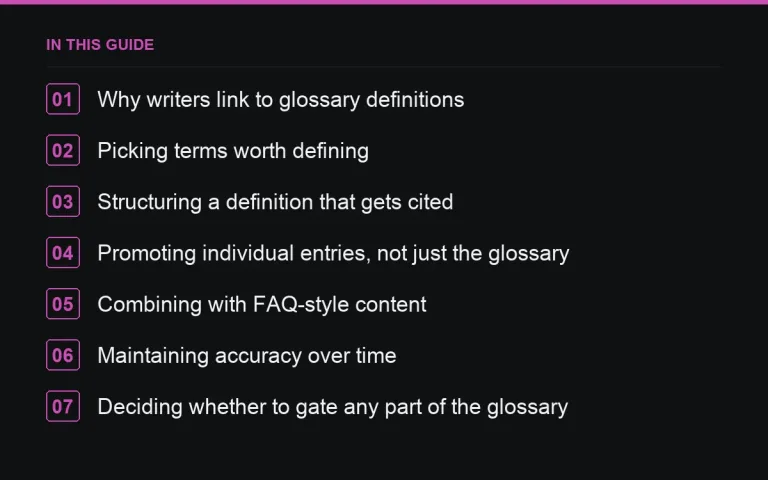
Why writers link to glossary definitions
When a writer mentions a technical or industry-specific term in passing, they often want to give readers a quick way to learn more without derailing their own article with a lengthy explanation. A clear, well-structured definition elsewhere is exactly what fills that need, and linking to it is faster than writing an aside themselves.
Picking terms worth defining
- Terms that come up often in your industry’s content but rarely have a clear, dedicated explanation
- Jargon that beginners in your field frequently ask about
- Terms your own competitors define poorly or not at all
Avoid terms so obscure that almost nobody searches for or references them, and avoid terms so basic that a dictionary definition already satisfies most readers.
Structuring a definition that gets cited
| Element | Why it matters |
|---|---|
| One-sentence plain definition at the top | Gives a writer something to quote directly |
| A short example or use case | Shows the term applied, not just described |
| Related terms linked from the entry | Keeps readers on your glossary once they land |
| No unnecessary padding | Writers skip entries that bury the definition in filler |
Promoting individual entries, not just the glossary
Rather than pitching your whole glossary as a resource, identify writers actively covering a topic that uses one specific term and suggest that single entry as a citation. This is a much smaller, easier ask than “please link to my glossary,” and it tends to convert better because it is directly relevant to what the writer is working on right now.
Combining with FAQ-style content
Glossary entries and FAQ answers solve a similar problem — a reader has a quick question and wants a quick, credible answer — but they are packaged differently. If your audience asks questions rather than searching for terms, a complementary https://successtoroad.com/blog/faq-hub-for-link-earning/ approach may capture more of that intent than a glossary alone.
Maintaining accuracy over time
Industry terminology shifts, and a glossary entry that goes stale or becomes technically inaccurate will eventually get quietly de-linked by careful writers. Review entries periodically, especially in fast-moving fields, and correct anything that has become outdated rather than letting it sit unchanged for years.
Deciding whether to gate any part of the glossary
Some companies consider gating advanced or premium glossary content behind a signup form. For a link-earning glossary this is almost always counterproductive, since the entire value of the tactic depends on writers being able to link directly to a freely accessible page their own readers can visit without friction.
Writing for skimmers, not just careful readers
Most people arriving at a glossary entry from a search or a link are trying to resolve a quick question, not settle in for a long read. Use bold key terms sparingly, short paragraphs, and a clear visual hierarchy so a skimming reader can extract the core definition within a few seconds, even if they never read the rest of the entry in detail.
Building internal linking that helps, not just SEO
Cross-link related glossary entries to each other so a reader who lands on one definition can naturally browse to the next relevant term. This keeps visitors on the page longer and increases the odds that a writer researching one term also discovers a second, related entry worth citing in the same article, effectively multiplying the value of a single outreach touch.
Handling disputed or evolving terminology
Some industry terms are genuinely contested — different practitioners use them slightly differently, or the accepted definition has shifted over time. Acknowledge this directly in the entry rather than presenting a single definition as unambiguous fact. A glossary that transparently notes “this term is sometimes used differently by X” reads as more credible to a careful writer than one that flattens real disagreement into an oversimplified answer.
Repurposing entries into other formats
A strong glossary entry can be repurposed into a short social post, a slide in a presentation, or a quoted definition inside a longer guide, extending its reach well beyond the original page. Each repurposed version is another opportunity for someone new to discover and eventually link to the original definition.
Where to go next
If you want a broader framework for content designed to earn links passively, read https://successtoroad.com/blog/content-that-earns-links/, and pair your glossary outreach with the pitching approach in https://successtoroad.com/blog/outreach-email-templates/. Review https://successtoroad.com/blog/link-building-checklist/ before a promotional push, and see https://successtoroad.com/blog/faq-hub-for-link-earning/ for a complementary format aimed at question-based rather than term-based searches. Consider https://successtoroad.com/services/writing/ on https://successtoroad.com/marketplace/ if you need help drafting a large batch of entries consistently.
Frequently asked questions
How is this different from a glossary built purely for SEO?
An SEO-only glossary aims to rank for search terms on its own. A link-building glossary is written and promoted specifically so other writers cite individual entries instead of explaining the term themselves, which requires more deliberate outreach.
How many terms should a glossary have before I start promoting it?
Enough to look like a genuine reference resource rather than a handful of thin entries — usually several dozen at minimum, though quality of each entry matters more than raw count.
Should I pitch the whole glossary or individual entries?
Individual entries almost always perform better in outreach, since they map directly to something a specific writer is working on rather than asking them to browse an entire resource.
Do glossary links tend to be dofollow?
It varies by publisher policy rather than by tactic. Focus on getting cited by relevant, authoritative sites rather than optimising specifically for link attribute.
Put it into practice
Filter 54,483 websites by DR, traffic, niche and price, and order with escrow — you pay only after the link is live.
Browse the marketplace